


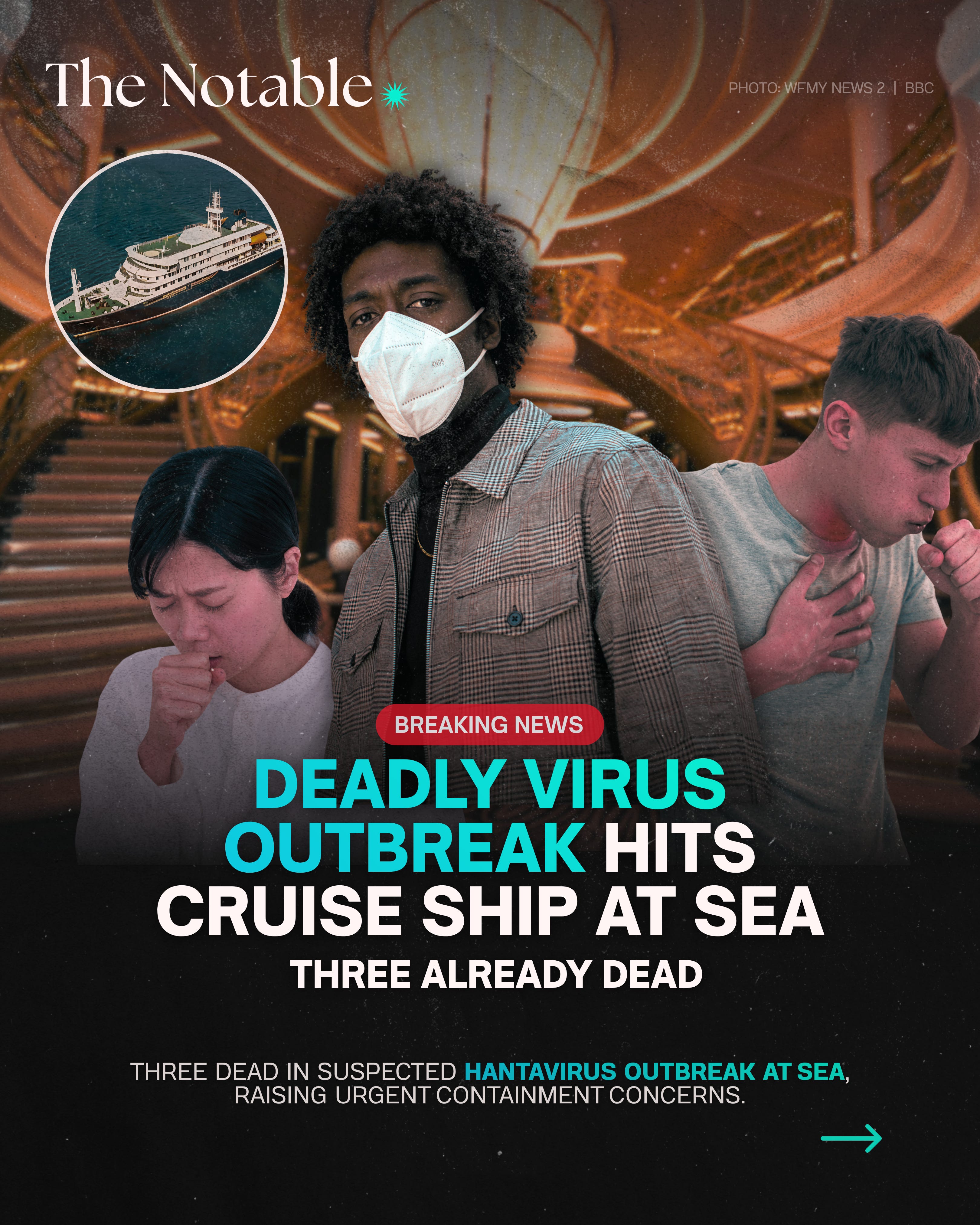
What happened
The MV Hondius, a Dutch-operated expedition vessel, was en route from Ushuaia, Argentina to Cape Verde when several passengers developed acute illness. At least six individuals were affected. One case has been laboratory-confirmed as hantavirus, while the remaining cases are still under investigation.
Three passengers have died. Others were evacuated for treatment as the ship approached West Africa, with at least one patient admitted to intensive care in South Africa.
The World Health Organization is coordinating with national authorities to determine the source of exposure and assess whether the cases are epidemiologically linked. At present, it is not clear whether transmission occurred onboard or prior to embarkation.
The pathogen in question
Hantavirus infections are uncommon but clinically serious. The virus is typically transmitted through inhalation of particles from rodent urine, droppings, or saliva. Human-to-human transmission is rare and, in most strains, not a primary driver of spread.
The clinical concern lies in disease progression. Early symptoms are non-specific, often resembling influenza. In a subset of cases, patients develop hantavirus pulmonary syndrome, characterised by rapid respiratory deterioration as fluid accumulates in the lungs. Mortality rates in severe cases are high relative to most respiratory infections.
This combination—low incidence but high severity—places hantavirus outside the profile of pathogens that dominate global preparedness frameworks.
A constrained response environment
Cruise ships present a particular operational challenge in such scenarios. They are controlled environments in administrative terms, but constrained in medical capacity. Onboard facilities can stabilise patients, but advanced care typically requires evacuation, which is contingent on location and timing.
Close quarters and shared infrastructure can complicate early containment, especially when symptoms are initially indistinguishable from more common illnesses. In this case, the interval between first symptoms and confirmation appears to have allowed a small cluster to develop before targeted measures could be implemented.
The experience is not analogous to high-transmission outbreaks seen during the COVID-19 pandemic. However, it underscores a different vulnerability: the difficulty of managing atypical, severe infections where detection is delayed and response options are limited by geography.
Preparedness and its limits
Public health systems tend to prioritise pathogens that are either highly transmissible or historically recurrent. Surveillance, modelling, and response protocols are calibrated accordingly.
Hantavirus does not fit neatly into these categories. It is geographically uneven, environmentally linked, and rarely encountered in maritime travel contexts. As a result, it occupies less space in operational planning despite its severity.
This creates a gap. Not a systemic failure, but a predictable limitation. Preparedness is necessarily selective. It cannot optimise equally for all risks.
The current incident illustrates how that selectivity can be tested when an uncommon pathogen appears in an atypical setting.
What remains uncertain
Key questions are still unresolved. Investigators are working to determine whether the cases share a common source and, if so, where exposure occurred. Possibilities include pre-boarding contact, environmental exposure during the voyage, or a combination of both.
The distinction matters. An onboard source would have implications for shipboard hygiene and monitoring protocols. A pre-boarding origin would shift the focus toward screening and embarkation procedures.
At present, only one case has been confirmed. The classification of an “outbreak” remains provisional pending further laboratory results.
Implications
There is no indication that this event represents a broader public health threat. Hantavirus does not spread easily between people, and the number of cases remains limited.
The relevance lies elsewhere. It highlights the operational challenges of managing rare but severe infections in mobile, semi-isolated environments. It also suggests that current frameworks, while effective for common threats, are less tested against low-probability, high-impact scenarios.
For the cruise industry and regulators, the likely outcome is incremental rather than structural change. Enhanced monitoring, clearer escalation protocols, and possibly revised guidelines for medical preparedness on long-haul routes.
The episode does not call for alarm. But it does offer a reminder of the boundaries of current preparedness.
Systems are designed around what is likely.
They are occasionally tested by what is not.