


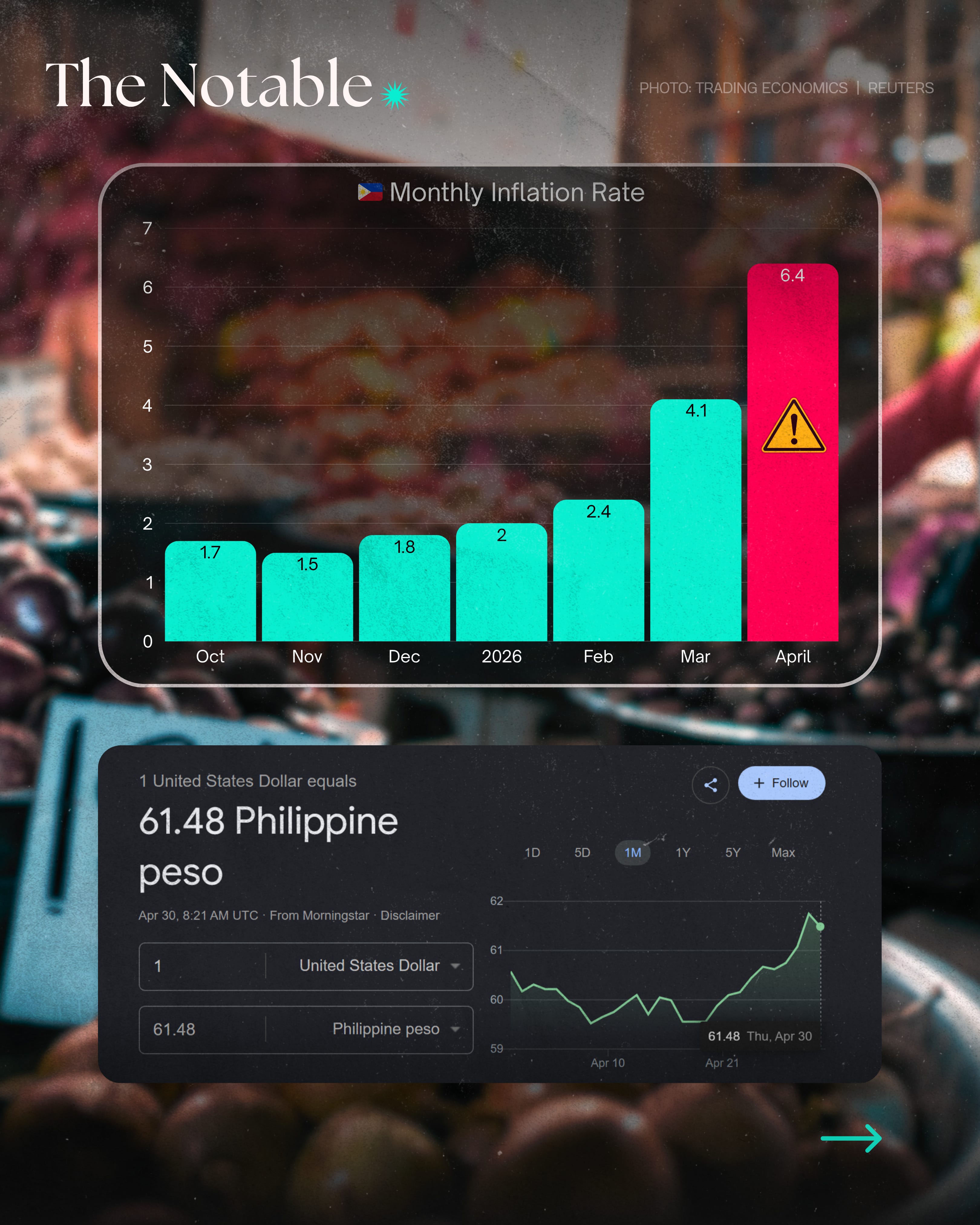
Inflation in the Philippines is accelerating once more, reversing what had briefly looked like a period of stabilization.
The Bangko Sentral ng Pilipinas now expects inflation to reach between 5.6% and 6.4% in April, a sharp increase from 4.1% in March. At the same time, the peso has weakened toward the ₱60–62 range against the US dollar, amplifying price pressures across the economy.
These two developments are not separate. They are deeply connected.
For much of early 2026, there were signs that inflation was easing. Price growth had begun to slow, and there was cautious optimism that the worst of the inflation cycle might be over.
That narrative is now being challenged.
The latest projections suggest that price pressures are building again, driven by a combination of rising food costs, higher electricity rates, and increasing transport expenses. But beneath these factors lies a more structural force: currency weakness.
As the peso depreciates, imports become more expensive. For an economy like the Philippines, which relies heavily on imported fuel, food inputs, and industrial goods, this effect is immediate and widespread. Higher import costs quickly translate into higher domestic prices.
This is not simply inflation returning. It is inflation being reintroduced through the currency.
The Limits of Domestic Control
What makes this episode more difficult is where the pressure is coming from.
A significant portion of today’s inflation is being driven externally. Global commodity prices remain volatile, and the US dollar has stayed strong, reflecting higher interest rates and persistent global uncertainty. These conditions tend to pull capital toward advanced economies and weaken emerging market currencies, including the peso.
This creates a constraint.
Even if domestic conditions improve, policymakers have limited control over these external forces. Raising interest rates can help stabilize the currency and contain demand, but it cannot fully offset global price movements or dollar strength.
As a result, inflation becomes harder to bring down and more likely to persist.
For the central bank, the challenge is becoming more complex.
The Bangko Sentral ng Pilipinas must now weigh the need to control inflation against the risk of slowing economic growth. If inflation continues to rise, it may need to keep interest rates elevated for longer or tighten further.
That comes with trade-offs.
Higher interest rates can help stabilize the peso and reduce inflationary pressure, but they also increase borrowing costs, which can dampen investment and consumption. In an environment where households are already facing rising prices, this balance becomes more delicate.
What This Means for Filipinos
The effects are already visible at the household level.
Higher inflation translates into rising costs for food, transport, and utilities. For many Filipinos, this reduces purchasing power and forces adjustments in spending. For businesses, higher input costs can lead to either increased prices or compressed margins.
If sustained, this environment could slow consumption, which remains a key driver of the Philippine economy.
More importantly, the nature of this inflation suggests it may not ease quickly. With price pressures tied to currency weakness and global conditions, relief is likely to be gradual rather than immediate.
What to Watch Next
The direction of the peso will be critical.
If the currency stabilizes, it could help contain imported inflation and ease pressure on prices. If it weakens further, inflation may remain elevated for longer, complicating both policy decisions and economic recovery.
For the administration of Ferdinand Marcos Jr., this presents a broader economic test. Managing inflation is no longer just a domestic policy question. It is increasingly tied to global financial conditions, currency stability, and the country’s structural exposure to external shocks.
The coming months will determine whether this is a temporary setback or the start of a more persistent inflation cycle.