


What we are seeing here is extraordinary.
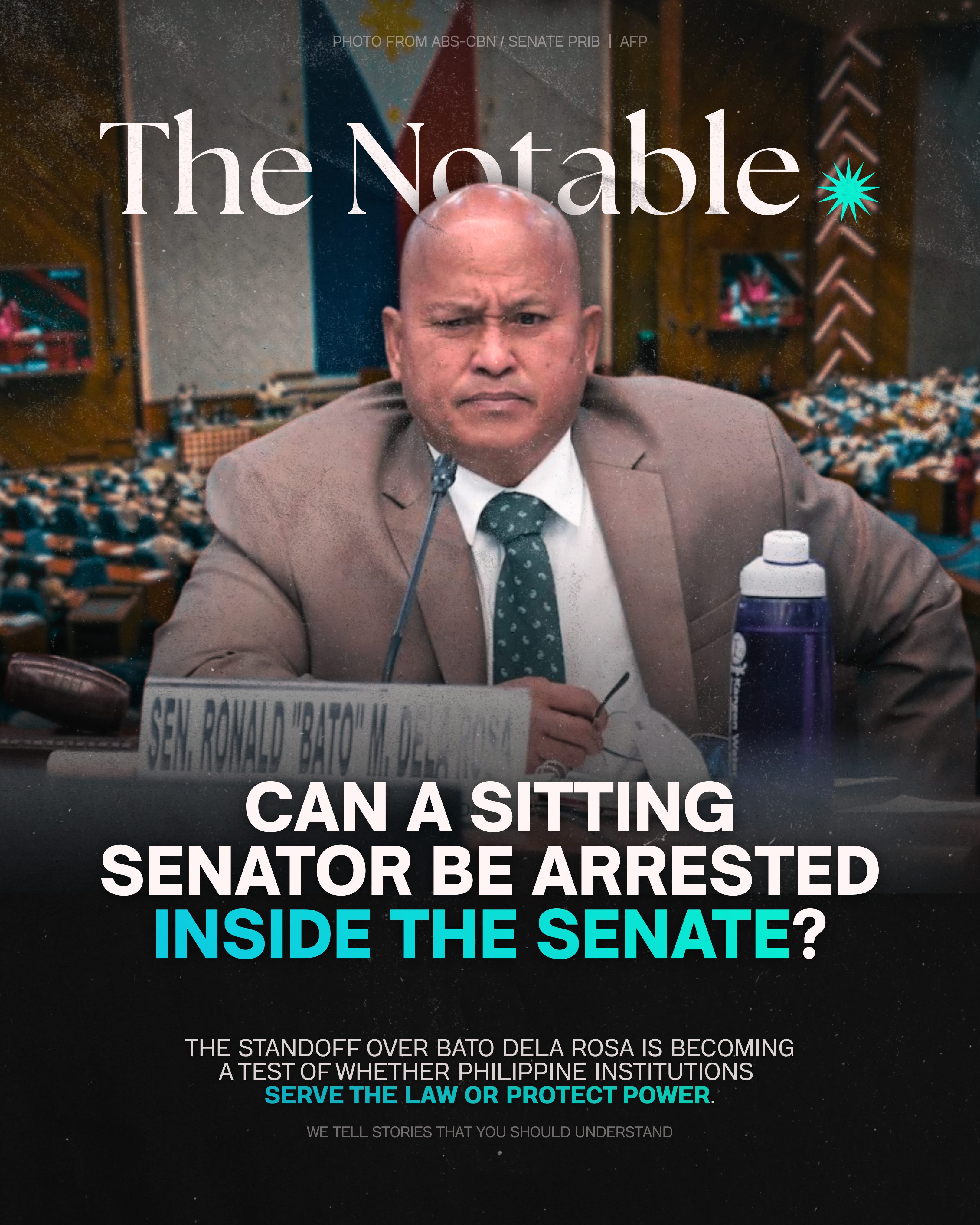
Senator Ronald “Bato” Dela Rosa, a former police chief under Rodrigo Duterte and now wanted by the International Criminal Court for crimes against humanity, reportedly ran through Senate hallways as authorities attempted to serve an ICC-related warrant. Soon after, the Senate complex went into lockdown. Allies placed him under “protective custody.” One of the country’s highest democratic institutions became a refuge.
The legal question quickly dominated public debate:
Can a sitting senator be arrested inside the Senate?
Legally, the answer is yes.
The Philippine Constitution gives senators limited protection from arrest while Congress is in session. But that privilege only applies to offenses punishable by six years or less. Crimes against humanity, the allegations facing Dela Rosa before the ICC, fall far outside that threshold.
In simple terms, the Senate is not a constitutional sanctuary for serious crimes.
But law is only part of the story…
The ICC cannot simply enter the Senate and arrest a Filipino senator. It has no police force in the Philippines. Any arrest would still depend on cooperation from Philippine institutions — local courts, law enforcement, or international coordination mechanisms like Interpol.
That gray zone is where politics takes over.
When institutions protect allies
Dela Rosa’s allies argue the ICC warrant is not automatically enforceable because the Philippines withdrew from the Rome Statute in 2019. Senate leaders insist they will only recognize a warrant issued by a Philippine court.
Technically, those arguments carry legal weight.
Politically, however, they are doing something else: buying time, creating procedural shields, and transforming the Senate into a barrier against external accountability.
And that is what makes this episode larger than a legal dispute.
Because Philippine history already shows senators can be arrested inside the Senate.
→ Leila de Lima was arrested there in 2017 under the Duterte administration.
→ Antonio Trillanes IV faced arrest in 2018 after Duterte revoked his amnesty.
The principle of arrest is not new.
What has changed is who the institution is protecting.
That contradiction sits at the center of the entire standoff.
Duterte’s drug war was built on the idea that the state could reach anyone. Thousands died under anti-drug operations that ICC prosecutors now argue amounted to crimes against humanity.
But the confrontation inside the Senate is raising a different question:
Can the Philippine state still reach the powerful?
That is the deeper tension behind the spectacle of a senator seeking refuge inside a democratic institution.
Because this is no longer just about Bato Dela Rosa.
It is about whether institutions apply power equally — or whether accountability becomes negotiable once political elites themselves are at risk.
Democracy and selective accountability
The broader political context makes the implications even harder to ignore.
The standoff is unfolding amid the escalating feud between the Ferdinand Marcos Jr. administration and the Duterte political dynasty, including tensions surrounding Sara Duterte.
That means the Senate is no longer functioning only as a legislature.
It is increasingly functioning as contested political territory — a place where institutions, legal processes, and democratic legitimacy are being pulled into factional warfare.
And that shift matters.
Because democratic systems rarely erode only through dramatic collapse. More often, institutions remain intact on paper while gradually becoming instruments of selective protection.
The rules still exist.
The procedures still operate.
The language of democracy remains.
But public trust weakens once people begin believing accountability depends on political alignment.
So can a sitting senator be arrested inside the Senate?
Legally, yes.
But the standoff surrounding Bato Dela Rosa is exposing a more uncomfortable reality: in modern democracies, power rarely survives through legal immunity alone.
It survives through institutions willing to delay, reinterpret, or selectively enforce accountability.
And that may be the most consequential question this crisis leaves behind:
whether the Philippine state still applies power equally… or primarily downward.