


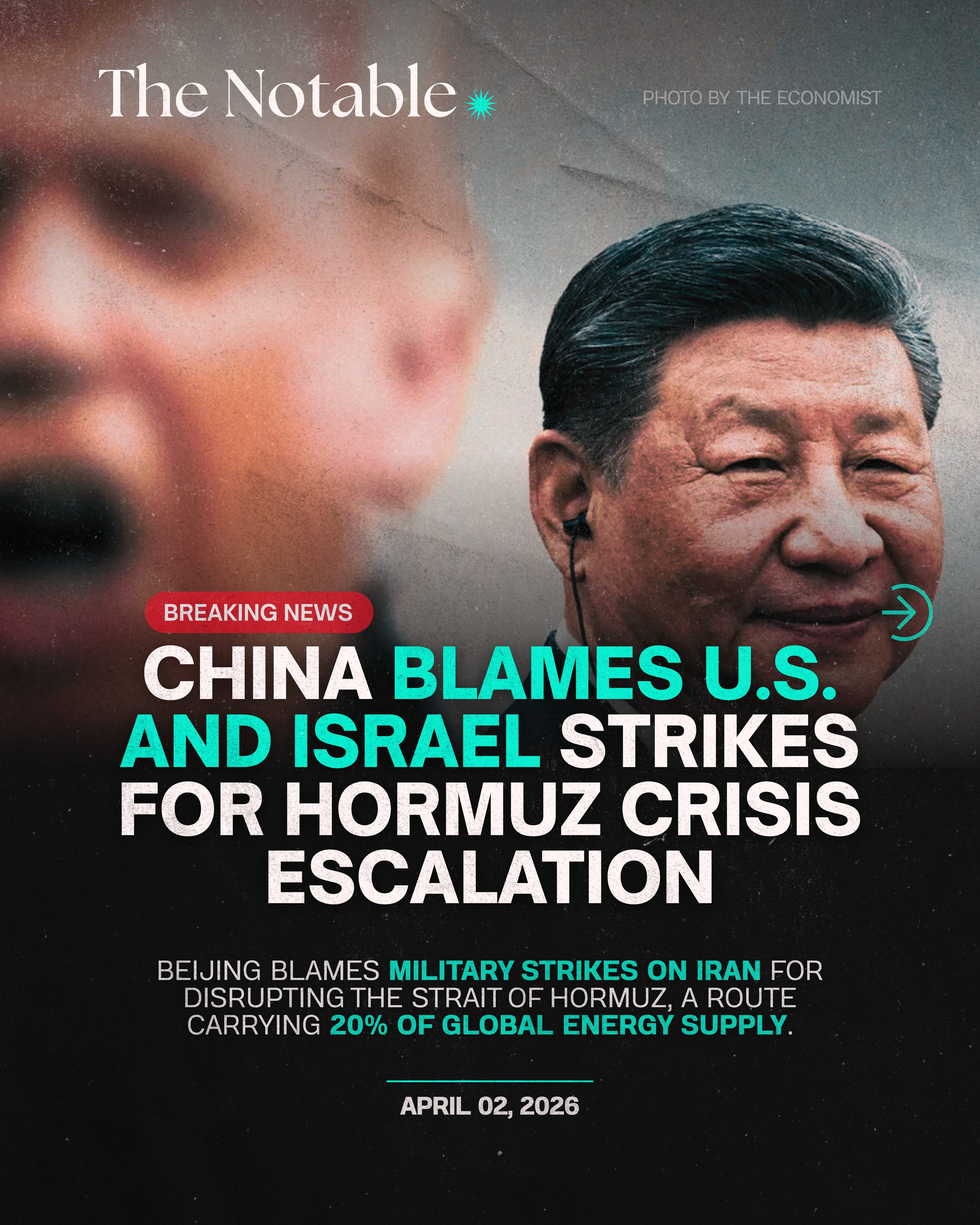
The language has shifted.
China is no longer limiting itself to calls for restraint. It is now directly assigning responsibility for one of the most consequential disruptions to global energy flows in years.
According to China’s Foreign Ministry, the “root cause” of the Strait of Hormuz crisis is the recent military operation targeting Iran, widely attributed to the United States and Israel. The statement marks a notable escalation in tone from Beijing, which had previously framed the situation in more neutral, stability-focused terms.
Now, the message is clearer. And sharper.
What actually happened
The current crisis traces back to late February 2026, when coordinated strikes hit Iranian targets, pushing an already fragile regional situation into open escalation.
Iran’s response was not confined to direct retaliation.
Instead, it moved to exert control over one of the most strategically important waterways in the world: the Strait of Hormuz.
The narrow corridor, which connects the Persian Gulf to global markets, carries around 20% of the world’s oil and gas supply. Within days of the escalation, commercial shipping traffic began to collapse. Tankers slowed, rerouted, or stopped altogether. Some vessels were forced to coordinate directly with Iranian naval forces to pass through.
The disruption was immediate. And global.
Oil prices surged. Supply chains tightened. Energy markets reacted not just to what had happened, but to what could come next.
China’s position is changing
For weeks, Beijing’s approach followed a familiar script: call for de-escalation, emphasize stability, and avoid direct blame.
That has now changed.
By explicitly linking the Hormuz disruption to U.S. and Israeli military action, China is doing more than commenting on the crisis. It is reframing it.
The implication is clear:
This is not an isolated maritime issue or an unpredictable escalation by Iran. It is, in China’s view, the direct consequence of military intervention.
This shift matters because China is not a distant observer.
It is one of the largest importers of energy in the world, with a significant portion of its oil passing through Hormuz. The disruption is not theoretical. It is economic, immediate, and strategic.
At the same time, China has been working quietly to secure limited passage for its own shipments, engaging Iran diplomatically while maintaining its public stance on de-escalation.
This dual approach reflects a broader pattern:
Position as a stabilizing force, while protecting national interests.
A crisis larger than the region
What is unfolding in the Strait of Hormuz is no longer just a Middle East story.
It is a system-level shock.
A single chokepoint now sits at the center of overlapping pressures:
Military escalation
Energy dependency
Global market sensitivity
Great power rivalry
And increasingly, competing narratives.
The United States and its allies frame the strikes as necessary security actions. Iran frames its response as defensive. China is now framing the entire crisis as a predictable outcome of escalation.
These narratives are not just rhetorical. They shape diplomatic responses, market expectations, and the boundaries of what happens next.
Diplomacy is stalling
Efforts at the United Nations have so far failed to produce a unified response.
Proposals have circulated. Language has been softened. Enforcement mechanisms have been diluted. But no meaningful consensus has emerged.
The divisions are structural.
Major powers are not just disagreeing on solutions. They are disagreeing on the cause.
That makes resolution harder.
And prolongs uncertainty.
What happens next
The trajectory of this crisis depends on two variables that are moving in opposite directions:
Escalation and containment.
If military operations expand, the risk to shipping in the Strait of Hormuz increases. A prolonged disruption could deepen the global energy shock, affecting everything from fuel prices to industrial output.
If diplomacy gains traction, even partially, the focus will shift to stabilizing passage and restoring confidence in the route.
For now, neither outcome is dominant.
What is clear is this:
The Strait of Hormuz is no longer just a geographic chokepoint.
It has become a pressure point for the global system.
And China’s latest statement signals that the battle is not only over territory or trade routes.
It is also over who gets to define why this crisis exists at all.