


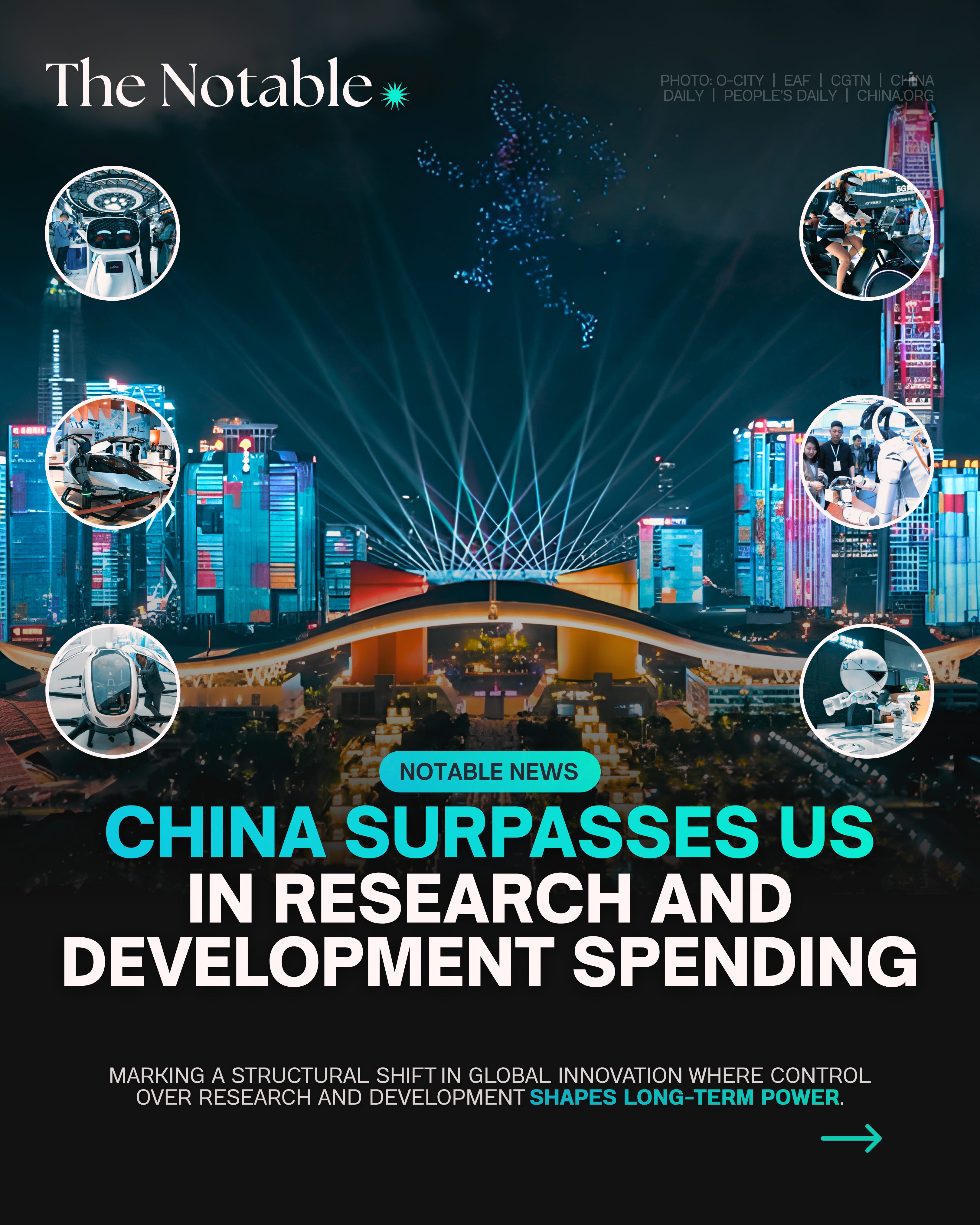
For the first time in modern history, China has overtaken the United States in total research and development spending.
According to new data released in March 2026 by the OECD, both countries have now crossed the $1 trillion threshold in annual R&D investment. But when adjusted for purchasing power, China’s total spending slightly exceeds that of the US.
On its surface, this looks like a numerical milestone. In reality, it signals something deeper: a structural shift in how global technological power is being built.
A Two-Decade Climb
China’s rise in research and development did not happen suddenly.
Since the early 2000s, Beijing has treated science and technology as a core pillar of national power. R&D spending has grown at an extraordinary pace, driven by state planning, industrial policy, and long-term strategic coordination. Under Xi Jinping, that push has intensified, with a clear emphasis on technological self-reliance and reducing dependence on Western systems.
The result is scale.
China now leads the world in total scientific publications. It filed roughly 1.8 million patent applications in 2024, compared to around 600,000 in the United States. It also ranks at the top of global indices measuring high-impact research output.
This is not a narrow or isolated lead. It reflects a broad expansion across the entire research ecosystem, from universities to state-backed labs to private industry.
Scale Versus Frontier
Yet the headline requires careful interpretation.
China’s lead is based on purchasing power parity, which reflects how much research activity its spending can generate domestically. In nominal terms and on a per capita basis, the United States still retains advantages.
More importantly, the US continues to dominate in key frontier domains. Advanced semiconductors, cutting-edge biotechnology, and foundational breakthroughs in artificial intelligence remain areas where American institutions and companies hold a strong edge.
This highlights a critical distinction.
China has built an unmatched capacity for scale, speed, and deployment. The United States remains strongest in frontier innovation, where new paradigms are created rather than expanded.
The competition is no longer about catching up. It is about two different models of technological power evolving in parallel.
Why This Moment Matters
R&D spending is not just an economic indicator. It is a forward-looking measure of capability.
The country that invests more consistently in research is more likely to shape the industries of the future, control critical supply chains, and influence global standards. These are not abstract outcomes. They determine how technologies are built, who benefits from them, and which systems the rest of the world depends on.
China crossing this threshold suggests that the center of gravity in global innovation is no longer concentrated in one system.
It is becoming contested.
The next phase of competition will not be decided by scale alone.
The United States is likely to double down on its strengths in high-end innovation ecosystems, where universities, venture capital, and private firms drive breakthrough discoveries. China, meanwhile, is expected to continue expanding its capacity to commercialize, deploy, and industrialize technology at speed.
This creates a more complex landscape.
Rather than a single dominant leader, the world is moving toward dual centers of technological power. Each operates with different strengths, incentives, and approaches. Each will attempt to shape the rules of emerging industries, from artificial intelligence to clean energy to advanced manufacturing.
The outcome will not be a simple handover of leadership.
It will be a sustained competition over who defines the future.
The Bigger Shift
What this moment ultimately reveals is not just that China has caught up in spending.
It shows that technological power is no longer anchored in one geography or one model. It is being rebuilt across competing systems, each with the capacity to innovate, scale, and influence the global order.
That shift is already underway.
And its consequences will shape the next era of the global economy.