


A new line is being drawn in Asia, and it is not on a map.
It is being drawn through energy.
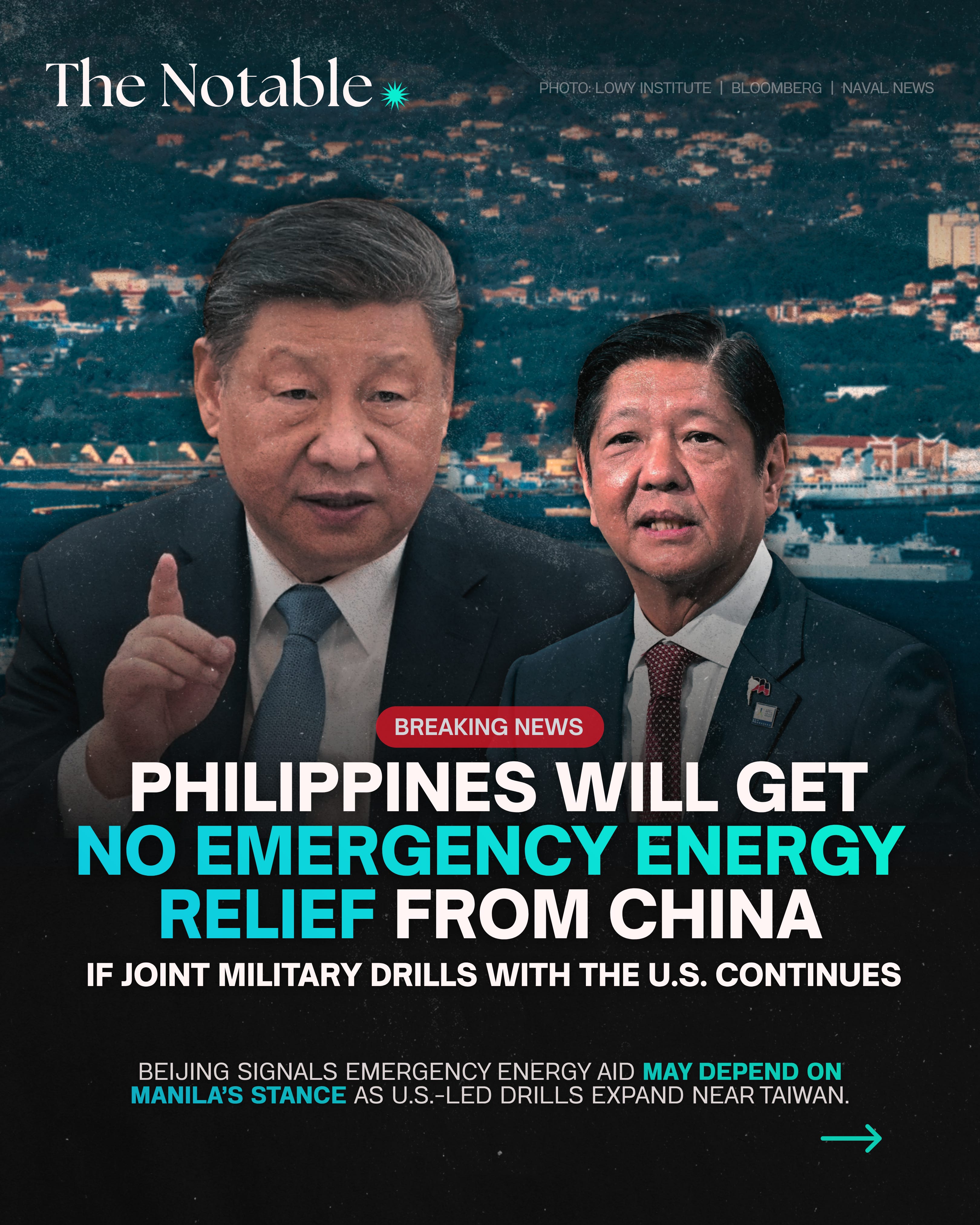
As the Philippines deepens its military alignment with the United States, China is signaling that cooperation in one domain may now depend on behavior in another. The message is not formal policy. There are no sanctions, no supply cuts, no official ultimatums. But the implication is clear enough to matter.
Support, especially in moments of vulnerability, may no longer be unconditional.
A Warning Delivered Without Saying It Directly
The signal came through Chinese state-backed media following the launch of Balikatan 2026, one of the largest joint military exercises between the Philippines and the United States in recent years. The drills involve thousands of troops and expanded participation from allies, including Japan and Australia. They are taking place near the South China Sea and in proximity to Taiwan, a location that carries deep strategic sensitivity for Beijing.
In response, messaging aligned with the government of Xi Jinping did not focus solely on security concerns. Instead, it introduced a different dimension.
Energy.
The warning suggested that if Manila continues to align itself closely with U.S.-led military activity near Taiwan, it may find China less willing to extend emergency energy support. The language was measured. It stopped short of declaring any concrete action. But it connected two domains that are rarely linked so explicitly: military alignment and economic lifelines.
A Vulnerability China Understands Well
This message lands at a sensitive moment for the Philippines.
Under Ferdinand Marcos Jr., the country has been navigating a fragile energy situation. The Philippines imports the vast majority of its fuel, leaving it exposed to global supply shocks. Ongoing instability in key energy corridors and broader geopolitical tensions have already tightened markets.
In such conditions, access to emergency energy support is not a marginal issue. It is foundational to economic stability.
By introducing uncertainty into that access, China is not applying immediate pressure. It is shaping expectations.
The Philippines now faces a more complex equation. Security cooperation with the United States may strengthen its strategic position. But it may also introduce new risks in areas that are more immediate and less visible, such as energy security.
From Military Signaling to Systemic Pressure
What makes this development notable is not just the warning itself, but the method.
This is not coercion in its traditional form. There are no tariffs, no embargoes, no sudden disruptions. Instead, China is using what might be described as conditionality. Assistance remains possible, but no longer guaranteed. Cooperation becomes contingent.
This reflects a broader pattern in how power is being exercised.
Rather than escalating directly in the military domain, pressure is applied through systems that sustain modern economies. Energy is one of the most effective of these systems because it operates on both urgency and dependence. When access is uncertain, the effects are immediate.
The message is calibrated. It avoids triggering outright confrontation while still forcing a strategic reconsideration.
Taiwan Changes the Equation
The proximity of the military drills to Taiwan is not incidental.
For Beijing, Taiwan is not simply a regional issue. It is a core strategic concern tied to sovereignty, legitimacy, and long-term national objectives. Any increase in foreign military activity near the island is viewed through that lens.
The participation of multiple countries in Balikatan 2026, combined with its geographic positioning, reinforces a perception in Beijing that alliances are becoming more coordinated and more operational.
In that context, linking economic cooperation to military behavior serves a dual purpose. It signals disapproval while also attempting to influence future decisions.
A Signal Beyond the Philippines
Although the warning is directed at Manila, its audience is broader.
Countries across Southeast Asia are watching closely. Many of them face similar structural conditions: reliance on imported energy, economic ties with China, and growing security relationships with the United States.
The situation in the Philippines offers a preview of how these competing relationships might begin to intersect more directly.
The underlying message is difficult to ignore. Strategic alignment is no longer compartmentalized. Choices in one domain can shape outcomes in another.
The most important development here is not whether China ultimately follows through.
It is that the linkage has been made at all.
For years, geopolitical competition in Asia has been understood through parallel tracks. Security on one side. Economics on the other. Increasingly, those tracks are converging.
Energy, trade, infrastructure, and finance are becoming tools within a broader strategic framework. They are not just background conditions. They are instruments of influence.
In this case, energy is being positioned as leverage.
What Comes Next
The Philippines is unlikely to reverse its defense posture. Its cooperation with the United States has been expanding, not contracting. At the same time, its energy needs are immediate and non-negotiable.
That tension is now out in the open.
Whether China moves from signaling to action remains uncertain. It may not need to. The introduction of doubt can be enough to alter behavior, particularly when the stakes involve critical supply.
What is clear is that the region is entering a phase where alignment carries more immediate and tangible consequences.
Not just in security terms.
But in the systems that keep economies running.
And those consequences are arriving faster than before.