


Cuba Is Printing Bigger Money
What new banknotes reveal about a system under pressure
Cuba is introducing its highest-value banknotes ever.
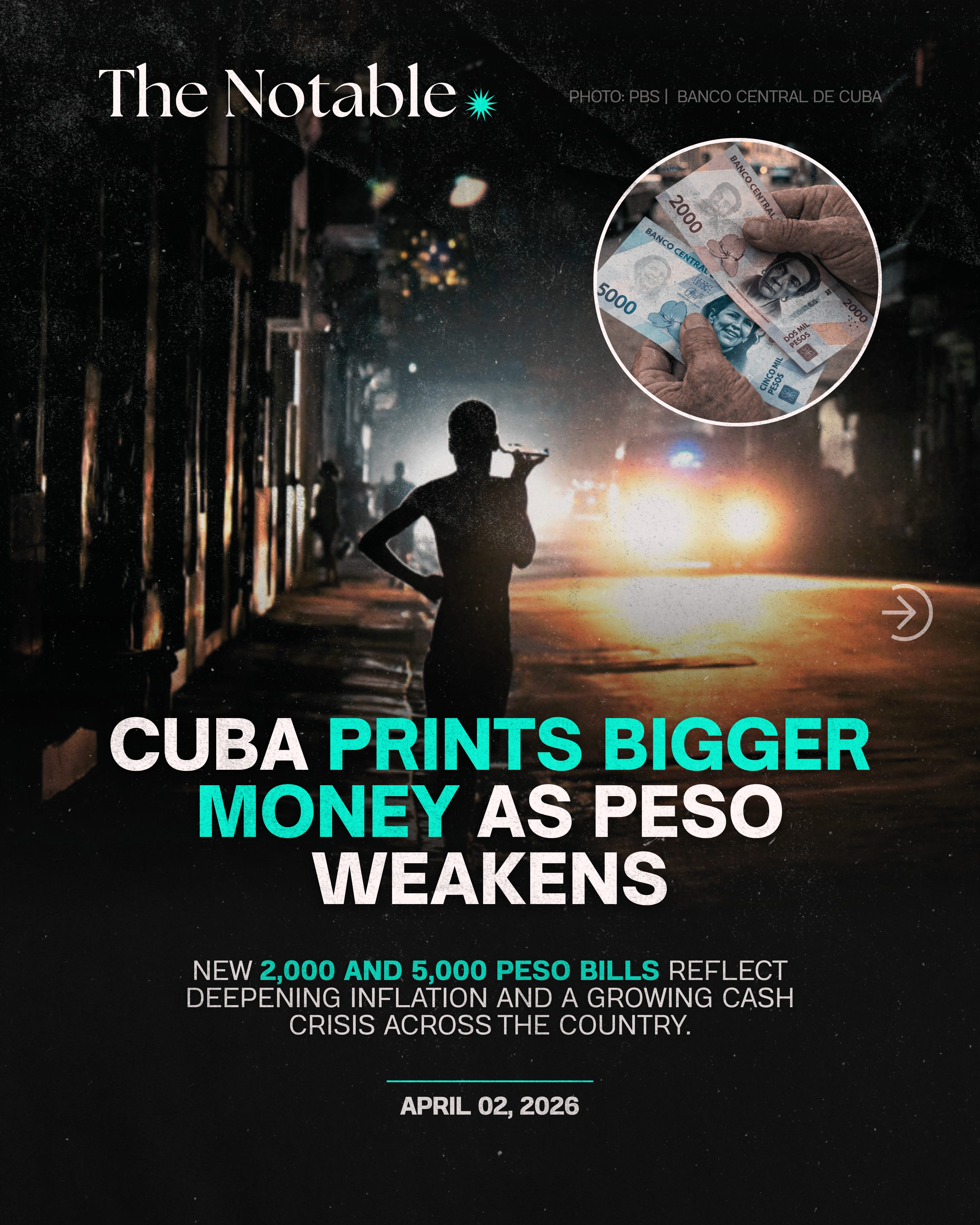
As of April 2026, the country’s central bank has begun circulating new 2,000 and 5,000 peso bills, starting in Havana before expanding nationwide. On the surface, the move is practical. Prices have risen to a point where existing bills are no longer sufficient for everyday transactions.
But beneath that decision is a clearer signal.
Cuba’s currency is losing value, and the system is adapting in real time.
A currency stretched by inflation
In recent years, the Cuban peso has undergone a sharp erosion in purchasing power. This traces back to the country’s 2021 currency reform, which eliminated the dual-currency system and attempted to reset the economy under a unified exchange rate.
Instead, it triggered a surge in inflation.
Prices rose rapidly, while wages struggled to keep pace. In informal markets, where much of the real economy operates, the peso weakened even further against foreign currencies. The result is a widening gap between official valuations and lived economic reality.
Today, even basic goods often require large volumes of cash.
The introduction of higher-denomination banknotes is a direct response to that shift.
The paradox of a cash shortage
What makes Cuba’s situation more unusual is that this inflationary environment is paired with a shortage of physical cash.
In most economies, inflation leads to more money in circulation. In Cuba, the opposite has also been true.
The government has faced constraints in producing enough banknotes, while demand for cash has increased. At the same time, frequent power outages have disrupted digital payments and ATM access, pushing more transactions into the physical economy.
This creates a contradiction:
A system where money is losing value, but is also increasingly difficult to access.
The new banknotes aim to ease that friction by reducing the volume of cash required for transactions.
A system under layered pressure
Cuba’s monetary strain does not exist in isolation.
The country is navigating a combination of structural and immediate pressures. Longstanding U.S. sanctions continue to restrict access to global markets and financial systems, limiting economic flexibility. More recently, fuel shortages and nationwide blackouts have disrupted productivity and daily life.
These pressures compound internal weaknesses, including low domestic output and limited foreign currency inflows.
The result is an economy operating with constrained inputs, rising costs, and limited room to stabilize.
What this move actually means
Introducing higher-value banknotes is often misunderstood as a policy solution.
It is not.
It is an adjustment.
The new 2,000 and 5,000 peso bills will make transactions easier and reduce logistical strain in the short term. But they do not address the underlying causes of inflation or currency weakness.
Instead, they reflect a system recalibrating to a new baseline where the currency itself holds less value.
What comes next
Cuba’s authorities are pursuing broader monetary changes, including exchange rate adjustments and efforts to stabilize the peso. Whether these measures succeed will depend on factors both inside and outside the country.
Economic recovery will require more than technical fixes.
It will depend on restoring confidence, improving productivity, and navigating external constraints that continue to shape the country’s options.
For now, the introduction of higher-denomination banknotes offers a clear signal:
Cuba is not just managing inflation.
It is adapting to it.