


View the mini-mag post here. (April 1, 2026)
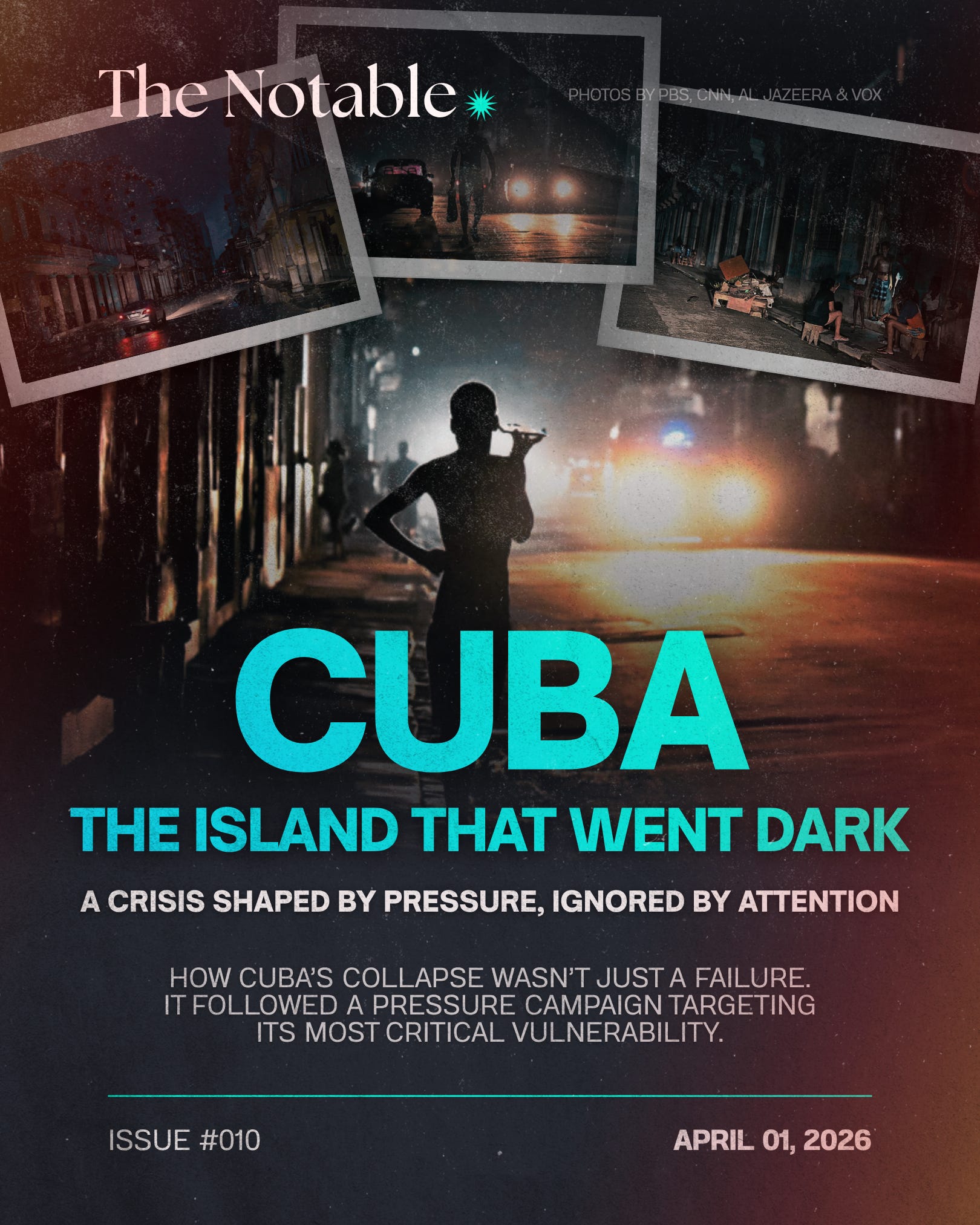
While global attention remains fixed on major geopolitical conflicts, a different kind of crisis is unfolding quietly in the Caribbean.
Cuba is experiencing widespread blackouts affecting millions of people. Entire cities are losing electricity for hours, sometimes longer. For many, daily life has become unpredictable. But this is not just a power outage. It is the visible result of a system pushed beyond its limits.
To understand what is happening, it helps to start with the trigger.
For years, Cuba operated on a fragile energy balance. The country relies heavily on imported fuel to keep its power grid running. Much of its infrastructure is aging and under strain, leaving little room for disruption. That system held together until early 2026, when oil shipments into the country declined sharply.
The reason was not purely internal.
The United States intensified pressure on suppliers transporting fuel to Cuba, effectively tightening access to one of the country’s most critical lifelines. As fuel became scarce, power plants began shutting down. What followed was not a single failure, but a cascade.
Electricity generation dropped. Transport systems slowed. Food supply chains were disrupted. Hospitals were forced to operate under increasing strain. The crisis spread quickly because energy sits at the center of modern life. When it fails, everything connected to it begins to weaken.
This pressure did not emerge suddenly. It reflects a longer strategic approach.
For decades, the United States has used economic restrictions to limit the Cuban government’s ability to sustain itself. The underlying logic is indirect but consistent: apply enough economic strain, and internal pressure may build over time. In 2026, that strategy became more targeted, focusing on energy as the system’s most critical dependency.
At the same time, Washington presents a different framing.
U.S. officials describe Cuba as a security concern, pointing to its alliances and internal political system. From this perspective, sanctions and restrictions are not escalation, but policy responses shaped by national security and governance concerns. The same actions can be understood in different ways, depending on where one stands.
On the ground, however, the effects are immediate and tangible.
Food spoils without refrigeration. Transport becomes unreliable due to fuel shortages. Hospitals operate under difficult conditions during outages. These are not abstract disruptions. They are daily realities affecting millions of people.
And the burden is not shared equally.
Those with access to generators, fuel, or foreign currency have some ability to adapt. Others do not. The result is a widening gap between those who can manage the disruption and those who cannot. Crises like this do not just strain systems. They expose underlying inequalities that were always present, but less visible.
The Cuban government has attempted to respond.
Emergency fuel shipments have arrived from allies such as Russia, offering short-term relief. But these supplies are limited. One shipment can sustain the country for only a matter of days. The underlying issue remains unresolved. Temporary fixes cannot replace stable, long-term energy access.
And this is where the story expands beyond Cuba.
What is happening on the island is not entirely unique. Many countries depend on external energy supplies to function. When that flow is disrupted, whether by market shifts, infrastructure failure, or geopolitical pressure, entire systems become vulnerable.
This reflects a broader shift in how power operates in the modern world.
Energy is no longer just an economic resource. It is increasingly a strategic lever. Control over supply can influence not just prices, but stability itself. Countries with fragile systems or heavy dependence on external inputs become more exposed to this kind of pressure.
Cuba is one example. But it is not the only one.
The more important question is not just what is happening now, but what it reveals.
How many countries today are more dependent on external energy than they appear? And how many of them are only one disruption away from a similar outcome?
Sometimes, the most important crises are not the ones dominating headlines. They are the ones unfolding quietly, revealing how the systems we rely on can begin to fail.
And how quickly that failure can spread.