


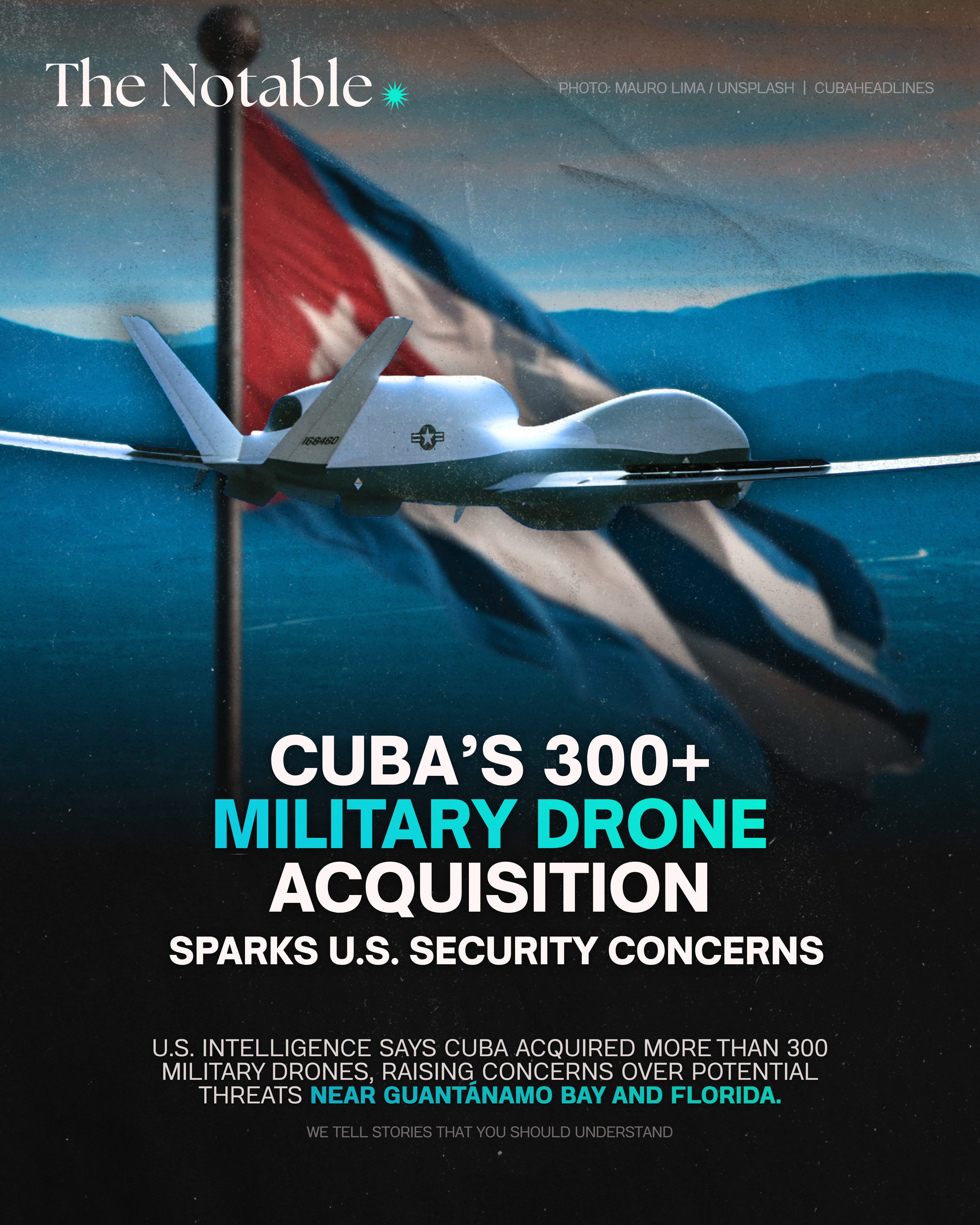
A new intelligence report has reignited fears inside Washington about how modern drone warfare is reshaping global security and bringing new threats closer to American territory.
According to a recent Axios report citing classified U.S. intelligence assessments, Cuba has reportedly acquired more than 300 military drones from Russia and Iran since 2023. U.S. officials believe Cuban authorities discussed contingency scenarios involving potential drone strikes on Guantánamo Bay, American military vessels, and possibly areas near Florida if tensions with Washington escalated into open conflict.
Officials stressed that the United States does not believe an attack is imminent. But the report has intensified concerns about the strategic implications of low-cost drone warfare appearing just 90 miles from the U.S. mainland.
Why The Report Matters
The story is significant not because Cuba suddenly rivals America militarily, but because warfare itself is changing.
For decades, Cuba posed little conventional threat to the continental United States. The military imbalance between the two countries was overwhelming. But drones have altered the equation. In conflicts across Ukraine and the Middle East, relatively inexpensive unmanned systems have allowed smaller states and proxy groups to challenge far larger powers with surprising effectiveness.
The concern is not simply about the number of drones. It is about proximity.
Key West sits roughly 90 miles from Cuba. Guantánamo Bay, one of America’s oldest overseas military installations, remains located on Cuban territory and has long been a symbol of unresolved hostility between Havana and Washington.
Rising Tensions Between Washington and Havana
The timing of the report is also significant.
Tensions between the Trump administration and Cuba have intensified in recent weeks. New sanctions were imposed earlier this month, surveillance activity near Cuba has reportedly increased, and CIA Director John Ratcliffe is said to have traveled to Havana for high-level discussions.
According to Axios, U.S. intelligence believes the drones were positioned across strategic parts of Cuba over the past several years. The systems were reportedly acquired from Russia and Iran, two countries that have increasingly expanded military cooperation with anti-Western governments worldwide.
Reuters later confirmed the existence of the U.S. intelligence assessment, though the agency noted it could not independently verify the claims regarding operational plans or capabilities.
The Bigger Strategic Fear
The modern concern is no longer limited to missiles, fighter jets, or large-scale invasions. Cheap drones can now threaten ships, infrastructure, surveillance systems, and military installations at relatively low cost.
That shift changes the strategic importance of geography itself.
For much of modern history, the continental United States benefited from distance. Oceans acted as buffers. Regional adversaries lacked the technological capacity to project power close to American territory.
Drone warfare is beginning to erode that advantage.
For Washington, the issue may ultimately be less about Cuba itself and more about what Cuba represents in a changing strategic landscape: a smaller state equipped with low-cost drone technology and backed by geopolitical rivals like Iran and Russia.
The broader message behind the report is clear.
The geography that once protected great powers may no longer guarantee the same security in the age of drones.