


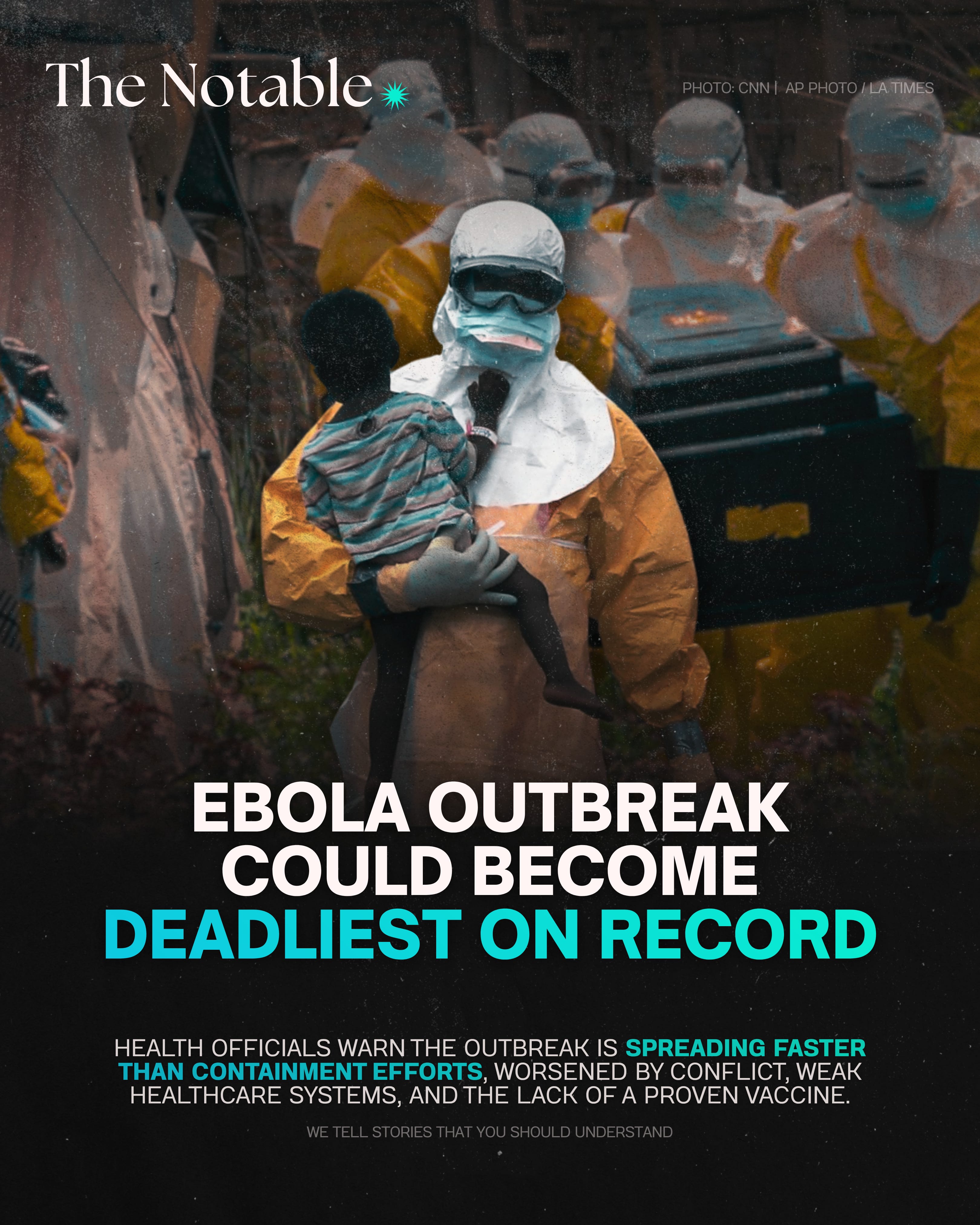
A rapidly spreading Ebola outbreak in Central Africa is raising alarms among global health agencies, with some officials warning it could become one of the deadliest Ebola crises ever recorded if containment efforts fail.
The outbreak is centered in eastern Democratic Republic of Congo, where healthcare systems are already under severe pressure from years of conflict, displacement, and instability. In recent weeks, the virus has spread across borders into Uganda, increasing fears of a wider regional emergency.
Health authorities say the outbreak involves the Bundibugyo strain of Ebola, a rarer variant for which there is currently no approved vaccine. That has made the situation significantly more difficult compared to previous Ebola outbreaks, where targeted vaccines helped slow transmission.
What Is Happening Now
The World Health Organization has declared the outbreak a Public Health Emergency of International Concern, warning that transmission is accelerating faster than response efforts in some affected areas.
According to health officials and humanitarian organizations, the outbreak may have circulated undetected for weeks before authorities formally identified it. By the time emergency responses intensified, cases had already appeared across multiple provinces and crossed into neighboring countries.
Uganda later confirmed imported Ebola infections linked to travel from Congo, including cases connected to healthcare workers and cross-border movement. Officials are now increasing screening and surveillance measures as they attempt to prevent wider transmission.
Why Health Officials Are Alarmed
One of the biggest concerns is geography.
Many of the hardest-hit areas are active conflict zones where armed groups operate and infrastructure is limited. Medical teams have struggled to safely reach some communities, while contact tracing efforts have slowed due to insecurity and population displacement.
In some cases, patients reportedly traveled long distances before symptoms were recognized, potentially exposing others in larger urban centers.
Health experts say this combination of delayed detection, conflict, mobility, and weak healthcare access creates conditions that could allow the outbreak to grow rapidly if containment measures fail.
Why This Outbreak Is Different
The current outbreak is not yet at the scale of the 2014–2016 West Africa Ebola epidemic, which killed more than 11,000 people and became the deadliest Ebola outbreak in history.
However, officials say the trajectory of the current crisis is concerning enough to justify urgent international attention.
Unlike COVID-19, experts do not currently believe the Ebola outbreak poses a high risk of becoming a global pandemic. Ebola spreads through direct contact with bodily fluids rather than airborne transmission, making it harder to spread internationally on the same scale.
Still, Ebola remains one of the world’s deadliest viruses, with fatality rates that can reach up to 50% or higher depending on the strain and available treatment.
The Vaccine Problem
A major challenge is that the outbreak involves the Bundibugyo strain of Ebola, which currently has no approved vaccine.
Experimental vaccines are still being developed, but officials say deployment could take months. Until then, health agencies are relying heavily on isolation measures, contact tracing, border screening, and emergency treatment centers to slow transmission.
Aid organizations warn that delays in international funding or coordination could significantly worsen the crisis.
What Happens Next
Global health agencies say the coming weeks will be critical.
If containment efforts stabilize transmission, the outbreak could remain regional. But if infections continue spreading through conflict zones and major population centers, the crisis could escalate into one of the most severe Ebola emergencies in modern history.
For now, officials are racing to contain the virus before the outbreak reaches a point where healthcare systems can no longer keep pace.