


For decades, Filipino workers have quietly powered the global cruise industry.
They serve meals, clean cabins, manage kitchens, entertain passengers, and keep some of the world’s largest floating resorts operating around the clock. On many cruise ships, Filipinos are not a minority workforce. They are the backbone of operations.
Now, a federal child exploitation investigation in the United States has placed that workforce under an uncomfortable international spotlight.
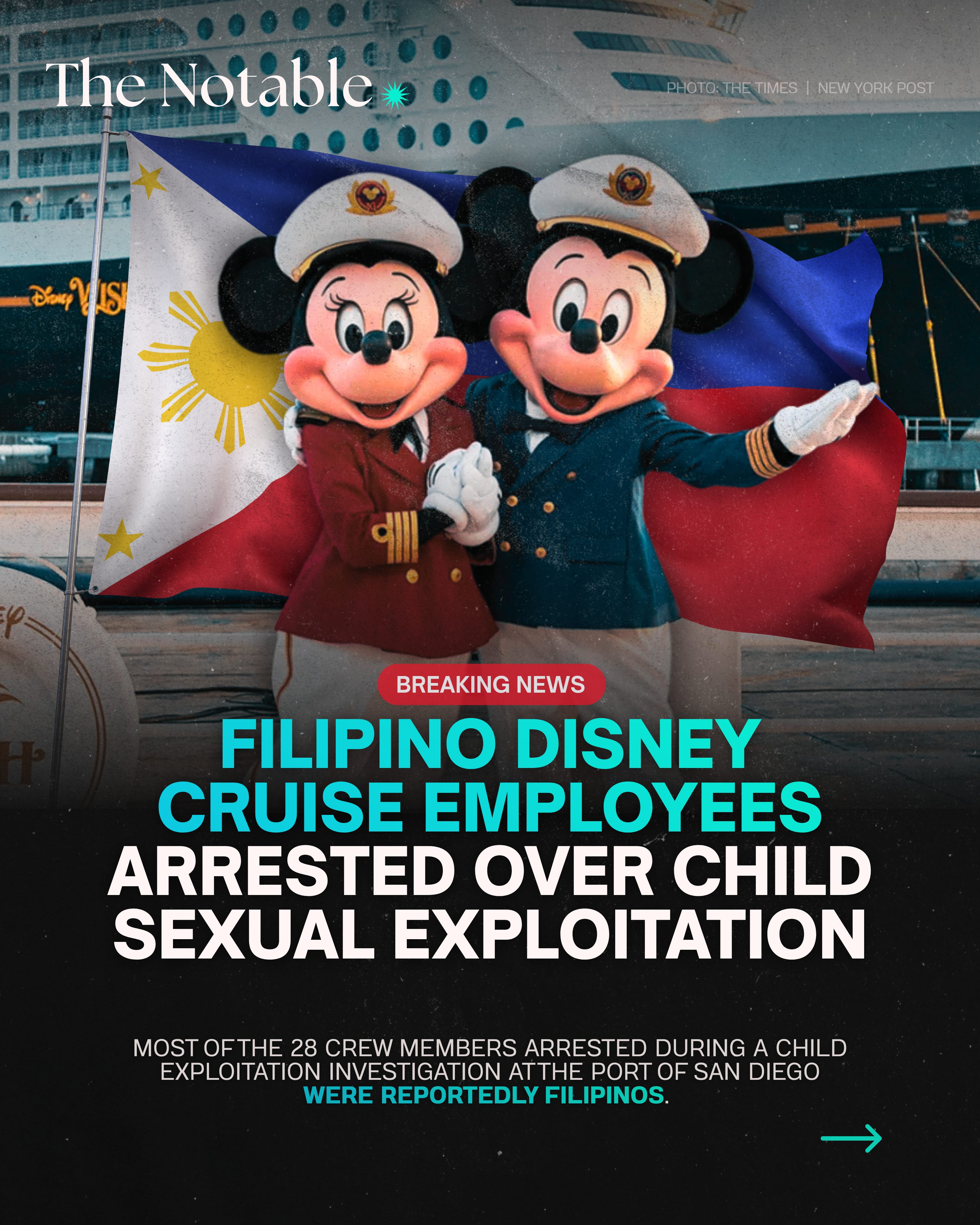
U.S. Customs and Border Protection officers detained 28 cruise ship crew members during a large enforcement operation at the Port of San Diego in late April, according to multiple reports. The operation targeted alleged possession and distribution of child sexual exploitation material (CSEM) through digital devices and online platforms.
Most of those detained were reportedly Filipinos.
The operation involved several cruise ships, including the Disney Magic and Holland America’s Zaandam. Federal officers boarded vessels docked in San Diego between April 23 and 25, removing crew members directly from the ships as passengers disembarked.
Videos circulating online showed some workers still wearing cruise uniforms while being escorted away in restraints by federal agents.
For many Filipinos watching from home, the images were jarring.
Not only because of the allegations themselves, but because cruise ship employment occupies a unique place in the Philippine economy and national identity.
The Philippines’ Invisible Global Workforce
The Philippines is one of the world’s largest suppliers of maritime labor.
Hundreds of thousands of Filipino seafarers work across global shipping and cruise industries every year. Many support extended families through remittances sent home from overseas contracts. Entire local economies in parts of the Philippines depend on overseas maritime employment.
Filipino crew members are especially dominant in hospitality and service roles aboard cruise ships because of the country’s long-established maritime training system, English proficiency, and reputation for customer service.
On some vessels, Filipino workers make up a substantial share of the operational workforce.
That means incidents like the San Diego detentions do not remain isolated legal stories. They quickly become national conversations tied to migration, labor, reputation, and vulnerability abroad.
A Difficult Reality for Overseas Workers
The latest operation has also renewed concerns among Filipino migrant advocacy groups about transparency and legal protections for detained seafarers.
Organizations such as the Tanggol Migrante Movement said they struggled to obtain information about detained crew members after the operation. Some advocates claimed workers were removed quickly, with limited communication available to families or support groups.
The International Seafarers Action Center reportedly became involved after multiple Filipino crew members aboard the Zaandam were detained.
Advocacy groups are not defending criminal behavior. But they are raising questions about due process, legal access, and how rapidly immigration enforcement actions can unfold for foreign workers operating inside complex international labor systems.
For many overseas Filipino workers, cruise employment already exists in a fragile space.
Workers often spend months at sea, live under strict corporate structures, and operate across multiple legal jurisdictions while depending on employer-sponsored visas. Once detained by immigration or federal authorities, they can quickly lose employment, housing, legal status, and access to communication simultaneously.
That vulnerability is part of why the story is resonating deeply in the Philippines.
The Collision Between Global Labor and Digital Crime
The San Diego case also reflects how modern criminal investigations increasingly intersect with global labor systems.
Federal agencies say the operation focused on digital evidence involving online child exploitation material, not physical incidents involving cruise passengers. Authorities allege the material was stored, shared, transported, or viewed through personal devices and digital platforms.
That distinction matters legally and operationally.
But it also highlights how borderless digital crimes now move through industries built on international mobility. Cruise ships, airports, ports, and migration systems have become central points in broader global enforcement efforts targeting online exploitation networks.
And when those industries rely heavily on migrant labor, entire national workforces can become indirectly tied to the reputational fallout.
That creates a difficult tension for the Philippines.
The overwhelming majority of Filipino seafarers working abroad are law-abiding workers supporting families and sustaining one of the country’s most important economic sectors. Yet incidents involving even a small number of workers can generate disproportionate scrutiny because of how visible Filipino labor is within the global cruise industry itself.
A Story Bigger Than One Cruise Ship
Disney Cruise Line says it is cooperating with authorities and has terminated employees connected to the investigation.
Federal agencies say investigations remain ongoing as digital evidence continues to be reviewed.
But beyond the arrests, the story reveals something larger about globalization itself.
Modern industries increasingly depend on massive international labor networks moving constantly across borders, ports, platforms, and legal systems. At the same time, modern law enforcement increasingly targets digital crimes that also move invisibly across borders.
Sometimes those two systems collide in highly public ways.
And when they do, the consequences rarely remain confined to the individuals involved. They ripple outward into industries, migrant communities, national reputations, and public trust.