


There is a simple explanation for why fuel prices may stay elevated in the months ahead. It is not a market anomaly or a short-term shock. It is a physical constraint.
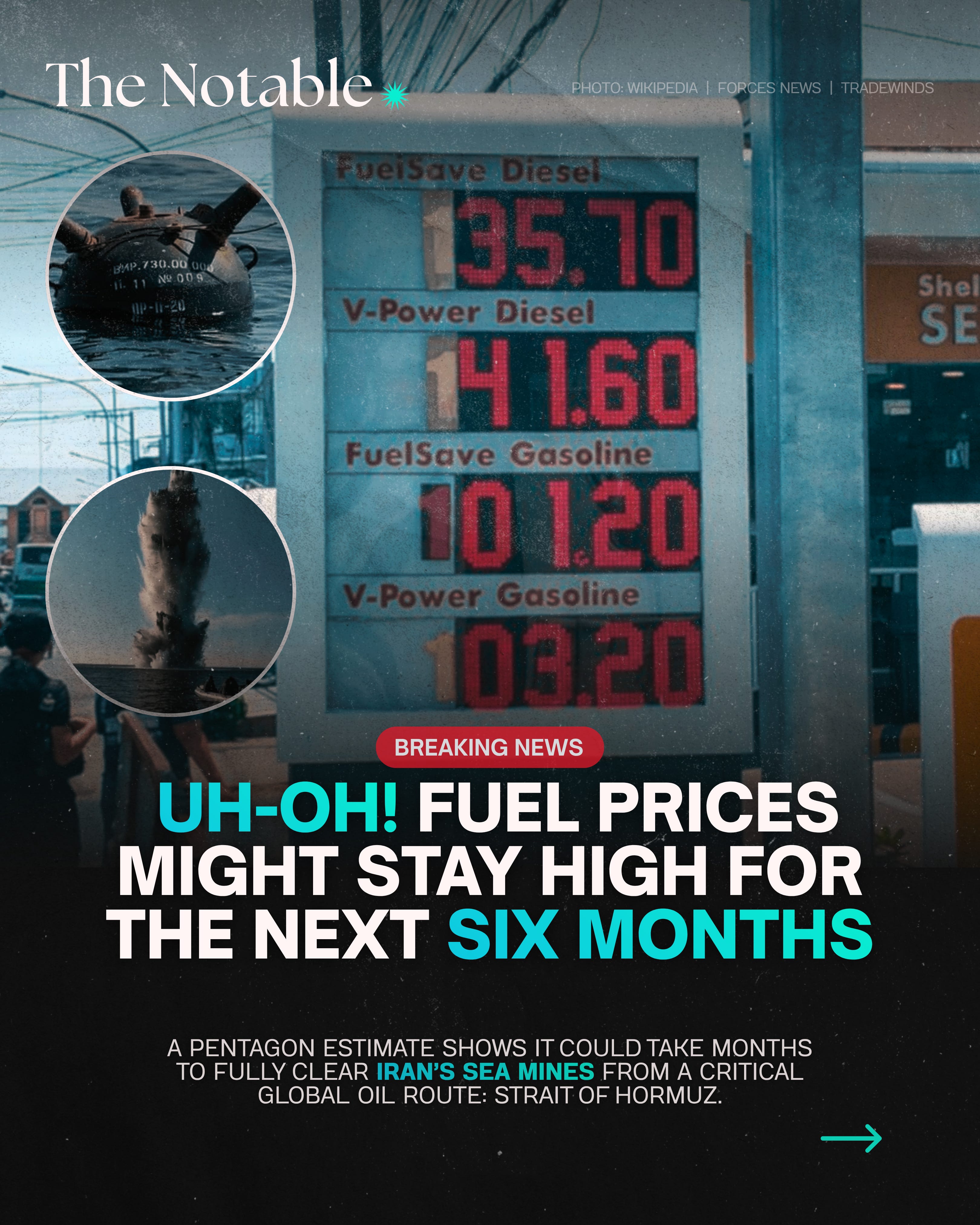
U.S. defense officials have warned Congress that clearing Iranian sea mines from the Strait of Hormuz could take up to six months. The estimate was delivered in a classified Pentagon briefing, offering a more sober timeline than public messaging has suggested.
The implication is straightforward. Even if active conflict subsides, the disruption to global oil flows may persist well beyond the fighting.
The chokepoint at the center of the system
The Strait of Hormuz is one of the most critical arteries in the global economy. Roughly one fifth of the world’s oil passes through this narrow corridor, connecting Gulf producers to global markets.
This concentration creates efficiency in normal times. It also creates vulnerability in moments of conflict.
Iran’s deployment of sea mines in the strait turns that vulnerability into leverage. A relatively low-cost, technically simple weapon can disrupt a disproportionately large share of global energy supply.
This is not about closing the strait entirely. It is about making it uncertain enough that normal flows cannot resume.
Why six months is not an overestimate
Naval mine clearance is slow by design. Mines are difficult to detect, can shift positions, and cannot be fully verified as removed with certainty. Some are anchored. Others can drift. Some may not even be precisely mapped.
This creates a structural problem. It is not enough to remove most of the mines. Shipping only resumes at scale when operators, insurers, and governments are confident that the route is safe.
Even a single undetected device can halt traffic again.
As a result, mine clearance is not just a military operation. It is a confidence-building process. That is what stretches timelines from weeks into months.
From shipping risk to fuel prices
The transmission mechanism to everyday life is indirect but powerful.
When risk in the strait rises, shipping costs increase. Insurance premiums climb. Some vessels delay or reroute. The effective supply of oil tightens, even if production levels remain unchanged.
That tightening feeds into global energy markets. Prices adjust not only to current supply, but to perceived risk.
For import-dependent economies, the effect is immediate. Higher oil prices translate into more expensive fuel, transport, electricity, and food. The shock spreads through the system.
What begins as a localized military tactic becomes a global economic pressure.
The six-month estimate reveals something more structural.
Modern conflicts are no longer defined only by active fighting. They leave behind residual disruptions that take time to unwind. In this case, the battlefield extends into global infrastructure.
Even under a ceasefire, clearance operations may take months to complete. During that period, energy markets remain sensitive to any signal of renewed risk.
The result is a prolonged phase of instability rather than a clean return to normal.
What to watch next
Three factors will shape how this evolves.
First, the trajectory of the conflict itself. A sustained pause in fighting is a prerequisite for systematic mine clearance.
Second, the pace and credibility of clearance operations. Partial progress is not enough. What matters is whether safe passage can be reliably demonstrated.
Third, market perception. Energy markets respond as much to confidence as to physical supply. If uncertainty persists, prices will reflect it.
The broader pattern is becoming clearer.
Strategic chokepoints are emerging as central nodes of modern power. Disrupting them does not require overwhelming force. It requires precision, timing, and an understanding of how tightly connected global systems have become.
In this case, a narrow stretch of water is shaping costs felt across continents.
And for now, that pressure is unlikely to ease quickly.