


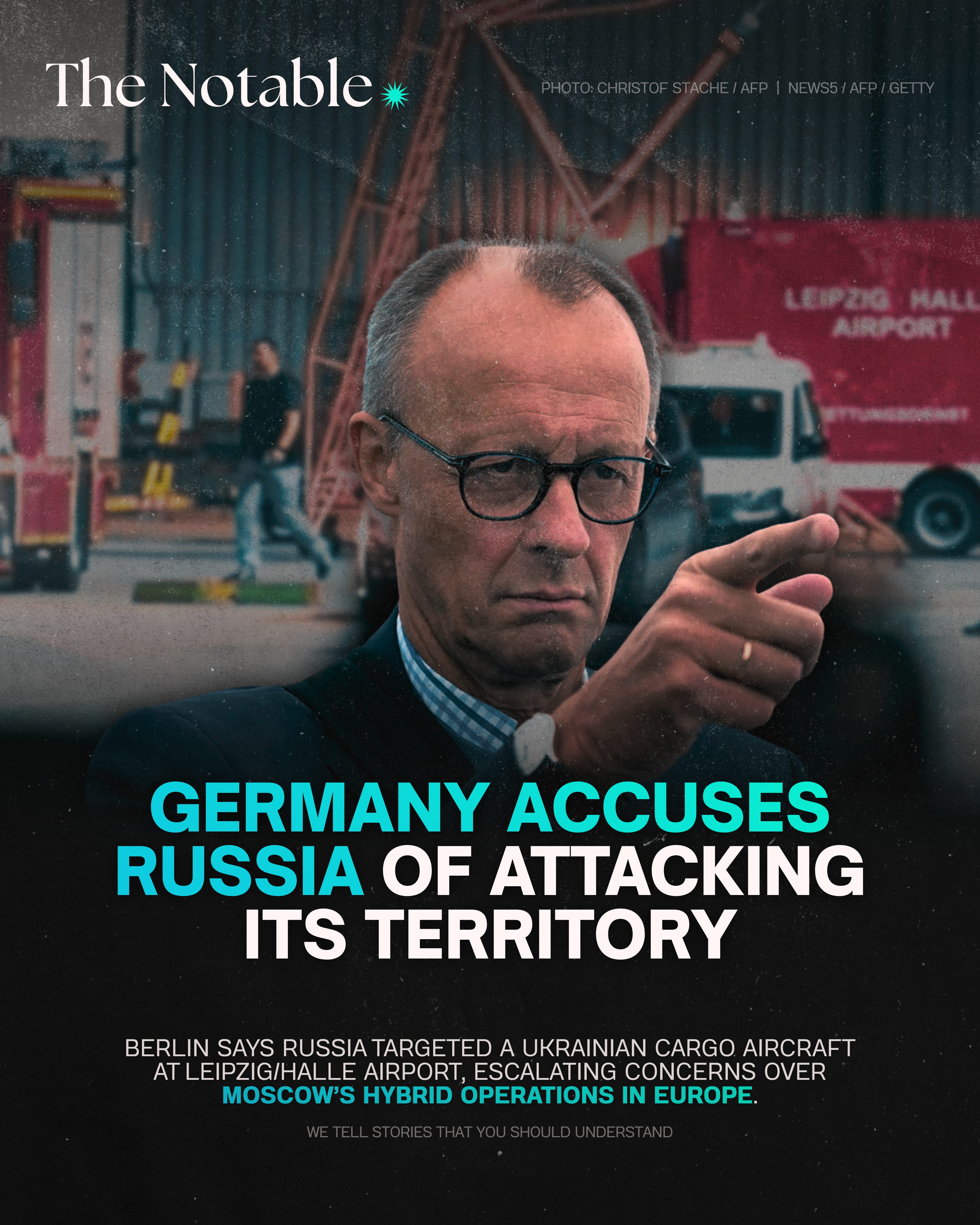
Germany has formally accused Russia of orchestrating an attempted drone attack on its territory, marking a significant escalation in Berlin’s response to what it describes as Moscow’s growing campaign of hybrid operations across Europe.
The incident centered on Leipzig/Halle Airport, a major cargo hub in eastern Germany. German authorities say an explosives-laden drone was discovered near Ukrainian cargo aircraft at the airport and that subsequent intelligence and investigative findings point to individuals acting on behalf of Russian state agencies.
Russia has rejected the accusation.
The episode matters beyond the immediate security incident. Germany is now treating what it describes as a Russian covert operation on German soil as part of a wider confrontation that increasingly extends beyond the battlefield in Ukraine.
What happened at Leipzig/Halle
The incident began in early August, when German authorities discovered a drone carrying explosives at Leipzig/Halle Airport.
The airport is an important European freight center and has links to NATO logistics operations. Ukrainian Antonov cargo aircraft also operate from the site, making the location particularly significant given Germany’s role in supporting Ukraine.
German investigators subsequently examined whether the drone had been deliberately positioned to target aircraft or infrastructure connected to Ukraine.
A separate incident involving an unidentified object encountered by a DHL cargo aircraft after departure from the airport also raised concerns about whether more than one drone had been involved.
Later in August, investigators reportedly discovered another drone and around 50 grams of suspected military explosive west of the airport. Authorities began examining whether several drones had been deployed as part of the same operation.
At first, German officials stopped short of publicly assigning responsibility to Moscow.
That changed in September.
Germany formally points to Russia
On September 1, German Interior Minister Alexander Dobrindt said Germany had concluded that Russia was responsible for the attempted attack.
According to the German assessment, investigative evidence and intelligence findings indicate that people involved in the operation were acting on behalf of Russian state agencies.
Foreign Minister Johann Wadephul similarly described the Leipzig incident as part of a broader pattern of Russian hybrid activity in Europe.
That distinction is important.
Germany is not claiming that Russia launched a conventional military attack against Germany. Rather, Berlin is accusing Moscow of using covert methods, including drones, sabotage and other forms of clandestine activity, to pursue strategic objectives without crossing into open war.
Russia has rejected the allegations and characterized the accusations as politically motivated.
Why Leipzig/Halle matters
The location gives the incident greater strategic significance.
Leipzig/Halle is one of Europe’s major air-freight hubs. It is also connected to military logistics supporting NATO and Ukraine.
The presence of Ukrainian cargo aircraft therefore adds another layer to the case.
If German investigators are correct that the operation was intended to target Ukrainian aircraft, the incident would represent an attempt to interfere with the infrastructure supporting Ukraine’s war effort from inside Germany.
That would make it fundamentally different from an ordinary drone intrusion.
It would also illustrate one of the central features of modern European security: the front line of the Russia-Ukraine conflict is no longer necessarily confined to Ukraine.
Europe’s expanding hybrid conflict
European governments have spent years warning that Russia is increasingly using methods that fall below the threshold of conventional warfare.
These activities can include cyberattacks, sabotage, espionage, disinformation, infrastructure disruption and covert operations.
The objective is often not to destroy a military target outright. It can instead be to create uncertainty, impose costs, disrupt logistics, intimidate governments or demonstrate that critical infrastructure remains vulnerable.
Germany has increasingly focused on this threat.
The Leipzig incident follows a series of European investigations into suspected Russian-linked sabotage and covert operations, including cases involving suspicious packages, infrastructure incidents and alleged attempts to disrupt support for Ukraine.
Taken individually, such incidents can appear limited.
Viewed collectively, European governments increasingly see them as part of a broader strategic pattern.
Berlin responds
Germany’s response to the Leipzig accusation has gone beyond public condemnation.
Berlin announced measures targeting Russia’s diplomatic and political presence in Germany, including the closure of Russia’s consulate general in Bonn.
Germany also announced plans to terminate the operating agreement for the Russian House cultural center in Berlin and tighten entry restrictions for Russian citizens.
Berlin is additionally pushing for further European Union sanctions against individuals it believes are involved in Russian hybrid operations.
The German government has also called for greater pressure on Russia’s so-called shadow fleet, a network of vessels used to transport Russian oil and circumvent Western sanctions.
These measures demonstrate that Berlin views the incident as part of a larger security problem rather than an isolated aviation incident.
Russia’s denial
Moscow has rejected Germany’s accusations.
Russia previously described the Leipzig incident as a fabricated provocation and denied responsibility for the drone operation.
That means an important qualification remains necessary: Russian responsibility is the official German assessment, based on German intelligence and investigative findings. It is not an allegation that Moscow has accepted, nor has Russia acknowledged conducting the operation.
The distinction matters because attribution in covert operations is inherently difficult.
Unlike a conventional missile strike, where launch systems and physical evidence can often provide a clearer chain of attribution, hybrid operations are deliberately designed to obscure who ordered and conducted them.
A dangerous new threshold
The most consequential aspect of the Leipzig case may therefore be the political response rather than the physical damage.
Germany is one of Europe’s largest military and economic powers and one of Ukraine’s most important supporters.
If Berlin concludes that Russia is deliberately targeting infrastructure connected to Ukraine on German soil, the calculation changes.
Germany must now consider how to deter further operations without allowing a covert confrontation to escalate into direct military conflict between Russia and NATO.
That is the central strategic problem.
Russia and NATO are already engaged in an intense confrontation over Ukraine. Yet both sides have strong incentives to avoid a direct conventional war.
Hybrid operations occupy the space between those two realities.
They allow states to impose costs, gather intelligence and create disruption while attempting to remain below the threshold that could trigger a military response.
The danger is that the threshold itself can become increasingly difficult to define.
Germany is not the only country concerned
Berlin’s assessment comes amid a broader European effort to respond to suspected Russian interference.
Governments across the continent have accused Moscow of conducting or supporting various forms of covert activity since Russia’s full-scale invasion of Ukraine in 2022.
European officials increasingly describe these actions collectively as a hybrid campaign designed to weaken Western support for Ukraine and exploit vulnerabilities in European societies and infrastructure.
NATO has also acknowledged an increase in Russian hybrid activity across Europe.
At the same time, NATO officials have emphasized that they do not currently assess a conventional Russian attack on the alliance as imminent.
That distinction is critical.
The current concern is not that Russia is preparing to invade Germany.
It is that the confrontation between Russia and Europe is increasingly being fought through activities that sit below the threshold of open warfare.
The bigger question
The Leipzig incident raises a broader question for Europe: How should NATO respond when a hostile state is accused of conducting covert attacks inside alliance territory without launching a conventional military attack?
That question is becoming increasingly urgent.
A drone carrying explosives near a Ukrainian aircraft may appear relatively limited compared with the scale of the war in Ukraine.
But if Germany’s attribution is correct, its significance lies in what the incident represents.
Russia would not simply be fighting Ukraine.
It would be using covert means to reach into the territory of the countries supporting Kyiv.
For Germany, that transforms the issue from distant geopolitical risk into a domestic security challenge.
And for Europe, it reinforces a reality that has become increasingly difficult to ignore: the boundary between the war in Ukraine and the wider European security environment is becoming harder to maintain.
What happens next
The immediate focus will be on whether Germany releases additional evidence supporting its attribution and whether other European governments endorse Berlin’s assessment.
The response from Moscow will also matter.
If Russia retaliates against Germany’s diplomatic measures, tensions could deepen further.
European governments will also be watching for additional suspected sabotage, drone activity or other covert operations targeting infrastructure connected to Ukraine or NATO.
The central challenge for Berlin and its allies will be to impose enough cost to deter further attacks without creating a cycle of escalation that neither side can easily control.
The Leipzig case may ultimately be remembered less for the damage it caused than for what it signaled: Germany is increasingly treating Russia’s alleged covert operations inside Europe as a direct national-security confrontation, not simply as a problem arising from the war in Ukraine.