


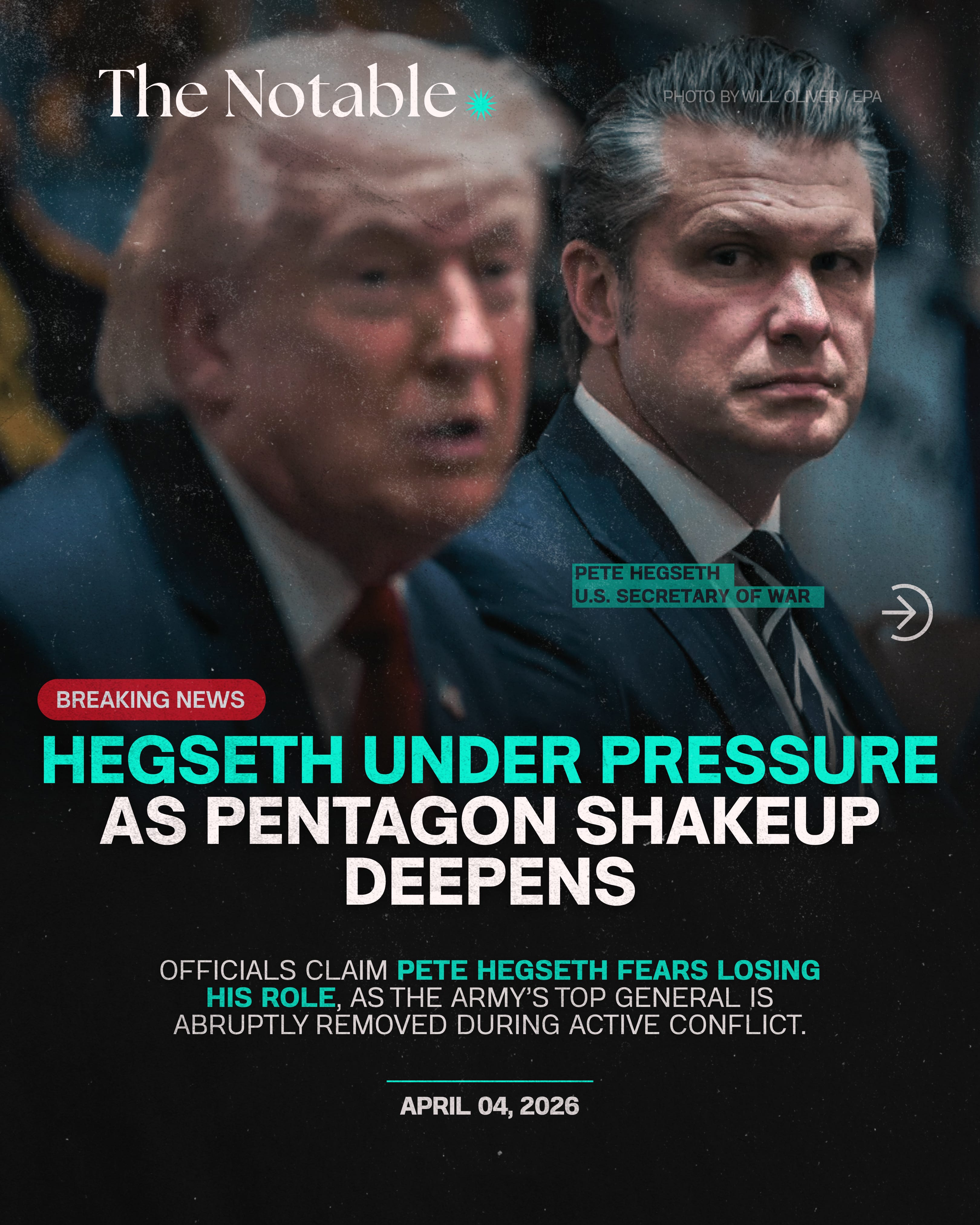
Hegseth Under Pressure as Pentagon Shakeup Deepens
The sudden removal of the U.S. Army’s top general is drawing attention not just for its timing, but for what it may reveal about the balance of power inside the Pentagon.
At the center is Pete Hegseth, the U.S. Defense Secretary, who forced the resignation of Randy George in early April. George, the highest-ranking officer in the U.S. Army, had been expected to remain in the role until 2027. His abrupt removal, alongside other senior officers, came without a public explanation.
The decision arrives at a particularly sensitive moment. The United States is engaged in active military operations tied to escalating tensions with Iran, making continuity in military leadership especially critical. Removing the Army’s top general during such a period is highly unusual and has prompted concern among officials and observers in Washington.
But the story does not stop at the decision itself.
According to reports citing officials within the Trump administration, Hegseth may be facing growing internal pressure. Some officials claim he has become increasingly concerned about his position, particularly amid speculation that Dan Driscoll, the current Army Secretary, could emerge as a potential successor. George, who was seen as closely aligned with Driscoll, may have been caught in the middle of these internal dynamics.
These claims remain unconfirmed. No official statement has linked the removal to internal rivalries or personal concerns. Still, the narrative is gaining traction because it aligns with a broader pattern.
Since his appointment under Donald Trump, Hegseth has overseen a significant reshaping of military leadership. Multiple senior officials across different branches have been removed or replaced in recent months. Supporters argue this reflects an effort to assert control and realign the Pentagon’s leadership. Critics see something more destabilizing: a politicization of military command at a time when strategic clarity is essential.
This tension sits at the core of the current moment.
The role of Defense Secretary is not administrative. It is operational, strategic, and central to how the United States conducts war. Decisions made at this level ripple across the entire military structure, shaping not just leadership, but readiness, coordination, and long-term planning.
That is why this development carries weight beyond a single personnel change.
If the removal of Randy George is part of a broader internal struggle, it suggests that political dynamics may be increasingly intersecting with military decision-making. If it is not, the absence of a clear explanation raises its own concerns about transparency and institutional stability.
Either way, the implications are immediate.
The Pentagon now faces a period of uncertainty at the top of its command structure, at a time when geopolitical risks are already elevated. Whether this proves to be a contained episode or the start of a deeper realignment remains to be seen.
What is clear is this: the story is no longer just about who leads the U.S. military.
It is about how power is being exercised within it.