


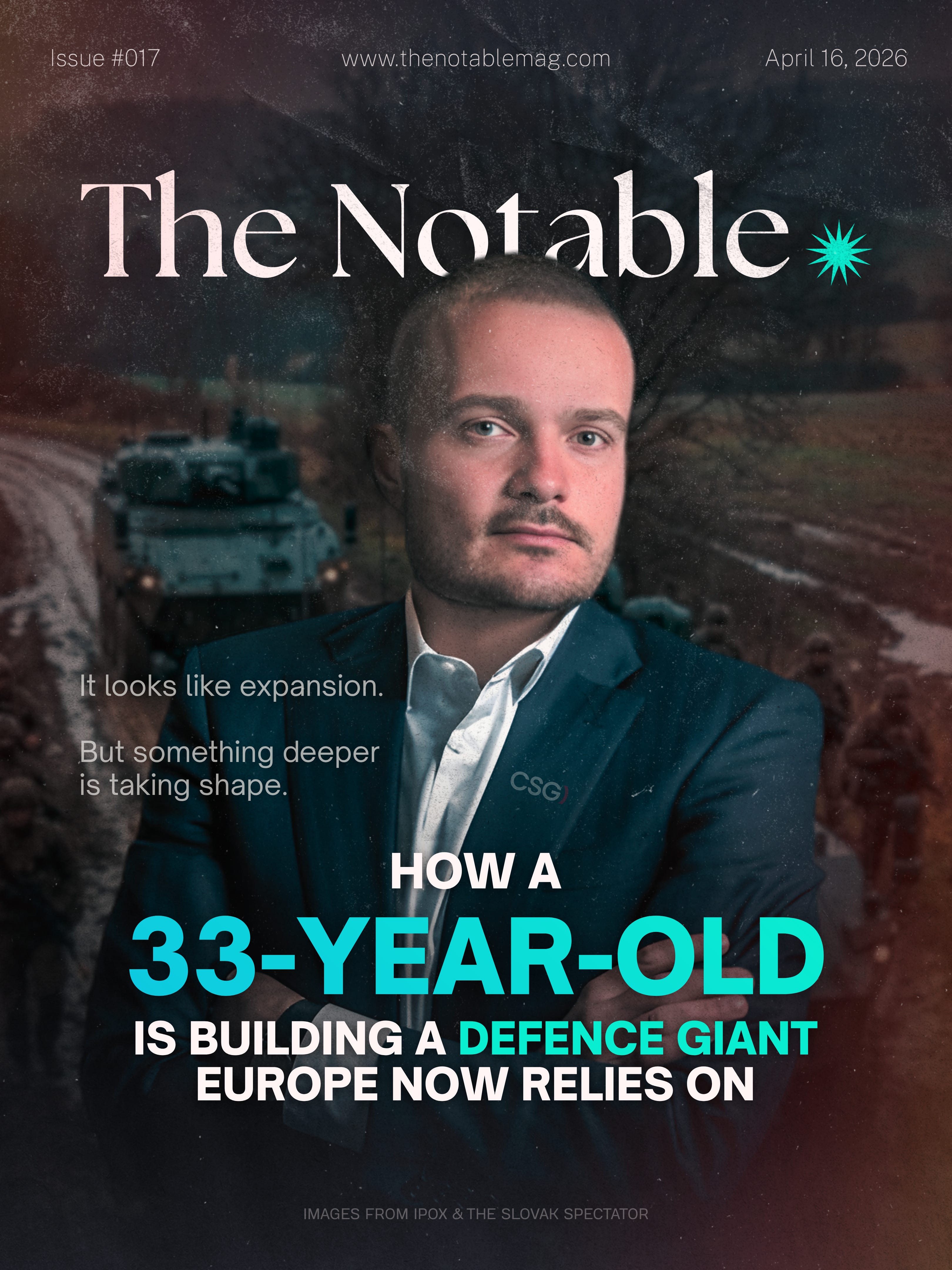
In January, Michal Strnad took his company public at a valuation of roughly €25bn. Until recently, he had been largely invisible, running Czechoslovak Group (CSG), the industrial holding his father assembled from post-Soviet remnants of Eastern Europe’s arms industry.
Within weeks, the listing did more than elevate Strnad’s profile. It repositioned CSG, from a regional consolidator into one of Europe’s most consequential defence companies.
The speed of that transition is the story. But the conditions that made it possible are the system revealing itself.
CSG’s growth is often described in simple terms: scale, acquisitions, and timing. The numbers reinforce that narrative. Revenues reached €6.7bn last year, roughly twelve times what the company generated in 2021. Around 80% comes from defence. It now operates over 30 production sites globally and employs about 14,000 people.
But the expansion is less about managerial execution than about a structural realignment in Europe’s defence economy.
For decades, Europe’s arms industry was fragmented, underfunded, and politically constrained. Procurement cycles were slow. Capacity was deliberately limited. War, when it appeared, was expected to be short.
That assumption no longer holds.
The war in Ukraine did not just increase demand for weapons. It changed the type of demand and the speed at which it moves.
Ammunition, once a low-margin, low-priority segment, has become central. Artillery shells, bullets, propellants are consumables, not capital goods. They are depleted continuously, not stockpiled indefinitely.
CSG sits precisely in that layer of the market.
It has become Europe’s second-largest ammunition producer, behind Rheinmetall. That positioning matters because ammunition operates on a different industrial logic than advanced weapons systems. It is less about technological superiority and more about volume, cost, and supply chain control.
Which is where CSG’s structure begins to look less incidental and more deliberate.
Much of its production remains anchored in the Czech Republic and Slovakia, regions where industrial labour is significantly cheaper than in Western Europe. That cost differential is not new. What has changed is its strategic value.
In a peacetime defence economy, cost advantages matter, but not decisively. In a wartime replenishment cycle, they compound.
European governments are not only supplying Ukraine, they are rebuilding their own depleted stockpiles. That creates a dual demand stream, immediate and structural. Orders are larger, timelines shorter, and political tolerance for delays lower.
CSG’s vertically integrated model, controlling everything from raw inputs like TNT to final ammunition assembly, allows it to respond faster than more fragmented competitors.
In January, it expanded that control further through a joint venture with Hellenic Defence Systems, adding explosives production into its network.
The mechanism is straightforward. Control more of the chain, reduce dependency, accelerate output.
But the implications are less straightforward.
The company’s rise has also been built through acquisition.
In 2022, CSG took a majority stake in Fiocchi Munizioni, a well-established Italian producer. In 2024, it acquired Kinetic Group, expanding its presence into the American market. More recently, it moved to buy a significant share of Hirtenberger Defence Systems, a specialist in mortar systems.
Individually, these deals look like standard consolidation.
Collectively, they suggest something else. A reassembly of Europe’s defence manufacturing base, but this time driven by private capital rather than state planning.
Strnad has been explicit about the direction. “The time for defence consolidation is now.”
The urgency is not rhetorical. It reflects a narrowing window.
For Europe, the war has exposed a structural imbalance.
Demand for military materiel has surged. Production capacity has not kept pace. Governments are now attempting to scale output rapidly, but they are doing so through an industrial base that was never designed for sustained high-volume conflict.
This creates pressure points across the system:
supply chains strained by sudden volume increases
procurement systems struggling to accelerate
industrial capacity concentrated in too few players
CSG’s rise is, in part, a response to that imbalance. It expands capacity where it is most constrained, ammunition, and does so across borders.
But it also shifts the structure of the industry.
Historically, Europe’s defence sector has been dominated by large, nationally anchored firms, companies like BAE Systems, Thales, and Airbus. These firms operate within political frameworks, balancing national priorities with commercial objectives.
CSG is different.
It is more mobile, more acquisition-driven, and less tied to a single national agenda. Its footprint spans Central Europe, Western Europe, and increasingly the United States.
That flexibility is an advantage in a fragmented market.
But it also introduces a tension. Defence production is becoming more transnational at the same moment that security concerns are becoming more national.
The company’s exposure to Ukraine illustrates this tension.
Roughly 27% of CSG’s sales last year were tied directly to Ukraine. The rest is increasingly linked to European rearmament, governments replenishing stocks and preparing for longer-term instability.
This dual dependency creates a paradox.
The company’s growth is anchored in a conflict that may not last indefinitely. Yet the investments it is making, factories, acquisitions, supply chains, assume that elevated demand will persist.
If the war ends, demand for ammunition could fall sharply. But if it continues, the current capacity may still be insufficient.
CSG is expanding into that uncertainty.
At the same time, a different kind of competition is emerging.
New entrants, particularly in defence technology, are beginning to reshape how military budgets are allocated. Companies like Helsing are building software-driven systems, drones, and AI-enabled targeting platforms.
These firms operate on a different logic. Faster iteration cycles, higher margins, and stronger alignment with modern warfare’s emphasis on precision and autonomy.
The risk for companies like CSG is not immediate displacement. Ammunition remains essential. But over time, budget allocation could shift, away from volume-intensive consumables toward high-tech systems.
Which introduces another layer of uncertainty, not just how much will be spent on defence, but what it will be spent on.
For now, however, the system is aligned in CSG’s favour.
European governments are committing to higher defence spending. NATO members are under pressure to meet or exceed spending targets. Supply chains are being restructured to reduce reliance on external actors.
In December, CSG signed a multi-year agreement linked to a broader European rearmament initiative, potentially worth tens of billions of euros over time.
This is not a single contract. It is a signal.
Demand is no longer episodic. It is becoming embedded.
Strnad’s personal trajectory mirrors this shift.
At 33, he has moved from relative obscurity to becoming the Czech Republic’s richest individual, largely on the back of a sector that, until recently, attracted little public attention.
His growing visibility, through sponsorships, acquisitions, and domestic influence, suggests a broader normalization of defence wealth within European business culture.
That, too, is a change.
For much of the post-Cold War period, defence companies operated at the margins of public visibility. Profitable, but politically sensitive. Necessary, but rarely celebrated.
The current cycle is altering that balance.
What looks like the rapid rise of a company is, in practice, a reconfiguration of an industry.
CSG did not create the conditions for its growth. It moved into them, quickly, aggressively, and with a structure suited to the moment.
Low-cost production in Central Europe. Vertical integration. Cross-border acquisitions. Exposure to both immediate conflict demand and longer-term rearmament.
Each of these elements existed before.
What changed was the system around them.
And yet, the alignment is incomplete.
The same forces enabling CSG’s expansion, war-driven demand, political urgency, fragmented supply, also introduce instability.
Demand may persist, but its composition could shift. Consolidation may continue, but political resistance could grow. Production may scale, but supply chains remain vulnerable.
The industry is expanding into a future that is not fully defined.
For now, CSG is positioned as a beneficiary of Europe’s rearmament cycle.
But its rise also exposes something less comfortable.
The faster the system scales to meet conflict, the more it begins to depend on its continuation.