


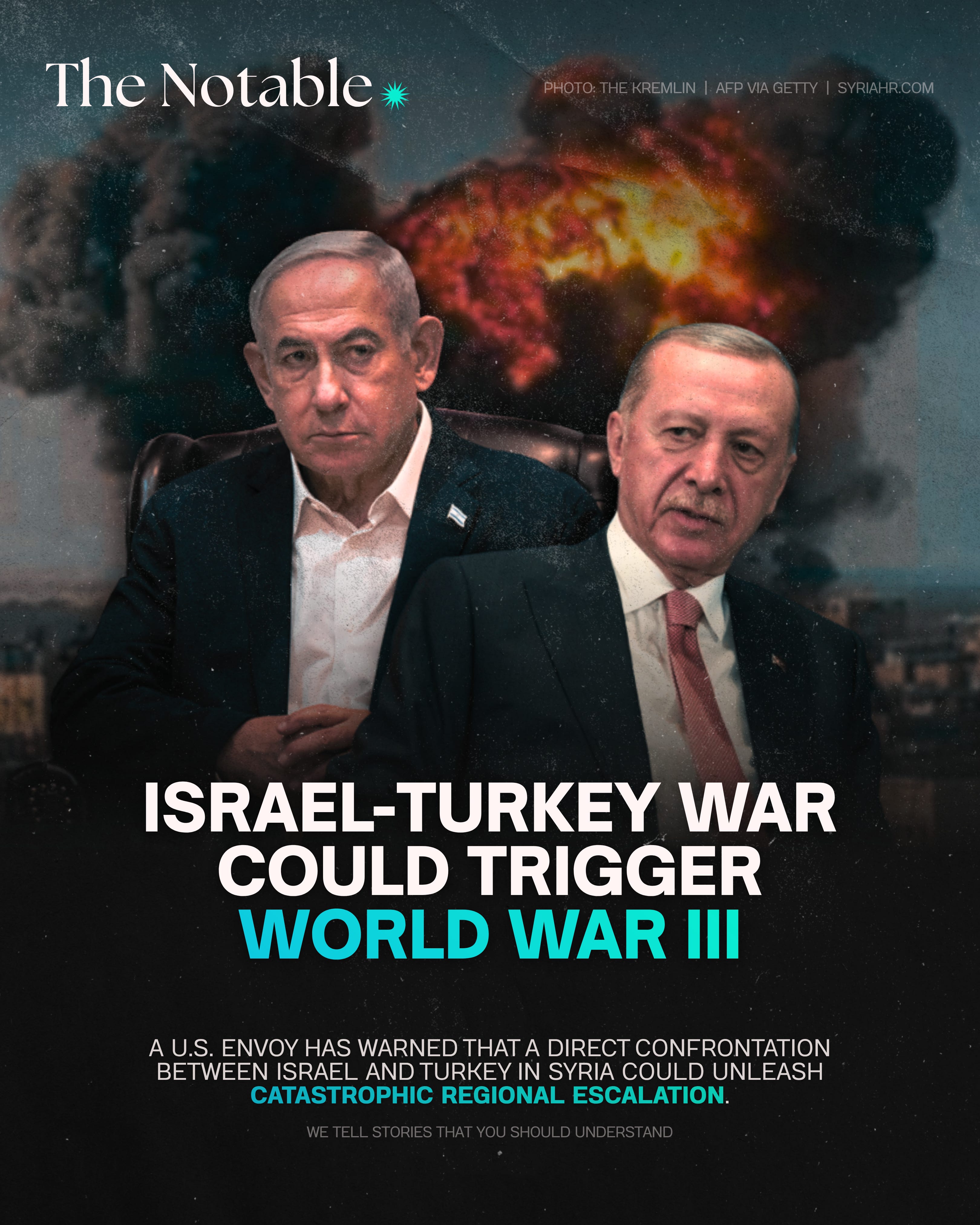
On August 18, Israel carried out airstrikes against the Abu al-Duhur military airbase in northwestern Syria.
The attack was significant not simply because Israel struck another site inside Syria, but because the target had become connected to Turkey’s expanding military role in post-Assad Syria.
Israel said it had intelligence indicating that Turkey was preparing to establish a military presence at the base. Ankara rejected that claim, saying there was no planned Turkish military buildup at Abu al-Duhur.
The disagreement matters because Turkey and Israel are increasingly pursuing competing strategic interests inside Syria.
What had previously been an indirect rivalry is beginning to acquire a more dangerous military dimension.
Why Israel Struck the Airbase
The Israeli government maintains that the strike was a security measure.
Israeli officials said intelligence indicated that Turkey intended to establish a military presence at Abu al-Duhur. Israel has repeatedly emphasized that it will not allow developments in Syria that it considers a direct threat to its security or freedom of military action.
Israeli Defense Minister Israel Katz later rejected U.S. envoy Tom Barrack’s characterization of the episode, arguing that Israel had clear intelligence concerning the planned Turkish presence.
According to Israel’s account, warnings were communicated to Syrian officials before the strike.
Turkey disputes this interpretation.
Ankara described Israel’s explanation as untenable and said its military cooperation with Damascus involves training, equipment and expertise rather than the deployment Israel claimed was imminent.
The underlying intelligence remains disputed publicly. Neither side has released enough evidence to independently settle the question.
Barrack’s Warning
The dispute took a more serious turn when U.S. envoy Tom Barrack publicly discussed the incident.
Barrack said Israel had raised concerns with Washington before the strike, claiming that Turkey was moving military assets toward the Syrian facility.
The United States examined the intelligence and, according to Barrack, concluded that a Turkish military deployment was not actually taking place.
He described the Israeli strike as an unnecessary escalation and warned about what could have happened if Turkish forces had been present.
If Turkish commanders had interpreted Israeli aircraft approaching the facility as an attack on Turkish personnel, Ankara could have responded militarily.
That could have created a direct Israel-Turkey confrontation inside Syrian territory.
And that is where Barrack’s warning became extraordinary.
He said such an escalation could potentially risk “World War III.”
The statement should not be interpreted as a prediction that a global war is imminent. Barrack was describing the potential consequences of an uncontrolled escalation between two powerful states with major international relationships.
Was Israel Trying to Provoke Turkey?
Barrack also raised a more controversial possibility.
He suggested that one theory was that Israel could have been attempting to “bait” Turkey into a confrontation.
He connected that possibility to Israel’s upcoming October election, suggesting that a confrontation with Turkey could potentially have domestic political value.
But this remains an allegation or theory, not an established fact.
Barrack himself presented multiple explanations for the strike, including the possibility of an intelligence failure or miscommunication between Israeli political leadership, intelligence officials and the military.
That distinction is crucial.
There is currently no publicly established evidence proving that Israel deliberately launched the strike to provoke Turkey for electoral reasons.
Israel has instead maintained that it was responding to a genuine security threat.
Israel Rejects the Account
Israeli Defense Minister Israel Katz pushed back strongly against Barrack’s version of events.
Katz said Barrack’s comments contained inaccuracies and defended Israel’s intelligence assessment.
From Israel’s perspective, the possibility of Turkish military deployment at the airbase represented a significant strategic concern.
Turkey’s growing presence in Syria is already changing the regional balance.
Ankara has developed close ties with Syria’s new government following the fall of Bashar al-Assad, while Israel has continued conducting military operations inside Syrian territory to prevent what it considers unacceptable security threats.
The result is an increasingly crowded and contested military environment.
The danger is not necessarily that either Israel or Turkey wants a war.
The greater danger is that both sides could take military actions they consider defensive while the other side interprets them as aggressive.
That is how escalation can begin.
Syria Has Become the New Fault Line
The confrontation cannot be understood without looking at what happened after Assad’s fall.
The collapse of the Assad government fundamentally changed Syria’s strategic environment.
Turkey emerged as one of the most important external powers supporting Syria’s new political order. Ankara has sought influence through security cooperation, military assistance and political engagement.
Israel, meanwhile, has sought to preserve its ability to operate throughout Syria.
Israel is particularly concerned about the possibility of hostile forces, weapons networks or Iranian influence returning to Syrian territory. It has therefore continued conducting military operations designed to prevent developments it considers threatening.
These objectives increasingly overlap.
Turkey wants a stable and sovereign Syrian state with a strong relationship with Ankara.
Israel wants a Syrian security environment that does not permit hostile military infrastructure to emerge near its borders.
Those goals do not necessarily make war inevitable.
But they create the conditions for repeated confrontation.
Why Turkey Changes the Equation
Turkey is not another actor operating inside Syria.
It is a major regional military power and a member of NATO.
That dramatically raises the stakes of any direct confrontation.
Israel is also closely aligned with the United States and maintains deep military and intelligence relationships with Washington.
A direct Israel-Turkey conflict would therefore place the United States in an extraordinarily difficult position.
Washington would face pressure to protect its strategic relationship with Israel while simultaneously preventing a military crisis involving a NATO member.
That is one reason the United States has been pushing for a deconfliction mechanism between Israel, Turkey and Syria.
The objective is straightforward: ensure that military operations do not accidentally place Israeli and Turkish forces on a collision course.
The Real Risk Is Miscalculation
The most important element of Barrack’s warning is not the phrase “World War III.”
It is the possibility of miscalculation.
Modern Middle Eastern conflicts increasingly involve multiple military powers operating in close proximity.
Aircraft can enter the same airspace. Intelligence assessments can be wrong. Warnings can be misunderstood. Commanders can make decisions based on incomplete information.
A military operation intended to send a message can therefore produce a response that neither side anticipated.
The Abu al-Duhur episode illustrates precisely that danger.
Israel believed it was addressing a potential Turkish military threat.
Turkey said that threat did not exist.
The United States appears to have reached a similar conclusion before the strike.
If Turkish forces had actually been present and responded militarily, the situation could have changed within minutes.
A Wider Regional Problem
The Israel-Turkey dispute is also occurring against the backdrop of a Middle East undergoing major strategic realignment.
The fall of Assad removed one of the region’s longstanding power structures.
Iran’s influence in Syria has been weakened.
Turkey’s influence has expanded.
Israel has increased its military freedom of action.
Arab governments are trying to protect their interests while avoiding being pulled into another major regional conflict.
The United States is attempting to manage relationships with actors whose strategic objectives are increasingly difficult to reconcile.
Syria sits directly at the intersection of these competing interests.
That makes the country one of the most important potential flashpoints in the Middle East.
What Happens Next
For now, there is no Israel-Turkey war.
The immediate response has instead focused on preventing another incident.
Washington is working toward mechanisms that could separate Israeli and Turkish military operations in Syria.
Syria and Israel have also continued diplomatic contacts aimed at reducing tensions and keeping Syria from becoming an arena for a broader Israeli-Turkish confrontation.
But the underlying strategic dispute remains.
Turkey is unlikely to abandon its growing role in Syria.
Israel is unlikely to surrender its freedom to conduct military operations there.
That means the conditions that produced the Abu al-Duhur crisis have not disappeared.
The Bigger Picture
The most consequential development is not that Israel and Turkey are about to enter a world war.
It is that two powerful states with opposing strategic objectives are increasingly operating inside the same battlespace.
That creates a new category of risk for the Middle East.
The danger lies in the gap between intention and consequence.
Israel may believe it is preventing a threat. Turkey may believe it is defending its interests. Syria may seek to strengthen its sovereignty. The United States may try to keep everyone apart.
Yet one misread signal, one disputed intelligence report or one military response could force all of them into a crisis they did not intend to create.
That is why Barrack’s warning deserves attention.
The question is not whether World War III is about to begin.
The question is whether Syria is becoming the place where a much larger conflict could begin by accident.