


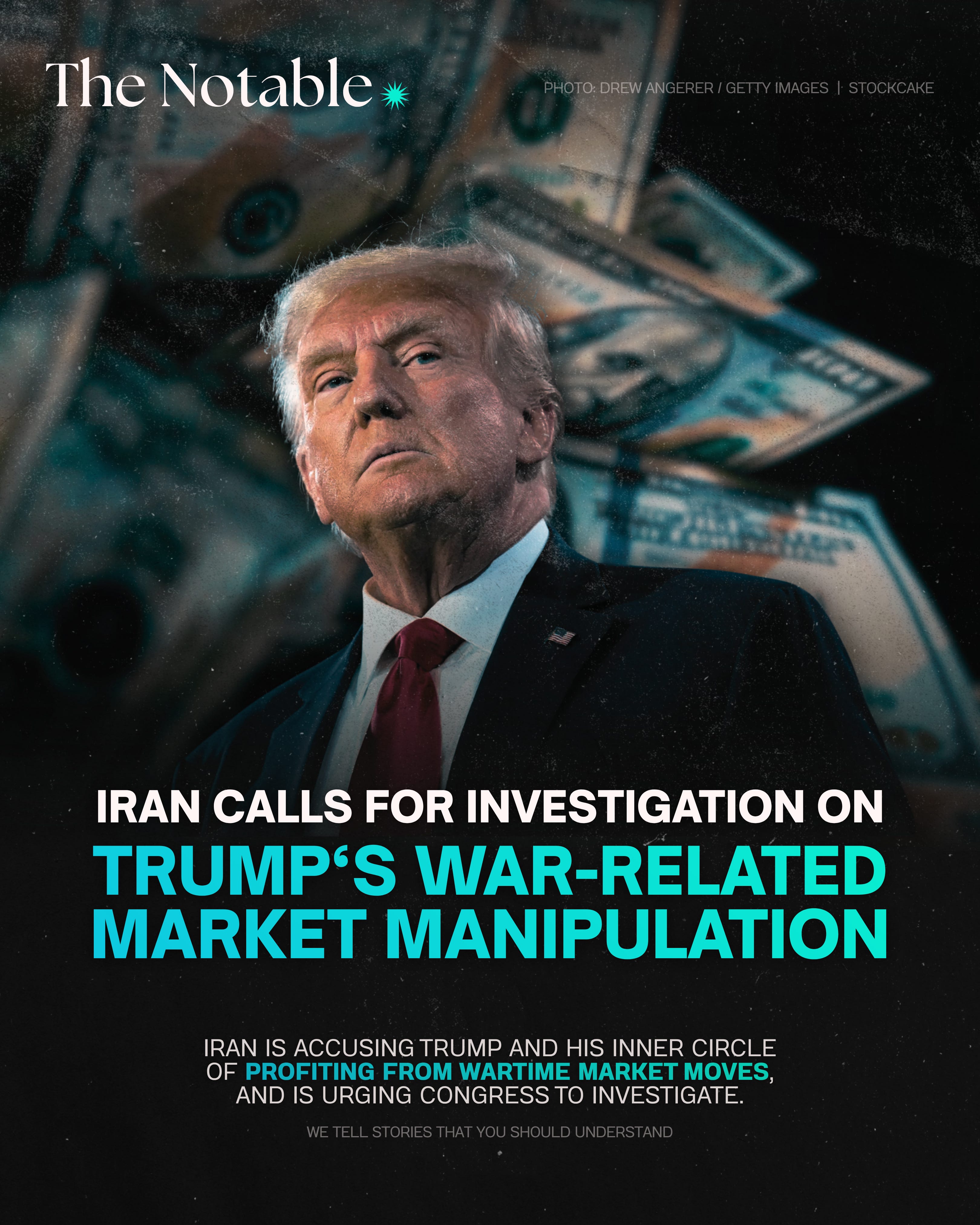
Iran has called on the U.S. Congress to investigate whether President Donald Trump, members of his family and senior officials profited from financial market movements connected to the war with Iran.
The demand was made by Mohammad Reza Naqdi, a senior adviser to Iran’s Revolutionary Guard leadership, during a rare interview with PBS NewsHour.
Naqdi alleged that Trump and people around him could have benefited financially from decisions that moved oil and other markets. He called on Congress to examine the assets of Trump, his family and his inner circle before and after the conflict.
The allegation is serious. But it is also important to distinguish between an accusation, suspicious trading activity and proven insider trading.
No credible evidence currently establishes that Trump, his family or his officials were responsible for the suspicious trades that have attracted scrutiny.
What makes the story notable is that the Iranian accusation comes amid separate questions already being raised in the United States about trading activity around Trump’s Iran policy decisions.
Iran’s accusation
Naqdi’s argument is straightforward.
He claims that Trump’s military and diplomatic decisions can create significant movements in financial markets, particularly oil markets. If someone with advance knowledge of those decisions traded before they became public, that person could potentially profit from the resulting price movement.
Naqdi therefore called for Congress to compare the assets of Trump, his family and members of his inner circle before and after the war.
That would, in theory, allow investigators to look for unexplained gains that coincided with major policy decisions.
But the source of the allegation matters.
Naqdi is a senior Iranian military figure speaking amid an ongoing confrontation between Tehran and Washington. His accusation should therefore be treated as an allegation from an adversarial government, not as an established finding of U.S. authorities.
The more important question is whether independent evidence exists to justify the underlying concern.
There is some.
Suspicious oil trades had already drawn U.S. scrutiny
Before Iran made its latest accusation, suspiciously timed trades surrounding Trump’s Iran policy had already attracted attention in the United States.
The most significant concern involves oil futures.
Oil prices can move sharply when markets receive new information about war, sanctions, ceasefires, negotiations or potential attacks involving Iran. The Strait of Hormuz makes the relationship particularly important because the waterway is one of the world’s most consequential energy chokepoints.
In March, reporting identified unusual trading activity shortly before major Trump announcements concerning Iran.
One reported episode involved a large oil-futures position placed shortly before Trump announced a pause in planned strikes on Iranian power infrastructure.
The timing attracted attention because Trump’s announcement altered expectations about the immediate trajectory of the conflict and therefore the likely direction of oil prices.
But timing alone does not prove illegal activity.
A trader could have acted on publicly available information, market signals, analysis or speculation. Establishing insider trading requires substantially more than demonstrating that a trade happened shortly before an important announcement.
U.S. regulators have looked at suspicious trades
The controversy became more significant when the Commodity Futures Trading Commission, the U.S. regulator responsible for overseeing derivatives markets, examined suspicious oil-futures trading around major changes in Trump’s Iran policy.
Reuters reported in April that the CFTC was examining trades placed shortly before significant shifts in the administration’s Iran policy.
One episode involved a position worth hundreds of millions of dollars placed shortly before Washington and Tehran announced a ceasefire.
The scale and timing were enough to attract regulatory attention.
But there is an important distinction between an investigation into suspicious trading and a finding of insider trading.
The CFTC’s examination did not establish publicly that Trump, his family or administration officials made those trades.
Nor does the existence of suspicious trades demonstrate that the people responsible had access to classified information.
That remains the central unresolved issue.
The Trump portfolio adds another layer
Questions have also emerged around Trump’s own financial activity.
Trump’s financial disclosures show an unusually large number of transactions across stocks, funds and other securities.
CBS News reported that Trump’s investment accounts conducted thousands of transactions involving more than 1,000 individual companies and funds during the first months of 2026.
The sheer volume has attracted scrutiny because some transactions occurred around government policy decisions that could affect particular companies or sectors.
But again, the existence of those transactions does not establish insider trading.
Trump’s organization has maintained that his investments are handled by outside managers and that Trump and his family do not receive advance knowledge of individual trades.
Investment professionals have also pointed out that a large number of transactions can result from automated investment strategies such as tax-loss harvesting and direct indexing.
In other words, a large trading volume is not itself evidence of wrongdoing.
The relevant question is whether any individual transaction was based on material, nonpublic information.
Then there is Truth Social
A separate development has added another dimension to the controversy.
Trump Media & Technology Group introduced Truth API, a system providing institutional customers with real-time access to posts from influential Truth Social accounts.
The service launched for institutional customers in August and has attracted attention because Trump’s posts can move financial markets.
That creates an unusual situation.
Trump is both a political decision-maker whose statements can influence markets and the central figure of a social-media platform whose posts can themselves have immediate financial consequences.
The controversy is not necessarily that investors receive secret information.
Trump’s posts are public.
The issue is timing.
If certain traders can receive a post even fractionally earlier than the wider market, high-speed trading systems could potentially react before other investors.
That has led to criticism and a lawsuit challenging the arrangement.
Trump Media has defended the service, while its executives have argued that any timing advantage is extremely small.
Still, the controversy highlights a broader problem at the heart of the Iran allegations:
How much financial value can be attached to information before the public receives it?
Why Iran is focusing on Trump’s financial activity
Iran’s accusation therefore arrives in an environment where the basic premise is already being debated in Washington and on Wall Street.
Trump’s policy decisions can move markets.
His statements can move markets.
Oil prices are particularly sensitive to developments involving Iran because of the potential consequences for global energy supply.
And Trump’s personal financial activity has attracted scrutiny because of the enormous number of transactions made during a period of significant policy change.
These circumstances do not prove insider trading.
But they explain why questions about information access, timing and financial incentives have become politically important.
Iran is effectively taking those existing questions and making a much more direct accusation: that people around the president may have financially benefited from decisions made during the war.
That claim remains unproven.
The evidence investigators would actually need
If Congress were to investigate the allegations seriously, the most important evidence would not simply be Trump’s financial statements.
Investigators would need to reconstruct the timeline of information.
Who knew that a particular military or diplomatic decision was coming?
When did they know?
Was that information material enough to affect market prices?
Who traded before the announcement?
Who communicated with those traders?
Were any trading accounts connected to government officials, family members, advisers or intermediaries?
And did the traders’ positions change immediately after the information became public?
Those questions matter because insider trading cases generally turn on the relationship between information, access, timing and intent.
A trade that happens minutes before a major announcement may look suspicious.
But investigators would still need to establish why that trade happened and whether the person making it possessed information they were legally prohibited from using.
The key distinction: suspicion is not proof
This distinction is particularly important in a story involving both an ongoing war and a highly political accusation.
There are currently several separate facts:
Iran has accused Trump and his inner circle of profiting from wartime market movements.
U.S. regulators have examined suspiciously timed oil trades around major Iran-policy decisions.
Trump’s investment accounts have conducted extensive trading activity.
Truth Social has introduced a system giving institutional customers real-time access to posts from influential accounts, including Trump’s.
But none of those facts, individually or collectively, proves that Trump or his family engaged in illegal insider trading.
The unanswered question is whether there is an actual connection between government information and financial transactions.
That is what evidence would have to establish.
Why the Iran conflict makes this especially sensitive
The financial stakes are unusually high because Iran is not an ordinary geopolitical event.
The conflict affects oil production, shipping, sanctions, insurance costs and the security of the Strait of Hormuz.
Any indication that the United States is preparing an attack can affect expectations for energy supplies.
Any indication of a ceasefire can push those expectations in the opposite direction.
That creates enormous opportunities for traders who correctly anticipate changes in U.S. policy.
It also creates an enormous incentive to determine whether anyone with privileged access to government decisions is able to trade ahead of the market.
This is why the issue extends beyond Trump personally.
At its core, it concerns whether political power and privileged information can be converted into private financial advantage.
What happens next
Iran’s demand for a congressional investigation does not mean Congress will automatically open one.
The more significant developments would be any decision by U.S. lawmakers or regulators to formally examine the specific allegations, identify the traders behind the suspicious oil positions, or establish links between those traders and people with access to confidential government information.
That evidence would fundamentally change the story.
Until then, the most defensible conclusion is narrower.
Iran has made a serious allegation. U.S. authorities have separately examined suspicious trading around Trump’s Iran policy. Trump’s own financial activity and Truth Social’s new trading-access feature have added to the broader conflict-of-interest debate. But there is currently no established evidence proving that Trump, his family or his officials engaged in illegal insider trading.
The real story is therefore not yet about whether the allegation is true.
It is about whether the evidence exists to prove it.