


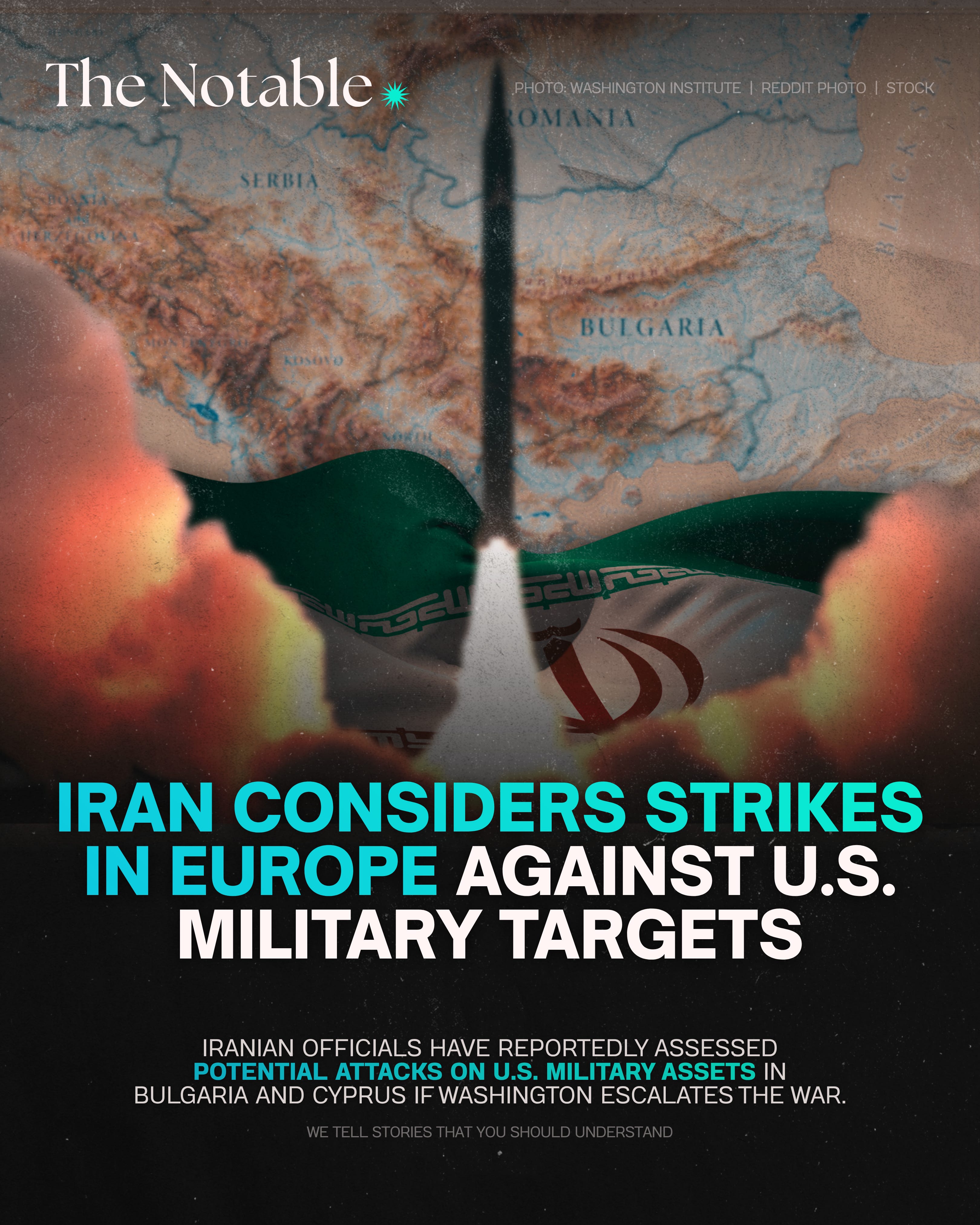
Iran is reportedly considering attacks against U.S. military assets in southeastern Europe if the conflict with Washington escalates, according to reporting by the Financial Times.
The locations identified include Bulgaria and Cyprus, raising the possibility that a renewed U.S.-Iran confrontation could extend beyond the Middle East and place American military facilities in Europe under greater threat.
The reporting does not indicate that Iran has ordered an attack, nor that strikes against European targets are imminent. Rather, Iranian officials are reportedly assessing potential options in preparation for a possible escalation.
That distinction matters. But so does the geographic shift.
The European Targets
According to the Financial Times, two people close to Iran’s regime said Iranian officials have considered targeting U.S. military assets in southern and southeastern Europe.
Bulgaria is particularly significant.
In July, Bulgaria approved the temporary deployment of up to eight U.S. KC-135 aerial-refueling aircraft and 250 American personnel at Bezmer Air Base in southeastern Bulgaria. The deployment was intended to support U.S. military operations in the Middle East.
The first American aircraft arrived at the base on July 31.
Iran had already protested the arrangement, warning Bulgaria against allowing its territory to facilitate American military operations against Tehran.
Bulgaria has said that the aircraft are intended for logistical support and that no direct attacks against Iran would be launched from Bulgarian territory.
The country’s role nevertheless gives Iran a concrete U.S. military presence to consider if the war expands.
Cyprus has also been identified in the Financial Times reporting, although publicly available information provides less detail about the specific U.S. assets that Iranian officials may have considered there.
A Diplomatic Window Has Closed
The development comes at a critical moment in the U.S.-Iran confrontation.
A memorandum reached by Washington and Tehran in June established a 60-day negotiating period intended to provide a path toward a longer-term agreement.
That window expired on August 17 without a final agreement.
The expiration does not automatically mean that war must resume. But it removes an important diplomatic framework that had temporarily constrained the conflict and comes as both sides prepare for the possibility of renewed military confrontation.
Iran has subsequently signaled that it could adopt a more offensive posture if diplomacy fails.
The timing is therefore significant: the reported consideration of targets in Europe comes almost immediately after the diplomatic deadline expired.
Iran Has Been Preparing for a Wider Conflict
The Financial Times report is also consistent with a broader picture described by the Wall Street Journal.
The Journal reported on August 17 that Iran had used the period following the June memorandum to prepare for a potentially broader confrontation.
According to the report, the Islamic Revolutionary Guard Corps gained greater authority, missile and drone production was accelerated, and Iran prepared its military and security apparatus for the possibility of renewed fighting.
The reporting also described preparations for offensive operations beyond Iranian territory.
That does not necessarily mean Tehran has decided to expand the war geographically. It does suggest that Iranian planners are considering what a larger conflict could look like and where American vulnerabilities might exist.
The Battlefield Could Become More Distributed
This is the most consequential element of the latest reporting.
A conflict between the United States and Iran has historically been understood primarily through the geography of the Middle East: Iran itself, the Persian Gulf, Iraq, Syria, Israel and the surrounding region.
But U.S. military power is geographically distributed.
American aircraft, personnel, logistics hubs and bases across Europe help sustain operations far beyond the continent itself. If Iran were to target those assets, the geographical boundaries of the conflict could become much less predictable.
That does not mean Iran would attack Europe broadly.
The reported consideration is specifically focused on U.S. military targets, not European civilian infrastructure or European countries as such.
But European governments hosting American military assets could nevertheless find themselves caught between their alliance commitments and the risk of becoming targets of Iranian retaliation.
Why Bulgaria Matters
Bulgaria illustrates the dilemma particularly clearly.
Sofia has sought to distinguish between supporting American logistics and directly participating in military operations against Iran.
From Iran’s perspective, however, the distinction may matter less if American aircraft operating from Bulgarian territory contribute to the wider U.S. campaign.
That creates a familiar problem for countries hosting foreign military forces: the host state may not consider itself a combatant, while the opposing side may view the foreign military presence as a legitimate military target.
Bulgaria is therefore an important test case for how far the current confrontation could spread.
The Undersea Infrastructure Risk
The latest reporting also points to another potential escalation pathway: critical infrastructure around the Strait of Hormuz.
Iran has reportedly examined options involving subsea infrastructure in the region.
This is significant because the Persian Gulf is not only a major energy corridor. It is also connected to international communications infrastructure.
Claims that Iran could simply sever cables carrying a fixed percentage of global internet traffic should be treated cautiously. The exact share of global traffic passing through particular cable systems varies by definition, route and redundancy, and internet traffic can often be rerouted.
The broader concern is nevertheless real.
A deliberate attack on subsea communications infrastructure would introduce a new dimension to the conflict, potentially affecting communications, financial systems and commercial connectivity well beyond the immediate battlefield.
This Is Not Yet an Attack on Europe
It is important not to overstate what has been reported.
Iran has not publicly announced a decision to attack Bulgaria or Cyprus.
The Financial Times reporting concerns Iranian assessments and discussions, based on sources close to the regime. There is no public evidence establishing that an operational order has been issued.
Iran also faces practical limitations when it comes to striking targets at long distances.
Therefore, the story should not be interpreted as evidence that an Iranian attack on Europe is imminent.
The significance lies elsewhere.
Iranian planners appear to be considering how to impose costs on the United States if the conflict resumes, and that calculation may extend to American military infrastructure outside the Middle East.
What Happens Next
The most important question is whether Washington and Tehran return to direct military confrontation after the expiration of the June negotiating framework.
If fighting resumes, several developments will matter.
First, whether the United States expands its military campaign and increases the use of European bases and logistical facilities.
Second, whether Iran moves from planning and threat assessments toward actual attacks on U.S. assets outside the Middle East.
Third, how European governments respond if American installations on their territory become potential targets.
And finally, whether the conflict remains concentrated around Iran and the Persian Gulf or develops into a more geographically distributed confrontation.
The Bigger Picture
The immediate story is about possible Iranian targets in Bulgaria and Cyprus.
The larger story is about the changing geography of the U.S.-Iran conflict.
The expiration of the June diplomatic window has removed one layer of restraint at precisely the moment Iran is reportedly preparing for a wider confrontation. Meanwhile, the United States maintains military infrastructure across a network of countries that extends far beyond the Middle East.
If Iran ultimately decides to strike those assets, the consequences would not necessarily be limited to the battlefield.
European governments could suddenly face a strategic dilemma they had sought to avoid: supporting U.S. military operations while managing the possibility that their own territory becomes part of the conflict.
For now, the reported Iranian assessments remain just that: assessments.
But they offer a glimpse into how Tehran may be thinking about the next phase of the confrontation.
The question is no longer simply whether the U.S.-Iran conflict will resume.
It is how wide the battlefield becomes if it does.