


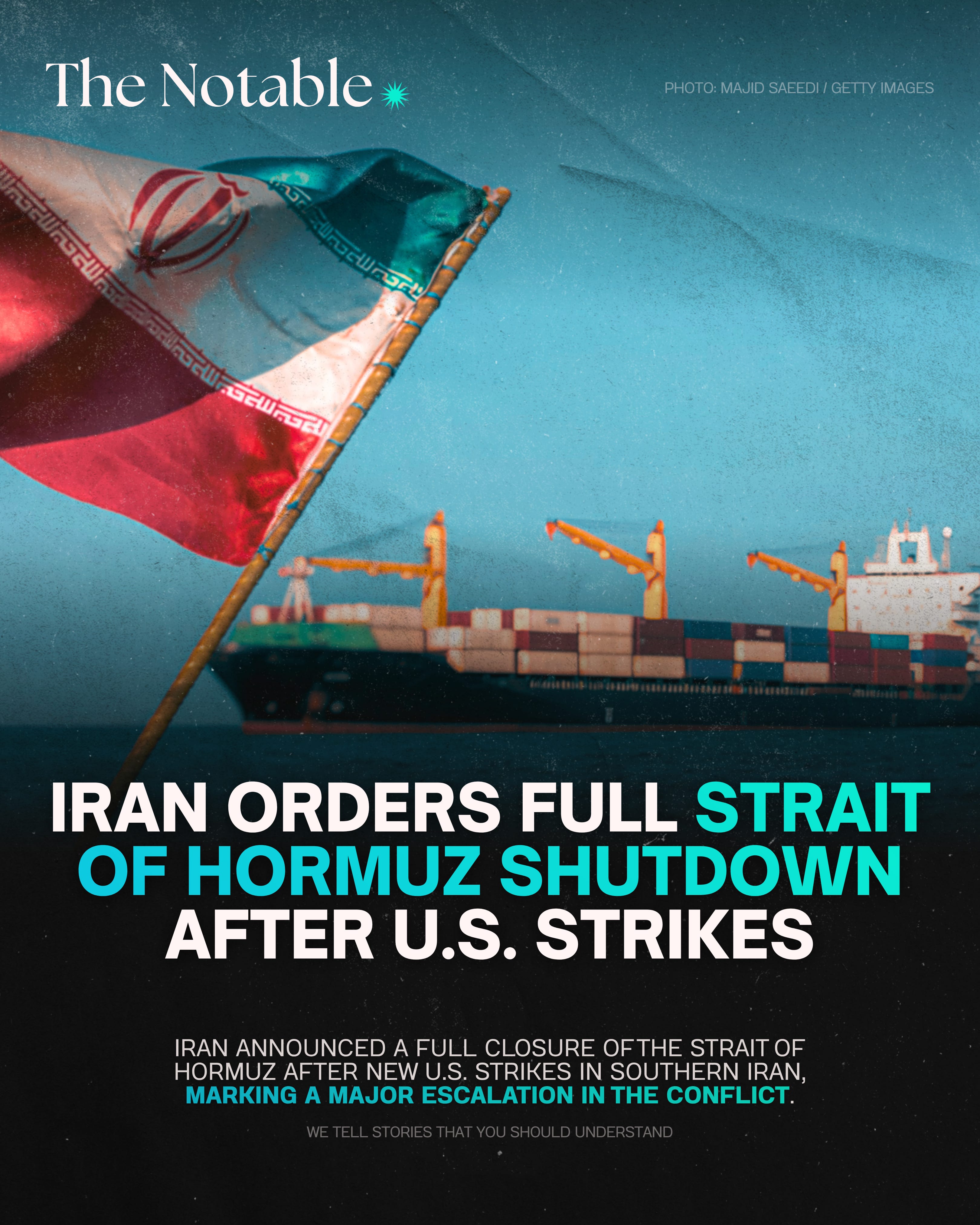
Iran has announced a full closure of the Strait of Hormuz following new U.S. military strikes on targets in southern Iran, marking one of the most significant escalations in the conflict so far.
The announcement was made by Iran’s military leadership after American forces carried out fresh attacks against Iranian positions. Tehran warned that vessels attempting to transit the strait could be targeted, raising immediate concerns about global energy supplies, shipping routes, and the risk of a broader regional confrontation.
The Strait of Hormuz is not just another waterway. It is one of the most strategically important chokepoints in the world economy.
Roughly one-fifth of global oil and gas shipments normally pass through the narrow corridor connecting the Persian Gulf to international markets. Major energy exporters including Saudi Arabia, Iraq, Kuwait, the United Arab Emirates, and Iran itself rely on the route to move energy supplies to customers across Asia, Europe, and beyond.
As news of the closure spread, energy markets reacted quickly. Traders began pricing in the possibility of a prolonged disruption to global oil flows, pushing crude prices higher and renewing fears of another energy shock.
A Longstanding Threat Becomes Reality
For decades, Iran has periodically threatened to close the Strait of Hormuz during periods of heightened tensions with the United States and its regional rivals.
Those threats were often viewed as a powerful deterrent rather than an imminent action.
This time appears different.
The closure announcement follows months of escalating military exchanges between Washington and Tehran. Although a ceasefire earlier this year temporarily reduced direct hostilities, tensions never truly disappeared. The latest round of American strikes has now triggered one of Iran’s most consequential responses yet.
Whether the closure can be fully enforced remains an open question.
The United States has previously maintained that freedom of navigation through the strait is a vital national interest. Commercial shipping traffic has not completely stopped, and military observers are closely monitoring whether vessels continue to transit the waterway despite Tehran’s declaration.
The distinction is important.
Announcing a closure and successfully shutting down one of the world’s busiest maritime corridors are not necessarily the same thing.
Why the Strait Matters
The significance of the Strait of Hormuz extends far beyond the Middle East.
The modern global economy depends on a continuous flow of energy. Even countries that import little oil directly from the Persian Gulf can feel the effects of disruptions because oil is priced in a global market.
If shipments are interrupted for an extended period, the consequences could ripple across supply chains, transportation networks, manufacturing industries, and consumer prices worldwide.
The effects would likely be felt first in energy markets, but they would not stop there.
Higher oil prices can increase transportation costs, raise inflationary pressures, and complicate economic planning for governments already dealing with geopolitical uncertainty.
For Asia in particular, the stakes are especially high. Many of the region’s largest economies remain heavily dependent on energy flows passing through the Persian Gulf.
A New Phase of the Conflict
The closure announcement also signals that the conflict may be entering a more dangerous phase.
Until now, much of the fighting has been concentrated on military targets and strategic infrastructure. By targeting a critical artery of global commerce, Iran is demonstrating its ability to impose costs not only on the United States but on the broader international system.
That changes the strategic calculation.
The issue is no longer confined to the battlefield. It now directly affects global markets, energy security, and international trade.
The coming days will likely determine whether the Strait of Hormuz becomes the central flashpoint of the conflict or whether diplomatic and military efforts can prevent a wider disruption.
For now, governments, shipping companies, energy traders, and military planners around the world are watching the same narrow stretch of water.
What happens there next could shape the trajectory of the conflict and the global economy alike.