


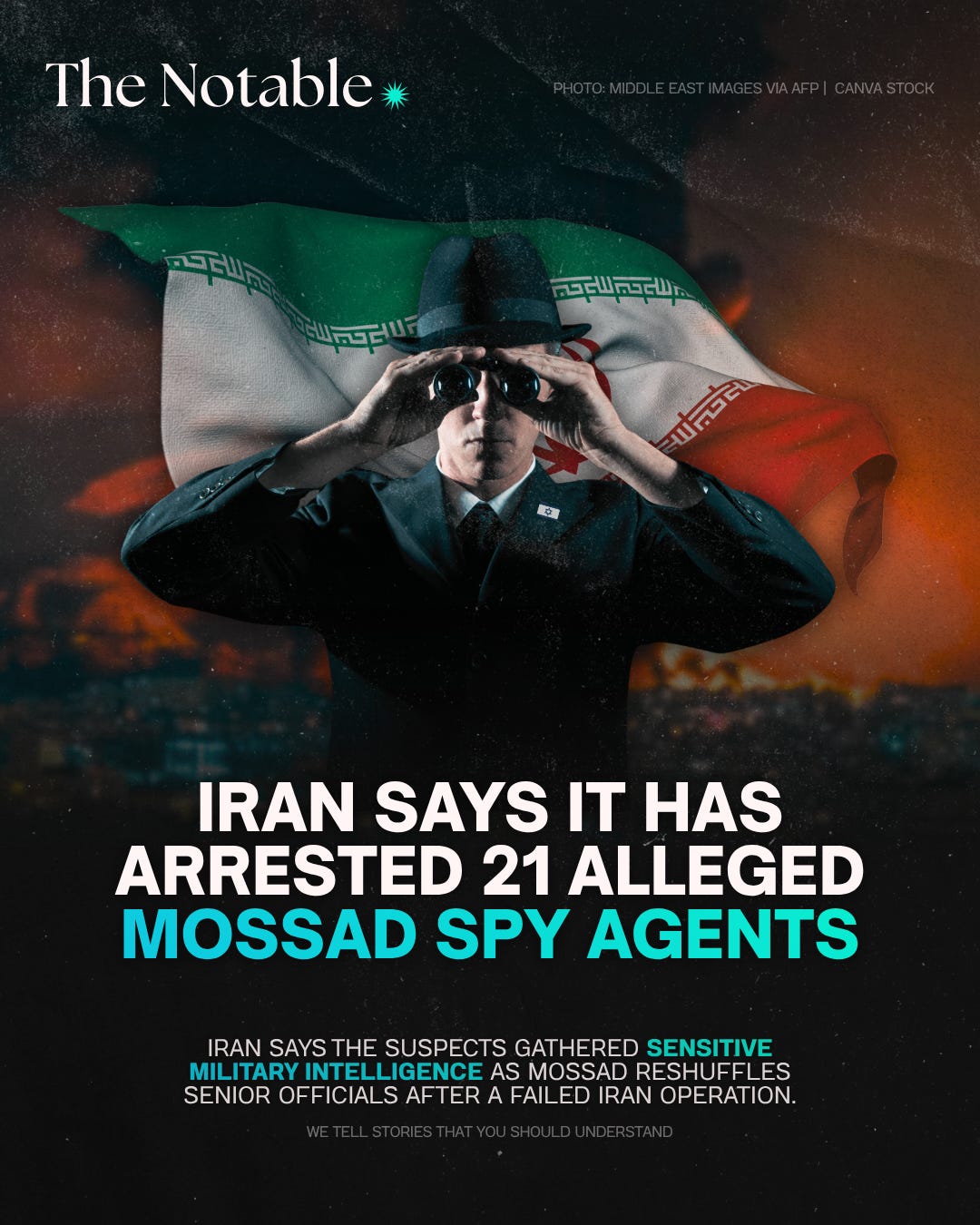
Iran says it has arrested 21 people accused of working for Israel’s Mossad and collecting sensitive information on military and air-defense sites.
The announcement came as Israeli media reported a separate development inside Mossad: its director, Roman Gofman, has removed two senior officials reportedly connected to a failed strategy aimed at destabilizing Iran’s government.
The two developments are not known to be directly connected. But occurring at the same time, they offer a rare glimpse into the continuing intelligence confrontation between Iran and Israel.
Iran Announces 21 Arrests
Iranian authorities said the 21 suspects were detained in Kerman province, accusing them of operating on behalf of Mossad and collecting sensitive information about Iranian military and air-defense installations.
Iranian authorities also announced separate arrests involving four armed suspects and five people allegedly connected to a January 2026 coup plot. Weapons were reportedly seized during the operations.
The allegations concerning the 21 suspected Mossad operatives have not been independently verified. At this stage, the arrests should therefore be understood as an Iranian government claim, rather than established evidence that those detained were Israeli intelligence agents.
That distinction matters in a conflict where both Tehran and Jerusalem have strong incentives to publicize intelligence successes and portray the other side as vulnerable.
A Mossad Leadership Shake-Up
The arrests came as Israeli reporting revealed changes at the top of Mossad’s Iran-focused operations.
Mossad chief Roman Gofman reportedly removed two senior officials, including the heads of the agency’s Intelligence Directorate and Iran division.
According to Israeli reports, the changes were linked to a failed strategy intended to undermine Iran’s Islamic Republic. The plan reportedly sought to combine Israeli military pressure with internal unrest and support for Iranian Kurdish forces.
The officials involved have not been publicly identified, and their reported removal does not necessarily mean they have left Mossad altogether. Israeli reporting indicates they could remain within the organization in other roles.
The Failed Iran Strategy
The reported strategy went beyond conventional intelligence gathering.
Israeli planners reportedly considered using the disruption created by military strikes to encourage opposition forces and minority groups inside Iran. A key element involved Iranian Kurdish armed groups operating from Iraq, which could potentially enter northwestern Iran and help trigger a broader uprising.
The objective was to create pressure on the Iranian government from multiple directions: military attacks from outside, armed opposition on the ground and wider domestic unrest.
But the Kurdish component never developed as envisioned.
Iranian military pressure, opposition from Iraqi Kurdish authorities, leaks and uncertainty over American intentions all complicated the strategy. Iraqi Kurdish leaders were reluctant to allow their territory to become a launchpad for a major ground offensive into Iran.
Reuters previously reported that the anticipated Kurdish assault failed to materialize and that U.S. policy also shifted. President Donald Trump ultimately said the United States had ruled out a Kurdish ground offensive.
Why the Kurdish Front Mattered
The Kurdish question is particularly sensitive because Iran has a substantial Kurdish population concentrated largely in the country’s northwest, near the borders with Iraq and Turkey.
Iranian Kurdish armed groups have operated from bases in Iraq for years, making them a potential pressure point in any conflict with Tehran.
For Israel, encouraging such forces could theoretically have opened another front against the Iranian government while Israeli and U.S. forces applied military pressure elsewhere.
For Iran, however, the possibility of an armed Kurdish uprising represents a major internal-security threat.
That helps explain why Tehran has historically treated Kurdish militant groups as a national-security priority and why any attempt to mobilize them during a wider conflict would carry significant strategic consequences.
Two Sides of the Same Covert War
The timing of the two developments is striking.
Iran is publicly announcing arrests it describes as a major counterintelligence success against an alleged Israeli network. At roughly the same time, Israeli reporting is revealing internal changes at Mossad following the failure of an ambitious strategy directed at Iran.
But there is no confirmed evidence that the 21 arrests caused the Mossad leadership changes, or that the two events are operationally connected.
The safer conclusion is broader: both developments demonstrate the intensity of the covert struggle surrounding Iran.
For years, Iran and Israel have conducted an undeclared intelligence conflict involving espionage, sabotage, cyber operations, assassinations, military strikes and efforts to penetrate each other’s security structures.
The conflict has become increasingly intertwined with conventional warfare.
What the Developments Reveal
The latest developments point to an important reality: military power alone is not the entire contest between Iran and Israel.
Both sides are also fighting over information, intelligence networks and the ability to disrupt the other from within.
Iran’s announcement suggests Tehran wants to demonstrate that its security services can identify and dismantle suspected Israeli networks. Israel’s reported personnel changes, meanwhile, suggest that Mossad is reassessing elements of its strategy after an operation designed to generate broader instability inside Iran failed to produce the expected outcome.
Neither development, by itself, determines the balance of power.
But together they show how the conflict has moved beyond missiles and air strikes. The struggle is also taking place inside intelligence agencies, clandestine networks and contested political spaces where success is often difficult to verify publicly.
What Remains Unclear
Several important questions remain unanswered.
Iran has not publicly provided enough independently verifiable evidence to establish that all 21 detainees were Mossad operatives. Their identities, alleged intelligence activities and the precise nature of their contacts with Israel remain unclear.
Likewise, Israeli reporting about the failed regime-change strategy provides only a partial picture of Mossad’s internal decision-making. The full scope of the plan, the extent of U.S. involvement and the reasons for the leadership changes remain difficult to establish from public information.
That uncertainty is significant.
In an intelligence war, governments routinely release information selectively. Arrests can be presented as victories, while personnel changes can be framed as routine restructuring rather than accountability for operational failures.
The facts that can currently be established are therefore narrower than the competing narratives.
The Bigger Picture
Iran says it has disrupted an alleged Mossad network. Israeli media reports that Mossad has reshuffled senior leadership following a failed strategy targeting Iran’s government.
Neither side has publicly demonstrated complete control over the intelligence battlefield.
What is clear is that the confrontation between Iran and Israel increasingly extends into the hidden architecture of national security: intelligence collection, covert operations, internal dissent, proxy forces and attempts to influence the political stability of the other state.
The arrests in Kerman and the Mossad shake-up are two separate developments. But together, they underscore the same reality: the Iran-Israel conflict is being fought not only in the skies and on the battlefield, but also in the shadows.