


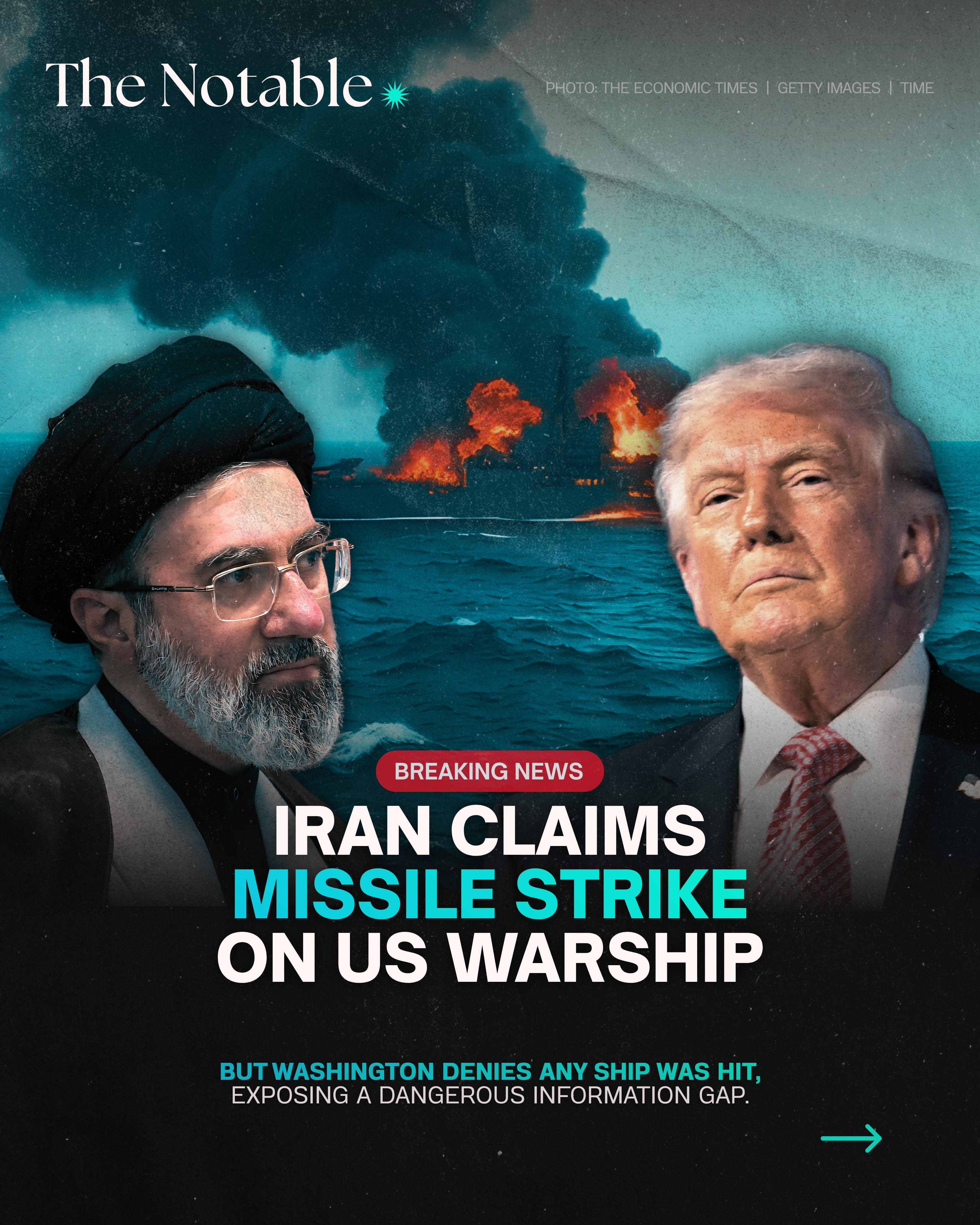
In the early hours of May 4, Iranian state-linked media reported that its forces had launched missiles at a United States warship near the Strait of Hormuz. According to Tehran’s account, the vessel had attempted to enter the strategic waterway without coordination and was forced to turn back after the strike.
Washington’s response was immediate and categorical. US officials denied that any warship had been hit, and said no such incident had taken place.
Between those two statements lies the actual story.
This is not simply a question of whether a missile struck a ship. It is a question of competing realities, in a region where perception can be as consequential as fact.
A confrontation, or a claim?
Iran’s version of events presents a clear narrative of deterrence. A foreign warship approaches a sensitive maritime boundary, ignores warnings, and is met with force. The outcome, in this telling, is controlled escalation. Iran demonstrates capability and resolve, while avoiding full-scale confrontation.
The US version removes the confrontation entirely. There was no strike, no impact, no forced retreat. Nothing occurred that would justify escalation or even recognition as an incident.
Both positions are strategically coherent.
For Iran, acknowledging action reinforces its claim to authority over access to the Strait of Hormuz, a vital corridor through which a significant portion of global oil supply passes. It signals that foreign military presence is conditional, not assumed.
For the United States, denying the incident avoids validating Iran’s narrative. To confirm that a US warship was targeted, or forced to alter course, would imply a shift in operational control in one of the world’s most critical maritime routes.
In that sense, the contradiction is not accidental. It reflects two different attempts to define reality.
The Strait of Hormuz has long functioned as a pressure point in global geopolitics. Roughly a fifth of the world’s oil consumption moves through this narrow passage. Any disruption, whether physical or perceived, carries immediate economic consequences.
What makes this moment distinct is not confirmed escalation, but unresolved ambiguity.
Markets respond not only to events, but to uncertainty. Shipping decisions, insurance costs, and military postures are all shaped by perceived risk. A reported missile strike, even if denied, introduces a new variable into an already fragile environment.
In recent weeks, tensions in the region have intensified. US efforts to secure commercial shipping routes have expanded, while Iran has reiterated that transit through the strait should not occur without its coordination. The conditions for friction are already in place.
An incident that cannot be clearly verified or dismissed adds a new layer of instability.
Power, signaling, and narrative control
At a deeper level, this episode reflects a broader dynamic in modern conflict. Power is no longer exercised only through direct confrontation, but through the ability to shape narratives in real time.
Iran’s claim projects strength and control. The United States’ denial projects stability and continuity. Both are forms of signaling, aimed at different audiences.
Regionally, Iran seeks to reinforce its position as a gatekeeper of the Gulf. Globally, the United States seeks to maintain the perception that freedom of navigation remains intact.
The involvement of political figures such as Donald Trump, alongside the influence of Iran’s internal leadership network, including Mojtaba Khamenei, adds another layer to this dynamic. Decisions are not made in isolation. They are shaped by domestic pressures, strategic priorities, and the need to maintain credibility both at home and abroad.
In this environment, acknowledging or denying an event becomes a strategic act in itself.
What matters now
The immediate question, whether a missile strike occurred, may remain unresolved.
What matters more is what follows.
If similar claims and denials continue, the risk is not only miscalculation, but normalization of ambiguity. Repeated incidents without clear verification can create a baseline of uncertainty that makes escalation more likely, not less.
In tightly contested environments like the Strait of Hormuz, clarity is stabilizing. Ambiguity is not.
For now, there is no confirmed damage, no confirmed retaliation, and no confirmed escalation.
But there are two competing versions of reality, and a strategic corridor where even perception can alter the balance.
That may be enough.