


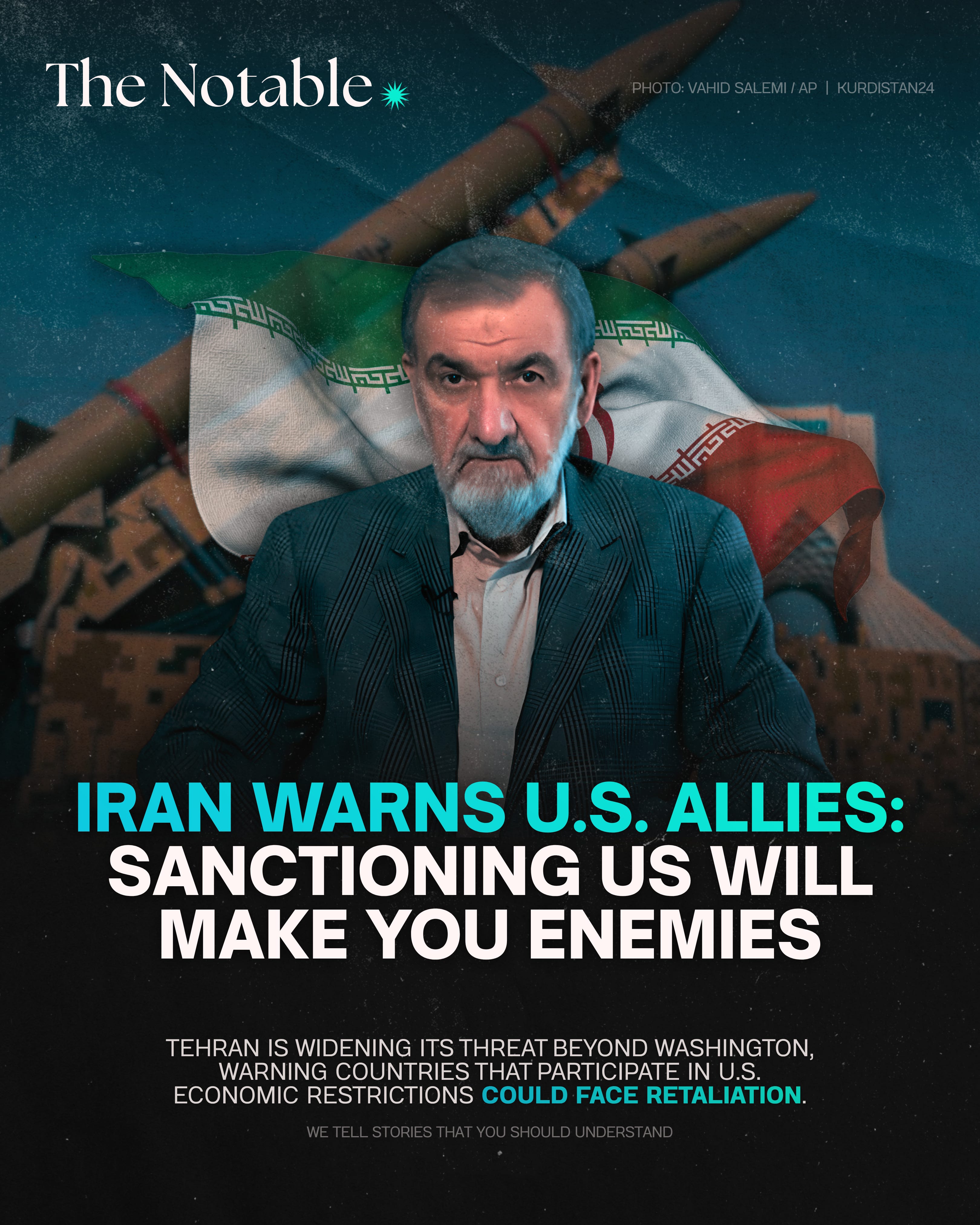
Iran has issued a sharper warning as the United States moves to intensify economic pressure on Tehran: countries that participate in U.S. sanctions could themselves be treated as enemies.
Mohsen Rezaei, secretary of Iran’s Supreme National Security Council, said countries that join U.S. economic restrictions against Iran would be considered enemies and warned that Tehran could target their interests.
The statement marks an important expansion in Iran’s rhetoric. The confrontation is no longer framed solely as a dispute between Washington and Tehran. It increasingly involves countries that trade with Iran, buy its oil or provide channels through which its economy can continue operating.
At the same time, the United States is attempting to make its sanctions campaign harder for Tehran to circumvent, creating a difficult choice for countries that maintain economic relationships with Iran.
Iran Broadens the Warning
Rezaei’s remarks were reported on August 22 as Washington prepared to introduce additional economic measures against Iran.
The warning was direct: countries that participate in U.S. economic restrictions would be considered enemies of Iran.
That distinction matters.
Iran has repeatedly threatened the United States and its regional partners during periods of confrontation. But extending the warning to countries that enforce or participate in U.S. sanctions creates another layer of pressure.
Governments now potentially face competing risks.
Supporting Washington’s sanctions strategy could expose their companies, banks and commercial interests to Iranian retaliation. Continuing to trade with Tehran, meanwhile, could expose them to U.S. sanctions or other economic penalties.
The result is a growing geopolitical contest over who will continue doing business with Iran.
Washington Is Trying to Isolate Iran Economically
The Iranian warning comes as the Trump administration prepares to increase economic pressure on Tehran.
U.S. officials have signaled that Washington wants to prevent Iran from maintaining economic lifelines through third countries. The administration has also threatened countries and companies that continue supporting Iranian trade.
Treasury Secretary Scott Bessent has indicated that the United States is preparing significant new economic measures, including potential secondary sanctions.
Secondary sanctions are particularly important because they extend the reach of U.S. policy beyond American companies.
Rather than simply prohibiting U.S. businesses from dealing with Iran, Washington can use its financial and economic leverage to pressure foreign companies and institutions to choose between maintaining business with Iran and retaining access to the U.S. financial system.
That leverage is one of Washington’s most powerful tools.
It is also precisely what Tehran is attempting to challenge.
China Is the Biggest Test
China sits at the center of the confrontation.
Beijing is one of Iran’s most important economic partners and the largest destination for Iranian oil exports. That makes Chinese participation critical to any serious attempt to economically isolate Tehran.
If Chinese companies continue purchasing Iranian oil despite American pressure, Iran retains a major source of revenue.
If Washington succeeds in significantly restricting those flows, the consequences for Iran could be much greater.
This puts China in a particularly important position. Beijing must weigh its economic relationship with Iran against its broader relationship with the United States, while also considering the strategic value of maintaining an independent relationship with Tehran.
China has previously criticized unilateral U.S. sanctions and opposed what it considers the extraterritorial application of American law.
The question is therefore not simply whether China supports Iran.
It is whether Beijing is willing to absorb the economic and diplomatic costs associated with resisting Washington’s sanctions campaign.
The UAE Has Already Taken a Significant Step
The pressure is also being felt closer to Iran.
On August 18, the United Arab Emirates announced the suspension of trade, commercial exchanges and financial transactions with Iran until further notice.
The UAE has historically been an important commercial and re-export hub for Iranian businesses, making the decision significant for Tehran.
The move came amid heightened regional tensions and military confrontation.
For Iran, losing or restricting access to important commercial channels can make sanctions evasion more difficult. For Washington, meanwhile, actions by regional governments that reduce economic links with Tehran strengthen the broader pressure campaign.
But the UAE’s decision should not automatically be interpreted as proof that every regional state is aligning with Washington.
Different governments have different security and economic interests, and many continue to maintain complicated relationships with both Iran and the United States.
Why the Threat Matters
The most important development is the potential expansion of the conflict from a bilateral confrontation into a broader economic contest.
Washington wants Iran to face increasing costs for continuing its policies. Tehran wants to ensure that those costs are not imposed without consequences for the countries helping Washington achieve that objective.
That creates a form of geopolitical pressure that can spread through trade networks.
A shipping company does not need to be Iranian to become exposed.
A foreign bank does not need to be based in the United States to face pressure.
A government does not need to be a formal military ally of Washington to become caught between competing demands.
This is what makes secondary sanctions so consequential. They can turn a U.S. foreign-policy decision into a commercial calculation for companies and governments around the world.
Iran’s response is an attempt to raise the cost of that calculation in the opposite direction.
The Strait of Hormuz Adds Another Layer
The economic confrontation is taking place against the backdrop of a much broader crisis involving the Strait of Hormuz.
The waterway is one of the world’s most important energy corridors, carrying a substantial share of global oil and liquefied natural gas shipments.
Any sustained disruption has consequences well beyond Iran.
Energy prices, shipping costs, insurance premiums and supply chains can all be affected by instability around the strait.
That means the economic pressure campaign against Tehran cannot be separated entirely from the wider regional security environment.
The more governments believe that sanctions could trigger retaliation or threaten their commercial interests, the more difficult it becomes to contain the confrontation to the U.S.-Iran relationship.
What Happens Next
The immediate question is how far Washington will go with its next round of sanctions and which countries or companies will be targeted.
The administration is expected to announce further measures, potentially increasing pressure on Iran’s trading partners.
For Tehran, the critical issue is whether its threat changes the behavior of those partners.
China will be particularly important.
If Beijing continues buying Iranian oil at scale, Iran will retain an important economic lifeline. If Chinese companies begin significantly reducing their exposure to Iran, Washington’s strategy could become considerably more effective.
Other countries will also face the same calculation, although with very different levels of economic and strategic exposure.
A Wider Test of Economic Power
The latest Iranian warning reveals the deeper struggle beneath the sanctions dispute.
The United States is using its financial power to make economic engagement with Iran increasingly costly.
Iran is attempting to convince other countries that complying with Washington will also carry a price.
The result is a contest over economic alignment.
For Washington, the objective is to constrain Iran’s ability to finance and sustain its policies.
For Tehran, the objective is to prevent isolation by keeping commercial relationships open and making participation in U.S. sanctions more dangerous.
That makes the next phase of the confrontation about more than sanctions themselves.
It is about who can persuade the rest of the world to choose their side.