


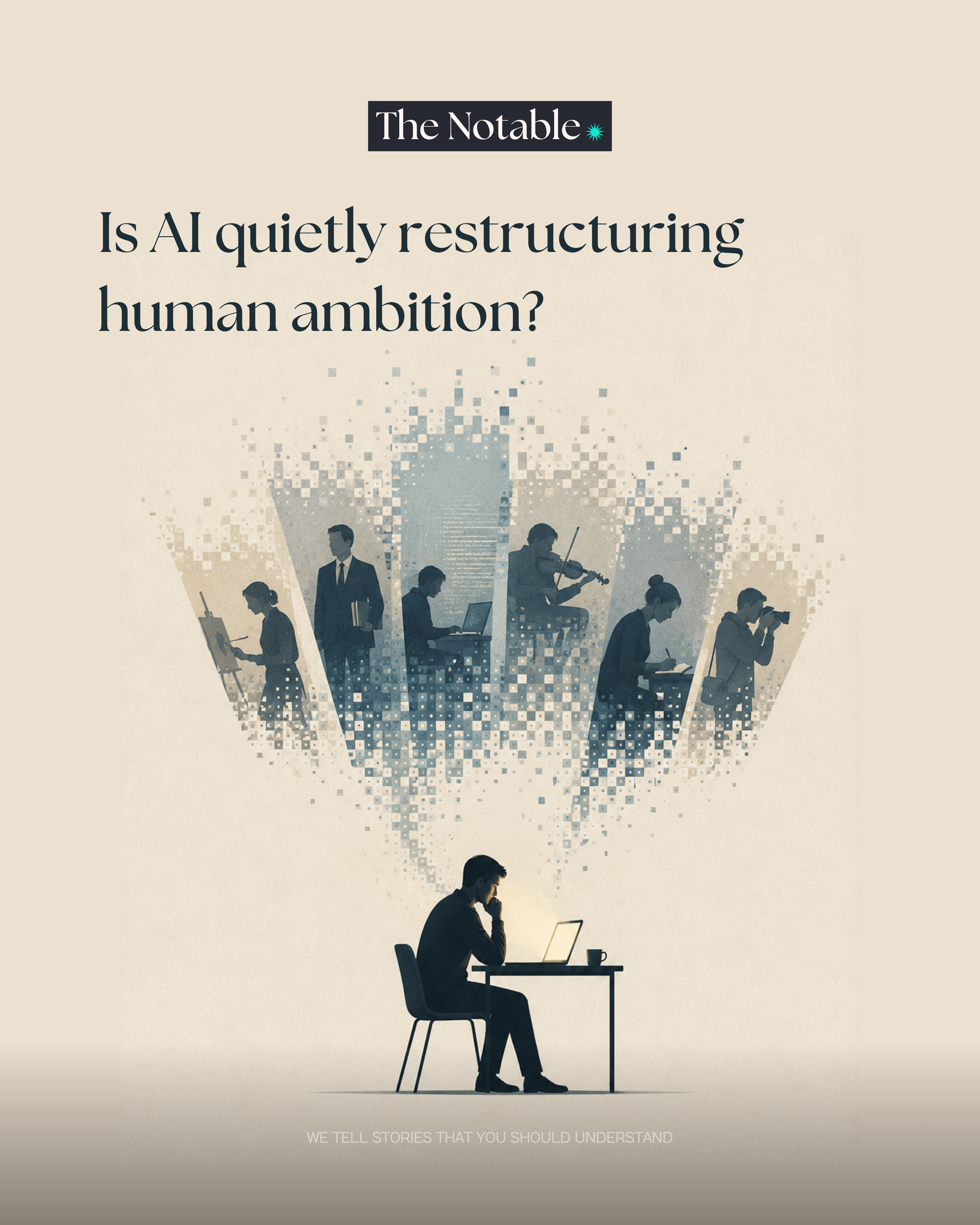
The Collapse of the Old Map
There was a time when ambition followed relatively stable rules.
Study hard. Build expertise. Climb institutions. Become difficult to replace.
For more than a century, modern economies rewarded people who specialized deeply enough to become indispensable. Lawyers mastered legal systems. Designers mastered tools. Programmers mastered code. Artists refined craft over decades. Knowledge itself became a form of security.
Artificial intelligence is beginning to destabilize that psychological contract.
Not through dramatic robot takeovers or sudden mass unemployment — at least not yet. The deeper shift is quieter, subtler, and potentially more consequential. AI is changing how people perceive the value of effort itself. It is altering what feels worth pursuing, what feels safe to master, and what kinds of futures still seem attainable.
This is not simply a labor story. It is a civilizational story about motivation, identity, and the architecture of modern aspiration.
Because ambition is not formed in isolation. It emerges from a society’s perceived opportunities. People strive when they believe effort will compound into meaning, security, recognition, or upward mobility. But when technological systems begin compressing expertise, automating entry-level pathways, and destabilizing long-term certainty, ambition itself starts to mutate.
The anxiety surrounding AI is often framed economically: Which jobs will disappear? Which industries will survive?
But beneath the economic panic is a more psychological question:
What happens to a society when people stop believing mastery guarantees relevance?
That question may define the next decade more than AI itself.
The Fear of Intellectual Commoditization
For young people especially, the shift is already visible.
Surveys increasingly show students reconsidering majors, careers, and long-term plans because of AI disruption. One large poll found that 42 percent of students say AI is influencing their career choices, while some have already changed academic direction entirely because they fear automation in their chosen field.
The timing matters.
Historically, youth optimism has been one of modern capitalism’s invisible fuels. Each generation believed new industries would create new ladders. The industrial era created engineers. The internet created founders, creators, and coders. Even amid disruption, technological revolutions usually expanded the imagination of what was possible.
AI feels different because it appears to target cognition itself.
Previous automation waves mechanized muscle. AI increasingly mechanizes portions of thinking, analysis, synthesis, design, writing, coding, and decision-making — the very domains modern educated classes were told would remain uniquely human.
That changes the emotional experience of ambition.
The old fear among workers was physical replacement. The emerging fear is intellectual commoditization.
A young lawyer no longer wonders only whether law remains prestigious. They wonder whether junior legal work will still exist long enough to justify the sacrifice. A designer wonders whether originality retains value in an economy flooded with machine-generated aesthetics. A programmer wonders whether years spent mastering syntax still produce leverage if AI can generate functional code instantly.
The result is not necessarily paralysis. But it is recalibration.
Across industries, people are beginning to optimize less for passion and more for survivability.
That may sound rational. In many ways, it is. But societies shaped primarily by defensive ambition behave differently from societies driven by expansive ambition. Innovation slows when individuals become psychologically cautious. Risk-taking narrows. People gravitate toward fields perceived as AI-resistant rather than intrinsically meaningful.
The Strange Paradox of the AI Economy
And yet the paradox of the AI era is that it may simultaneously suppress and expand ambition at the same time.
Every technological revolution destroys certain aspirations while creating entirely new ones.
The Industrial Revolution displaced artisans but created engineers, industrialists, and mass production economies. The internet destroyed some traditional industries while creating software empires, influencer culture, and the digital economy. Entire categories of ambition emerged that previous generations could not have imagined.
AI is already producing similar dynamics.
New forms of prestige are emerging around prompt engineering, AI systems design, automation strategy, synthetic media, and human-AI collaboration. Companies are rapidly building AI-focused executive roles. Entire startup ecosystems are forming around the orchestration of intelligence rather than the production of labor itself.
But there is a critical difference between previous technological shifts and this one:
AI evolves faster than institutional adaptation.
Education systems still largely train people for linear careers inside stable professional categories. But AI rewards adaptability, interdisciplinary thinking, and continuous reinvention. Universities were designed for credentialing within relatively predictable labor markets. AI is accelerating toward a world where static expertise depreciates faster than institutions can update curricula.
This creates a dangerous psychological lag.
People are still using twentieth-century models of ambition inside twenty-first-century technological conditions.
The consequence is rising uncertainty about what kind of effort actually compounds over time.
When Expertise Stops Feeling Safe
That uncertainty matters more than most policymakers realize.
Economic systems depend not only on labor, but on belief. They require populations willing to invest years into deferred rewards. Study now. Sacrifice now. Train now. Stability will come later.
But AI destabilizes the timeline between effort and reward.
If skills become obsolete rapidly, individuals may begin prioritizing flexibility over mastery. If AI can replicate competent output instantly, societies may place less value on depth and more value on speed, adaptation, visibility, and network positioning.
This could fundamentally reshape status hierarchies.
For centuries, expertise was scarce because knowledge acquisition was slow. AI dramatically lowers the cost of functional competence. The future premium may shift away from possessing information toward asking better questions, synthesizing ambiguity, exercising judgment, and generating trust.
Ironically, the more intelligence becomes abundant, the more human discernment may become valuable.
But transitions between economic eras are rarely psychologically smooth.
There is already evidence that younger generations feel increasingly conflicted about AI. Excitement is giving way to skepticism and anxiety, particularly among Gen Z workers confronting unstable labor expectations early in adulthood.
That emotional shift reflects something deeper than fear of unemployment.
It reflects fear of irrelevance.
Modern identity became heavily intertwined with professional achievement. In many societies, careers evolved beyond economic necessity into sources of meaning, self-worth, and social legitimacy. People increasingly define themselves by what they produce intellectually.
AI complicates that relationship.
When machines can generate writing, music, designs, strategy memos, code, and visual art in seconds, people begin questioning not only economic value, but existential distinctiveness.
What remains uniquely human in a world where intelligence itself becomes partially industrialized?
The Creativity Crisis Beneath the AI Boom
That question is quietly restructuring creative ambition too.
Some creators feel liberated by AI tools that accelerate experimentation and remove technical friction. Others feel psychologically diminished by the infinite scalability of synthetic output. The issue is not whether AI-generated work can technically imitate creativity. The issue is what happens to human motivation when creative expression no longer feels scarce.
Scarcity has always shaped prestige.
Part of what made mastery admirable was the visible investment required to achieve it. AI compresses that visible effort. A generation raised on instant generation tools may increasingly struggle to distinguish between expression and craftsmanship, between producing content and developing depth.
This does not mean human creativity disappears. But it may mean society’s relationship with effort changes profoundly.
And that may become one of AI’s most underappreciated consequences.
Because civilizations are shaped not only by what technology enables, but by what technology incentivizes.
Social media already altered ambition by rewarding visibility over expertise. Virality became a faster route to recognition than institutional accomplishment. AI could intensify this dynamic further by accelerating the production of mediocre abundance. When content becomes infinite, attention becomes even more valuable. And when attention becomes the dominant currency, ambition shifts toward whatever captures algorithms most effectively.
That risks producing a culture optimized less for excellence than for perpetual visibility.
The Return of Human Value
Yet there is another possible outcome.
AI may ultimately force societies to rediscover distinctly human capacities that industrial systems undervalued for decades: emotional intelligence, ethical judgment, taste, interpretation, leadership, trust-building, and meaning-making.
The more machines handle routine cognition, the more human advantage may reside in navigating ambiguity, emotion, and complexity.
In that sense, AI may not eliminate ambition. It may redefine what ambitious people aspire to become.
The deeper question is whether institutions can adapt quickly enough to guide that transition constructively.
Because technological revolutions do not automatically produce broad prosperity. They produce instability first. The winners are usually societies that redesign education, labor systems, and cultural expectations before social fragmentation accelerates.
At stake is not merely employment.
It is whether modern societies can preserve a sense of future orientation in an era where certainty is collapsing.
Ambition is ultimately a story people tell themselves about tomorrow. It is the belief that effort still matters. That becoming better still changes outcomes. That human potential still has direction.
AI is beginning to rewrite that story.
Quietly. Unevenly. But profoundly.