


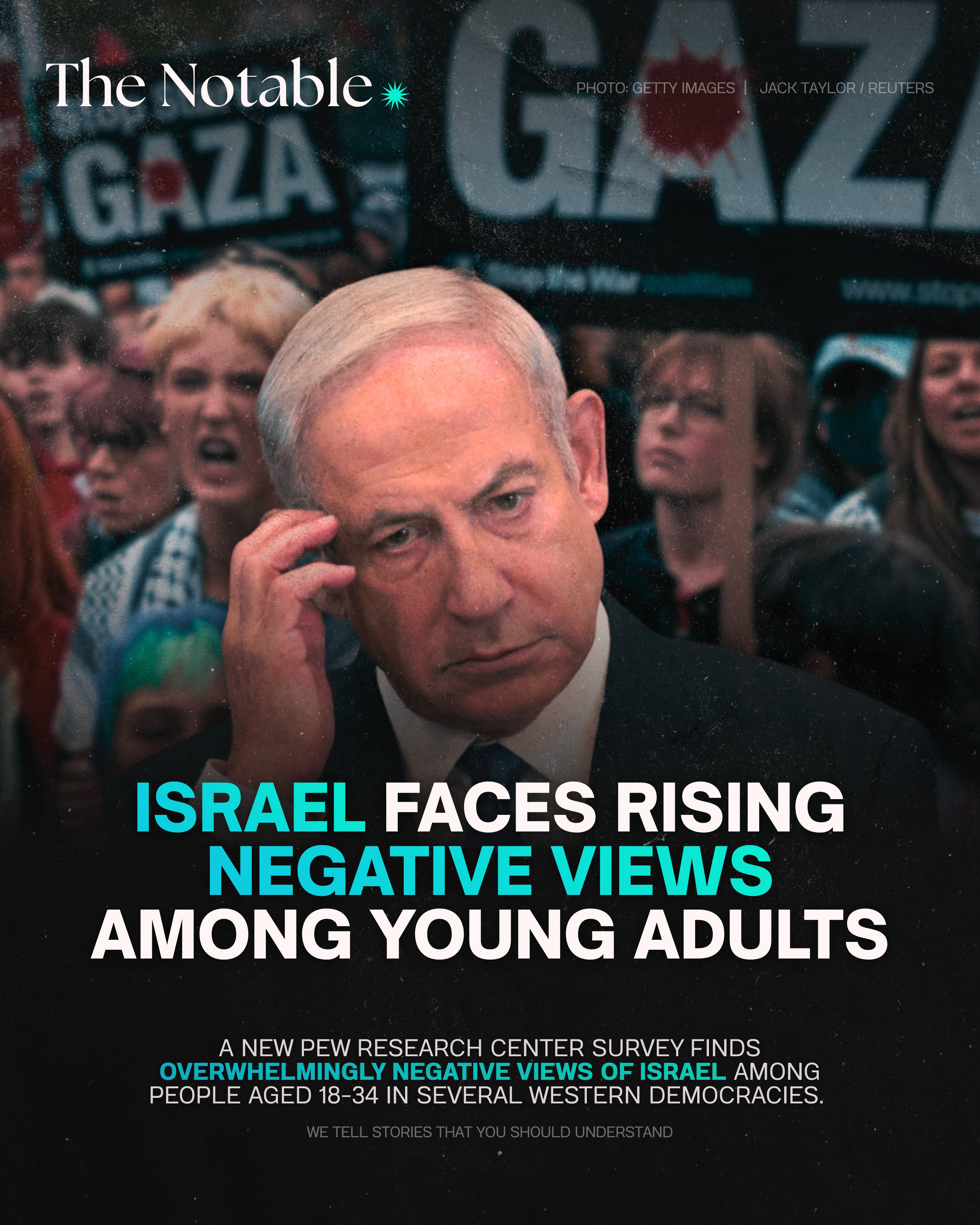
A new global survey suggests Israel may be facing a challenge that extends far beyond diplomacy, military strategy, or the current conflict in the Middle East.
It may be losing the next generation.
According to the latest Spring 2026 Global Attitudes Survey from the Pew Research Center, unfavorable views of Israel have reached striking levels among young adults across much of the Western world. Among people aged 18 to 34, negative perceptions now dominate in several major democracies, revealing a generational shift that could shape international politics for decades.
The numbers are difficult to ignore.
In Australia, 87% of young adults surveyed reported an unfavorable view of Israel. The figure reached 78% in the United Kingdom, 76% in Canada and Greece, 74% in France, and 74% in the United States.
While criticism of Israel is not new, the scale of these findings suggests something deeper may be taking place. In many countries, younger generations are substantially more negative toward Israel than older citizens, creating one of the largest age gaps in international public opinion on a major geopolitical issue.
The trend did not emerge overnight.
Since the outbreak of the Gaza war following the October 7, 2023 Hamas attacks, Israel has faced sustained international scrutiny. Images of destruction in Gaza, debates over civilian casualties, humanitarian concerns, and widespread protest movements have reshaped public discourse across universities, social media platforms, and political institutions.
For many younger people, the conflict has become a defining political issue.
The Pew survey suggests these attitudes are no longer confined to activist circles. They are increasingly reflected in mainstream public opinion.
Importantly, the findings are not limited to younger demographics. Pew also found that overall unfavorable views of Israel increased further between 2025 and 2026 in several major countries, including the United States, Canada, Australia, Germany, Italy, and the United Kingdom.
Yet the youth numbers stand out because they may offer a glimpse into the future.
Public opinion among younger generations often influences the direction of political parties, foreign policy debates, cultural institutions, and media narratives over time. As today’s young adults become tomorrow’s voters, lawmakers, journalists, executives, and opinion leaders, their views can gradually reshape the broader political landscape.
This does not necessarily mean support for Israel will disappear. Public attitudes can change, especially as conflicts evolve and new events reshape perceptions.
But the survey points to a growing challenge for Israel’s international image.
For decades, Israel maintained strong reservoirs of support across many Western societies. The latest data suggests that foundation may be weakening among younger generations.
The significance of that shift extends beyond the current conflict.
Governments can negotiate treaties. Militaries can win battles. Economies can recover from crises.
Rebuilding public legitimacy, particularly among an entire generation, is often far more difficult.
And that may be the deeper story emerging from Pew’s latest findings.