


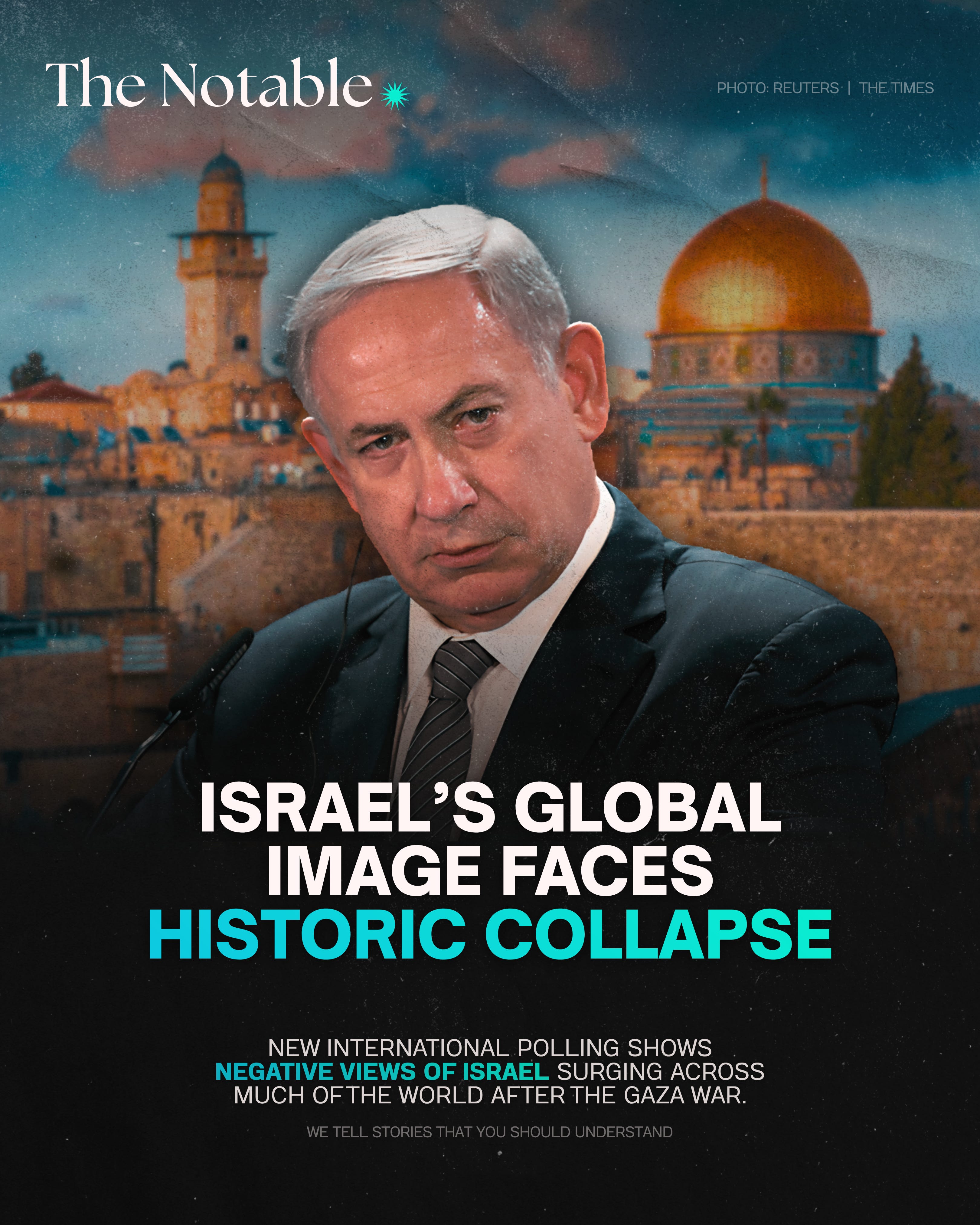
For decades, Israel maintained strong diplomatic and public support across much of the Western world. Even during periods of conflict, many governments and populations continued viewing Israel primarily through the lens of security, terrorism, and regional instability.
That consensus is now rapidly breaking down.
New international polling shows unfavorable views of Israel rising sharply across multiple regions following the Gaza war, marking one of the most dramatic reputational declines any modern state has experienced in such a short period of time.
The viral claim circulating online that Israel has become “97.55% hated globally” remains unverified and unsupported by major polling institutions. No credible organization has published data confirming that figure.
But the broader trend behind the viral narrative is real.
Israel’s global image has deteriorated significantly since the October 7 Hamas attacks and the Israeli military campaign that followed in Gaza. The shift is becoming increasingly visible not only in public opinion surveys, but also in diplomacy, protests, media narratives, university politics, and international institutions.
A Global Opinion Shift
Recent surveys from organizations including Pew Research Center show unfavorable views of Israel reaching record highs in many countries.
In parts of Europe, Asia, Latin America, and the Middle East, negative perceptions have intensified as the war continued and images from Gaza spread globally through television coverage and social media platforms.
The humanitarian dimension of the conflict became central to international opinion. Rising civilian casualties, destroyed infrastructure, displacement, and repeated warnings from humanitarian organizations transformed the war into a broader moral and political issue far beyond the Middle East.
The debate increasingly shifted from Israel’s right to defend itself after October 7 toward questions surrounding proportionality, civilian protection, international law, and long-term occupation.
This transition fundamentally changed how the conflict was perceived globally.
The Social Media Effect
Unlike previous Middle East wars, the Gaza conflict unfolded in an era dominated by TikTok, Instagram, X, Telegram, and decentralized information ecosystems.
Graphic footage, firsthand accounts, livestreams, and activist-driven narratives circulated globally in real time, often bypassing traditional media gatekeepers.
For younger audiences especially, social media became the primary lens through which the conflict was understood.
That matters because younger generations in many Western countries appear significantly more critical of Israel than older populations. The divide is becoming increasingly visible in polling data, protests, universities, and political movements.
In many countries, governments remained broadly supportive of Israel while large segments of the public moved sharply in the opposite direction.
This emerging gap between state policy and public sentiment may become one of the conflict’s most important long-term consequences.
Diplomatic Fallout Is Growing
The reputational crisis is no longer confined to public opinion.
International pressure on Israel has intensified across diplomatic and legal arenas.
Several countries moved toward recognizing a Palestinian state. International courts and legal bodies faced growing pressure to investigate allegations tied to the war. Protest movements and boycott campaigns expanded across major cities worldwide.
Even some of Israel’s traditional allies have become increasingly critical of the scale and conduct of the military campaign.
While governments continue balancing strategic alliances and domestic political realities, the political cost of openly aligning with Israel has risen considerably in many democracies.
For Israeli leadership, this creates a difficult strategic dilemma.
Military objectives may still be pursued, but the country’s international legitimacy and soft power are facing sustained erosion.
More Than A Middle East Story
What is happening extends beyond Israel and Gaza alone.
The conflict has become a symbol of a much larger global transition involving information power, generational politics, Western credibility, and the fragmentation of international consensus.
Across much of the Global South, many populations increasingly view Western responses to conflicts through the lens of double standards. Comparisons between reactions to Ukraine and Gaza became common across political discourse online.
At the same time, social media has weakened the traditional ability of governments and legacy institutions to shape dominant global narratives during wartime.
Public perception now evolves faster, more emotionally, and more globally than in previous eras.
That shift may permanently change how future wars are politically judged.
The “97.55%” Claim
The viral statistic claiming Israel became “97.55% hated globally” appears to have originated from social media posts and politically aligned commentary accounts rather than transparent polling data.
No major polling institution including Pew, Gallup, Ipsos, or YouGov has published such a figure or methodology.
Still, the popularity of the claim itself reflects something important: the scale of the reputational collapse many people now perceive Israel to be experiencing internationally.
In that sense, the viral number functions less as verified data and more as a symbol of a rapidly changing global mood.
What Comes Next
The long-term consequences remain uncertain.
Wars eventually end. Reputational crises often last much longer.
Israel still maintains powerful alliances, strong military capabilities, and deep institutional ties with the United States and Europe. But international perception matters in the modern geopolitical environment, especially in democracies shaped by public opinion and digital narratives.
The Gaza war may ultimately be remembered not only as a military conflict, but as a turning point in how much of the world views Israel, Western power, and the international order itself.
The deeper question now is not simply whether Israel can win militarily.
It is whether it can restore legitimacy in a world where global narratives are changing faster than governments can control them.