


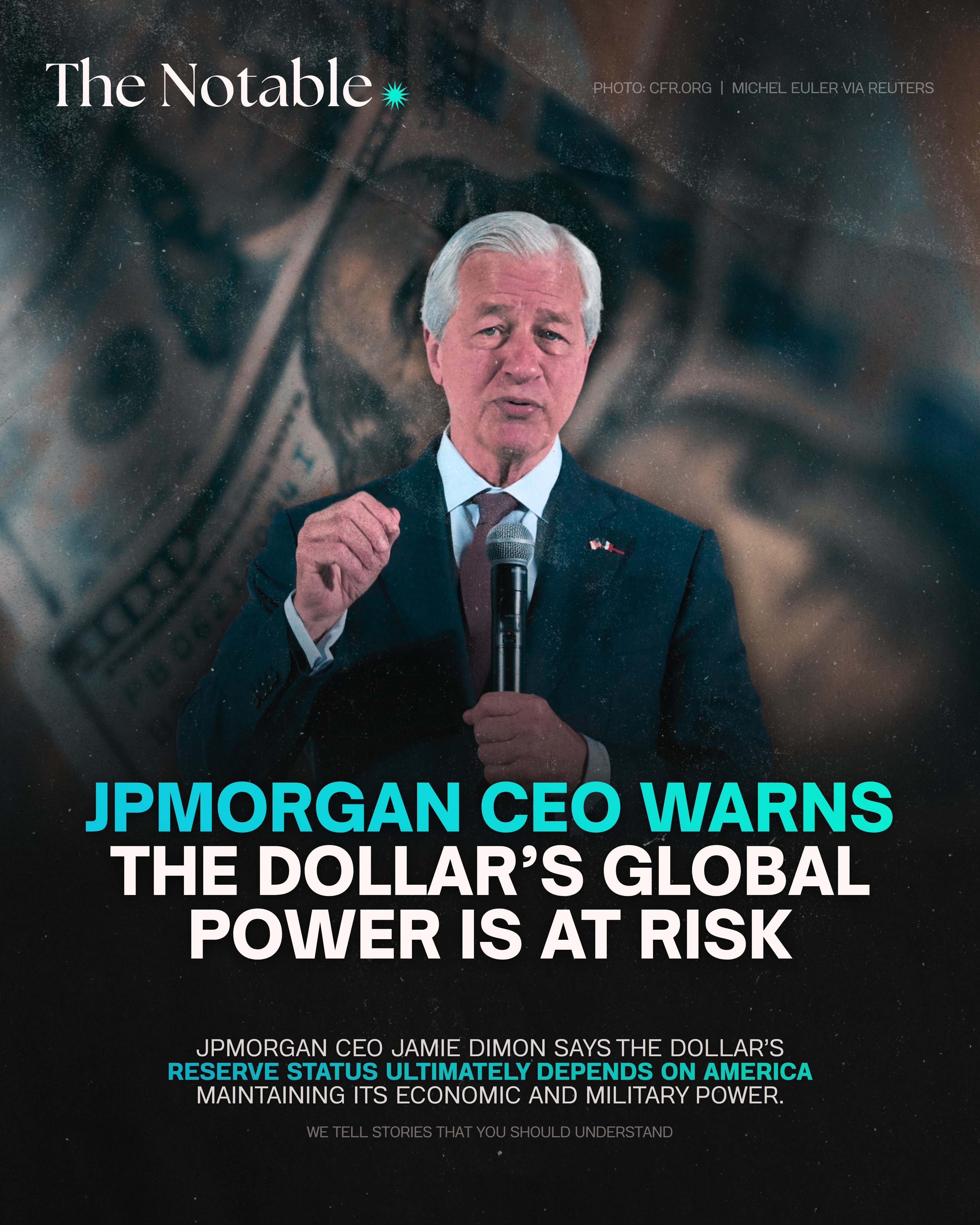
The warning is significant because the dollar remains the dominant currency in global finance. There is no immediate evidence that the United States is about to lose its reserve-currency position. But Dimon argues that the foundations supporting that position cannot be taken for granted.
His concern is not simply about the dollar. It is about whether the United States can preserve the broader system of power that makes the dollar so difficult for the rest of the world to replace.
Dimon’s Warning
In a recent appearance on PBS’s Firing Line with Margaret Hoover, Dimon reiterated his view that the dollar’s privileged global position ultimately rests on American strength.
His argument is straightforward: if the United States were to lose its position as the world’s leading economic and military power, the dollar could eventually lose its status as the world’s primary reserve currency.
That is a long-term warning, not a prediction of an imminent dollar collapse.
Dimon has made versions of this argument before. His concern is that America’s financial advantages depend on deeper foundations, including economic strength, military capability, institutional credibility, deep capital markets and global confidence in the United States.
The dollar is powerful partly because America is powerful.
The Dollar Is Still Dominant
The current data provide an important counterweight to the headlines surrounding Dimon’s comments.
According to the International Monetary Fund’s latest COFER data, the U.S. dollar represented 57.13% of allocated global foreign-exchange reserves in the first quarter of 2026.
That is lower than the dollar’s share during the late 20th and early 21st centuries, but it remains far ahead of any competing currency.
The euro is the second-largest reserve currency, while China’s renminbi remains a relatively small component of global official reserves.
The dollar’s importance is even clearer in foreign-exchange markets.
According to the Bank for International Settlements’ latest triennial survey, the dollar was on one side of 89.2% of all foreign-exchange transactions in April 2025.
That makes the dollar much more than America’s national currency. It is the central medium through which much of the global financial system operates.
So Why Is There Concern?
Because dominance and permanence are not the same thing.
The dollar’s share of global reserves has gradually declined from its levels around the turn of the century. At the same time, central banks have increased diversification into other currencies and, particularly, gold.
The shift has encouraged a growing debate over de-dollarization.
China and other governments have sought to reduce their exposure to the U.S. financial system. Some countries have increased the use of their own currencies in bilateral trade. Russia has sharply reduced its use of the dollar following Western sanctions.
But these developments should not be confused with the emergence of a credible replacement for the dollar.
The global financial system is not simply choosing between the dollar and another currency. The real question is whether another currency can reproduce the enormous ecosystem surrounding the dollar.
That is a much harder task.
What Makes the Dollar So Difficult to Replace?
Reserve-currency status is not determined simply by the size of an economy.
A country needs deep and liquid financial markets, a large supply of safe and trusted assets, reliable institutions, an open financial system and confidence that capital can move in and out without arbitrary restrictions.
The United States possesses these advantages at extraordinary scale.
U.S. Treasury securities sit at the center of global finance. The dollar is widely used in international trade, banking, debt issuance and foreign-exchange transactions. Global investors also have access to a financial market substantially larger and more liquid than those available in most competing currencies.
This creates a powerful network effect.
The more international businesses, banks and governments use dollars, the more useful dollars become to everyone else.
That makes replacing the currency extremely difficult even when countries have political reasons to reduce their dependence on it.
China Is the Most Important Challenger, But Not Yet a Replacement
China is central to the debate because it possesses the economic scale and geopolitical ambition to challenge aspects of the U.S.-led financial system.
Beijing has expanded the international use of the renminbi and promoted alternative payment and settlement arrangements. It has also strengthened economic relationships with countries that want to reduce their exposure to U.S. financial power.
But the renminbi still occupies a relatively small position in global reserves and foreign-exchange markets compared with the dollar.
China also maintains extensive controls over capital flows, which limits the renminbi’s ability to function as a truly global reserve asset on the same scale as the dollar.
That does not make the challenge irrelevant.
It means the more plausible scenario is gradual diversification, rather than a sudden replacement of the dollar by the renminbi.
Dimon’s Bigger Concern Is American Power
This is where Dimon’s argument becomes more interesting than a conventional debate about currencies.
His warning connects the dollar to the wider architecture of American power.
The United States does not maintain the dollar’s global position because other countries simply prefer American money. The system has developed around decades of American economic leadership, military reach, technological strength, financial depth and institutional influence.
If those foundations weaken substantially, the dollar could eventually become less indispensable.
That is why Dimon has also raised concerns about America’s industrial capacity, supply-chain vulnerabilities and dependence on foreign sources for strategically important materials.
From this perspective, currency power is an outcome of national power, not an isolated financial phenomenon.
The Fiscal Problem
Another part of the equation is America’s fiscal position.
The United States has accumulated a large and growing federal debt, while interest costs place increasing pressure on the government’s finances.
Dimon has repeatedly warned that America’s fiscal trajectory deserves serious attention.
The concern is not simply that high debt automatically destroys a currency. It does not.
The more important question is whether investors eventually begin to doubt the government’s ability or willingness to maintain sustainable fiscal policies.
So far, the evidence does not show a collapse in confidence.
U.S. Treasuries remain among the world’s most important safe assets, and the dollar continues to dominate international finance.
But persistent fiscal deterioration can become a strategic problem if it begins to undermine confidence in America’s long-term economic management.
Military Power Matters Too
Dimon’s argument also highlights an often-overlooked reality: the international monetary system exists within a geopolitical system.
The United States has maintained unmatched military reach for decades.
That power does not directly determine the dollar’s exchange rate or reserve share. But it forms part of the broader geopolitical architecture that supports American influence.
For Dimon, therefore, the relationship runs in both directions.
Economic power supports military strength. Military strength reinforces geopolitical influence. Geopolitical influence supports the international financial system.
The dollar sits inside that larger structure.
This Is Not the End of the Dollar
It is important not to overstate Dimon’s warning.
The latest data do not show that the dollar is on the verge of losing reserve-currency status.
The dollar still represents more than half of global allocated foreign-exchange reserves. It remains involved in nearly nine out of every ten foreign-exchange transactions. There is also no competing currency that currently offers the same combination of market depth, liquidity, institutional infrastructure and global usage.
The more realistic possibility is a gradual evolution toward a more diversified monetary system.
The dollar could remain dominant while losing some share.
More countries could hold gold. Regional currencies could become more important for trade. The renminbi could gain a larger international role. Alternative payment systems could expand.
None of those developments necessarily means the dollar has been displaced.
The Real Question Is American Strength
Dimon’s warning ultimately points toward a much bigger question than whether another currency can overtake the dollar.
It is whether the United States can maintain the foundations that made the dollar dominant in the first place.
That means controlling debt without destabilizing markets. Maintaining deep and trusted financial institutions. Preserving technological and industrial competitiveness. Securing critical supply chains. Maintaining military capabilities. And, perhaps most importantly, preserving international confidence in American institutions.
The dollar’s position has survived wars, financial crises and major shifts in the global economy.
But reserve currencies do not remain dominant forever.
The British pound once occupied a position comparable to the dollar’s today. Its decline was not caused by a single event. It reflected a broader shift in economic and geopolitical power.
That is the historical lesson behind Dimon’s warning.
America does not need to lose the dollar for its global power to weaken. But if American power were to weaken substantially over a long period, the dollar would eventually face the consequences.
For now, the dollar remains firmly at the center of global finance.
The question is whether the United States can keep the power that keeps it there.
The Notable Perspective
The dollar’s greatest advantage is not simply that the world uses it. It is that the world has built an enormous financial system around American power.
That makes de-dollarization difficult.
It also makes Dimon’s warning worth watching.
The real risk is not an overnight collapse of the dollar. It is a slow erosion of the economic, institutional and geopolitical advantages that have made the dollar indispensable for generations.
The currency may be the visible symbol of American financial power.
But the deeper story is American power itself.