


For decades, NATO’s nuclear deterrent has remained concentrated in Western Europe.
That may be starting to change.
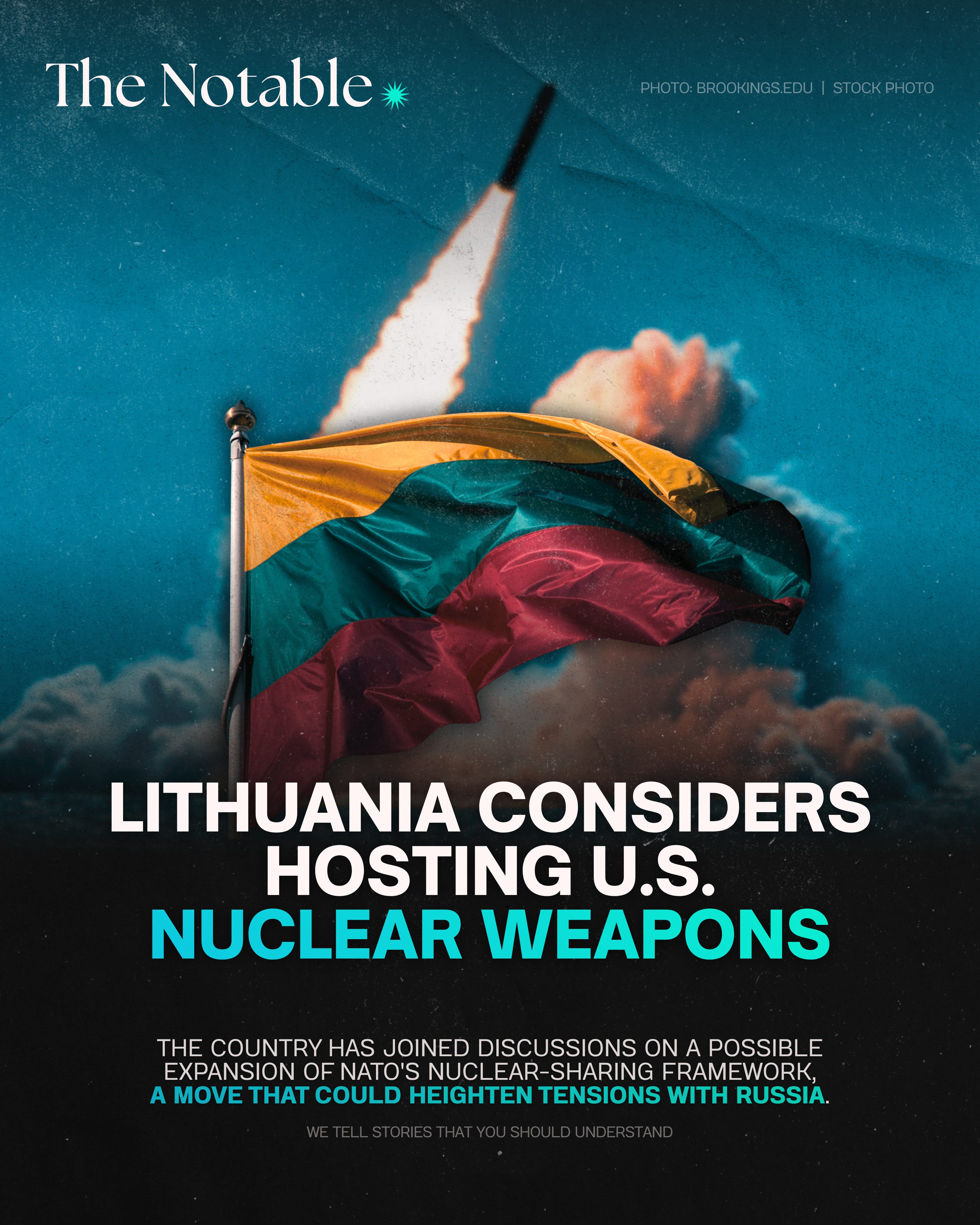
Lithuania has confirmed that it is participating in discussions regarding a possible expansion of NATO’s nuclear-sharing framework, raising the prospect that U.S. nuclear weapons could one day be stationed on the alliance’s eastern flank, much closer to Russia’s borders.
No deployment has been approved, and no agreement has been announced. But the discussions themselves are significant.
They suggest that European security planners are increasingly willing to reconsider long-standing assumptions about where NATO’s most sensitive military assets should be located.
What Happened?
The story emerged after reports indicated that Washington is exploring whether additional NATO members could participate in nuclear-sharing arrangements beyond the countries that currently host elements of the alliance’s nuclear deterrent.
Lithuanian officials later confirmed that the country is involved in those discussions.
The details remain largely classified, and neither Washington nor NATO has announced any formal decision. However, the confirmation marks one of the clearest indications yet that the alliance is considering options that would have been politically difficult to imagine before Russia’s full-scale invasion of Ukraine.
At present, NATO’s nuclear-sharing system is centered primarily in Western Europe. Any future expansion eastward would represent a notable shift in the alliance’s strategic posture.
The Constitutional Barrier
Despite the attention surrounding the discussions, an actual deployment would face major obstacles.
Lithuania’s constitution currently prohibits weapons of mass destruction on its territory. Any attempt to host nuclear weapons would likely require legal and constitutional changes before a deployment could even be considered.
Some Lithuanian political figures have already suggested that these restrictions should be reviewed in light of the deteriorating security environment in Eastern Europe.
That debate remains in its early stages, but it highlights how seriously parts of Lithuania’s political establishment are treating the possibility.
Why Lithuania Matters
Lithuania occupies one of NATO’s most strategically sensitive positions.
The Baltic nation borders Belarus, Russia’s closest military ally, and lies near Russia’s heavily militarized Kaliningrad exclave on the Baltic Sea.
For years, Lithuania has been among the strongest advocates for a tougher NATO posture toward Moscow. Since Russia launched its invasion of Ukraine in 2022, concerns about regional security have only intensified.
From Vilnius’ perspective, stronger deterrence is not an abstract strategic concept. It is viewed as a matter of national security.
That is one reason why discussions that might once have seemed politically impossible are now receiving serious consideration.
A Potential Turning Point for NATO
The broader significance of this story extends beyond Lithuania itself.
Since the end of the Cold War, NATO’s nuclear arrangements have largely reflected a Europe divided between a relatively secure West and a more vulnerable East. Russia’s invasion of Ukraine has challenged many of those assumptions.
Across Europe, governments are increasing defense spending, expanding military cooperation, and reassessing long-standing security policies. Countries that once viewed major conflict as unlikely are preparing for a far more uncertain future.
The discussion over nuclear deployments fits into that larger trend.
Whether or not nuclear weapons are ever stationed in Lithuania, the fact that such a possibility is being openly discussed demonstrates how dramatically Europe’s security landscape has changed.
What Happens Next?
For now, the talks remain exploratory.
No deployment has been approved, and no timeline exists for any future decision. Political, legal, and diplomatic hurdles remain substantial.
Yet the discussions themselves reveal an important reality: NATO is actively evaluating how to adapt its deterrence strategy to a security environment that looks very different from the one that existed even a few years ago.
If Lithuania eventually becomes part of NATO’s nuclear-sharing framework, it would mark one of the most consequential changes in the alliance’s military posture since the end of the Cold War.
And even if it does not, the conversation alone signals how rapidly Europe is entering a new strategic era.