


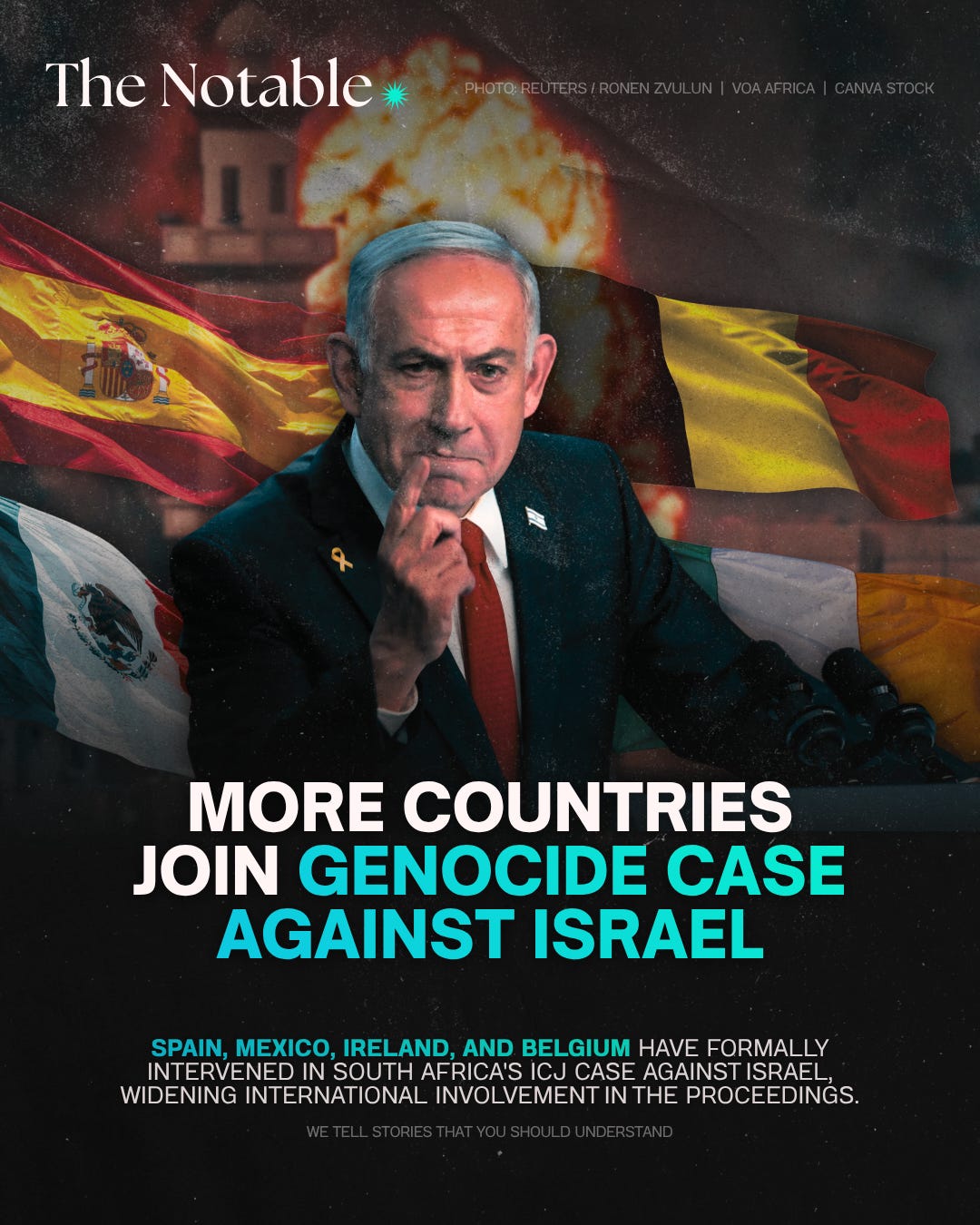
The legal battle over Israel’s military campaign in Gaza has entered another significant phase.
Spain, Mexico, Ireland, and Belgium have each formally intervened in South Africa’s case against Israel before the International Court of Justice (ICJ), adding their legal perspectives to proceedings that could have lasting implications for international law. Their interventions do not make them co-plaintiffs, nor do they determine the outcome of the case. Instead, they reflect growing international interest in how the ICJ interprets one of the world’s most important human rights treaties.
As the proceedings continue, the expanding list of participating states underscores that the case is no longer viewed solely as a dispute between South Africa and Israel. Increasingly, it is becoming a broader test of how the international community understands and applies the Genocide Convention.
Understanding the Case
The case began on 29 December 2023, when South Africa filed an application before the International Court of Justice, alleging that Israel had violated its obligations under the 1948 Convention on the Prevention and Punishment of the Crime of Genocide during its military campaign in the Gaza Strip.
South Africa argues that Israel’s military operations, restrictions on humanitarian assistance, and public statements by some Israeli officials amount to violations of the Convention. It has asked the Court to declare that Israel breached its treaty obligations and to order measures aimed at preventing further violations.
Israel strongly rejects the allegations. It argues that its military campaign is a lawful exercise of self-defense following Hamas’ attacks on 7 October 2023 and maintains that it takes steps to comply with international humanitarian law while targeting Hamas, not the Palestinian population.
The ICJ has not ruled on whether genocide has occurred. The proceedings remain in the written phase, and a final judgment is widely expected to take several years.
What Spain, Mexico, Ireland, and Belgium Have Done
Rather than joining South Africa as additional applicants, the four countries have intervened under Article 63 of the ICJ Statute.
Article 63 allows any state that is party to a treaty under interpretation to participate in a case if the Court’s interpretation of that treaty could affect its own legal rights and obligations in the future.
In practical terms, intervention gives these governments the opportunity to submit legal observations on how they believe the Genocide Convention should be interpreted. They do not assume control over the case, introduce new claims, or vote on the Court’s final decision.
The distinction is important. Intervention is a procedural mechanism designed to ensure that states whose treaty obligations may be affected by the Court’s interpretation have an opportunity to present their legal views.
For that reason, describing these countries as having “joined the genocide case” can be misleading. They have joined the proceedings only to the extent permitted under Article 63, not as new plaintiffs.
Why These Interventions Matter
Although interventions do not change the parties to the dispute, they carry political and legal significance.
Every additional state choosing to intervene signals that the Court’s interpretation of the Genocide Convention is viewed as having consequences well beyond the conflict in Gaza. The Convention is one of the foundational treaties of modern international law, and any authoritative interpretation by the ICJ will influence how states understand their obligations in future situations involving allegations of genocide.
The growing number of interventions also demonstrates that governments increasingly view the proceedings as setting important legal precedents rather than resolving a single bilateral dispute.
This does not necessarily mean intervening countries share identical political positions on the conflict. States may intervene for different reasons, including to clarify specific legal standards or reinforce their interpretation of treaty obligations.
What the ICJ Has Already Decided
The Court has already issued several rounds of provisional measures, which are temporary legally binding orders intended to preserve rights while the case is pending.
Among other measures, the ICJ has ordered Israel to take steps to prevent acts prohibited under the Genocide Convention, facilitate humanitarian assistance, preserve evidence related to alleged violations, and, in May 2024, halt its military offensive in Rafah to the extent necessary to comply with its obligations under the Convention.
These orders should not be interpreted as findings that genocide has occurred.
Under ICJ procedure, provisional measures are issued because the Court determines that there is a plausible basis for the rights claimed and that there is an urgent risk of irreparable harm before the case is fully decided. The Court has deliberately avoided ruling on the merits until all evidence and legal arguments have been examined.
The ICJ and the ICC Are Different Courts
Public discussion frequently confuses the International Court of Justice with the International Criminal Court, but they serve fundamentally different functions.
The International Court of Justice, based in The Hague, resolves legal disputes between states and interprets international treaties. It cannot prosecute individuals or impose criminal penalties.
The International Criminal Court, also based in The Hague, prosecutes individuals accused of crimes such as genocide, crimes against humanity, war crimes, and the crime of aggression.
South Africa’s case against Israel is being heard by the ICJ, not the ICC.
The distinction matters because the legal standards, jurisdiction, and potential outcomes are entirely different.
What Happens Next
The case remains in its written phase, during which Israel, South Africa, and intervening states continue submitting legal arguments to the Court.
Only after this process concludes will the ICJ hold additional oral hearings before deliberating on the merits of the case. Given the complexity of interstate litigation and the volume of evidence involved, a final judgment is expected to take years rather than months.
In the meantime, additional countries may continue to intervene under Article 63, further expanding the international dimensions of the proceedings.
The Bigger Picture
The legal dispute before the ICJ has become more than a case about a single conflict. It is evolving into a defining test of how international law responds to allegations of genocide during modern warfare and how the obligations contained in the Genocide Convention should be interpreted by states around the world.
Whatever the Court ultimately decides, its judgment is likely to become one of the most consequential interpretations of the Convention since it entered into force more than seven decades ago.
For governments, legal scholars, and international institutions alike, the outcome will shape not only debates over the war in Gaza but also the future application of one of the central pillars of international humanitarian and human rights law.