


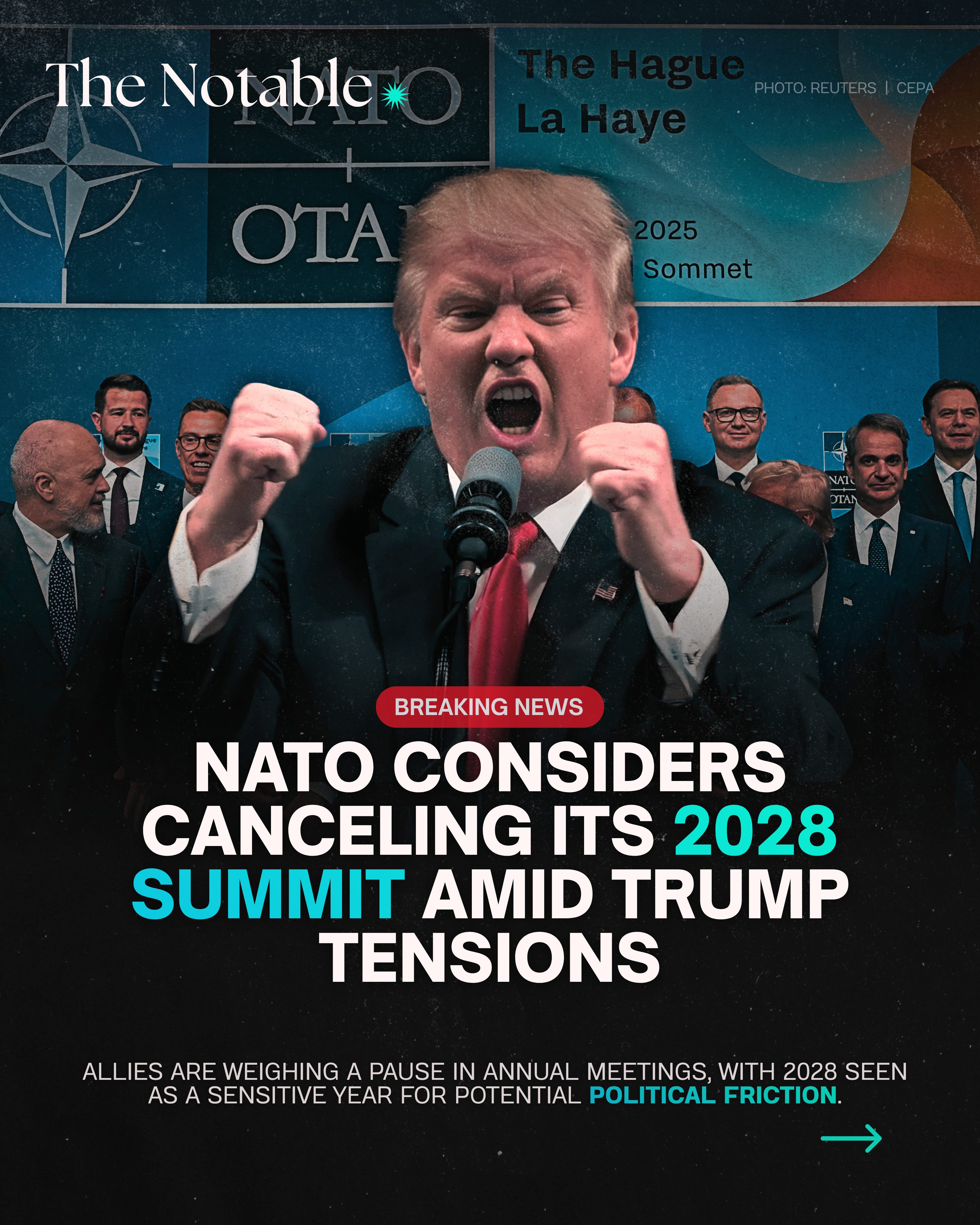
NATO is considering canceling its 2028 summit.
At first glance, the explanation appears simple: avoid another high-profile clash with Donald Trump in the final full year of his presidency. But the reality is more structural than personal. What is unfolding inside the alliance is not just a scheduling adjustment. It is a quiet recalibration of how NATO manages internal tension in a more politically volatile era.
According to a Reuters report citing multiple diplomatic sources, NATO officials are actively discussing whether to end the current practice of holding annual summits. Introduced in 2021, yearly meetings were meant to strengthen coordination at a time of rising geopolitical pressure.
Now, that same frequency is being questioned.
One proposal is to move toward a less regular rhythm, potentially holding summits every two years. Another option is more targeted: skip certain years entirely. And within that discussion, 2028 has emerged as a particularly sensitive candidate.
The reason is timing.
If the current political trajectory holds, 2028 would fall in the final full calendar year of Trump’s presidency. For many within NATO, that raises the likelihood of a summit defined less by coordination and more by confrontation.
The Problem With Annual Summits
Diplomats involved in the discussions describe a growing fatigue with the current format.
Annual summits create a predictable cycle of pressure. Leaders are expected to arrive with deliverables, make announcements, and project unity. But in practice, that expectation often produces the opposite. Negotiations become rushed. Disagreements surface publicly. And the meetings themselves risk becoming performative rather than strategic.
In recent years, this tension has become harder to manage.
Disputes over defense spending remain unresolved. Questions about burden-sharing continue to divide members. And differences over U.S. foreign policy decisions, including limited allied support for recent actions, have exposed underlying fractures.
Within this environment, the summit format itself is being reconsidered.
The Trump Factor
Trump is not the sole reason for this shift, but he is clearly part of the equation.
His previous engagements with NATO were marked by open criticism of allies, particularly over defense spending. He has repeatedly challenged the value of the alliance and signaled a willingness to reduce U.S. commitments. These positions introduced a level of unpredictability that NATO has had to absorb and manage.
That dynamic has not disappeared.
For some member states, the prospect of another summit cycle defined by public confrontation is not just politically uncomfortable. It is strategically unproductive. Avoiding a high-risk year like 2028 becomes, in that context, a form of risk management.
But importantly, not all diplomats frame the issue around Trump. Several emphasize that the deeper concern is structural. Even without him, the current model may no longer serve the alliance as intended.
What Happens Next
No final decision has been made.
The 2027 summit, expected to be held in Albania, is still moving forward, though its timing may shift. Any decision on future summits, including 2028, will ultimately involve NATO Secretary General Mark Rutte and require consensus among member states.
For now, what exists is a discussion, not a directive.
But the direction of that discussion matters.
Since 2021, NATO’s move to annual summits signaled urgency. It reflected a world where coordination needed to be faster, tighter, and more visible. Reconsidering that model suggests a different kind of realization.
The challenge facing NATO is no longer just external.
It is internal.
Political divergence within the alliance is becoming harder to manage in public settings. The mechanisms designed to show unity are increasingly exposing division. And in response, NATO is beginning to adapt not by confronting that tension directly, but by restructuring the spaces where it appears.
Skipping a summit may seem procedural.
In reality, it is strategic.
It signals an alliance adjusting to a world where cohesion is no longer assumed, and where managing differences may require quieter, less visible forms of coordination.
The question is not simply whether NATO meets in 2028.
It is what that decision says about the state of the alliance itself.