


For decades, American military aid to Israel has been treated as one of the fixed pillars of the modern geopolitical order.
Now, Benjamin Netanyahu is openly suggesting that pillar may eventually no longer be necessary.
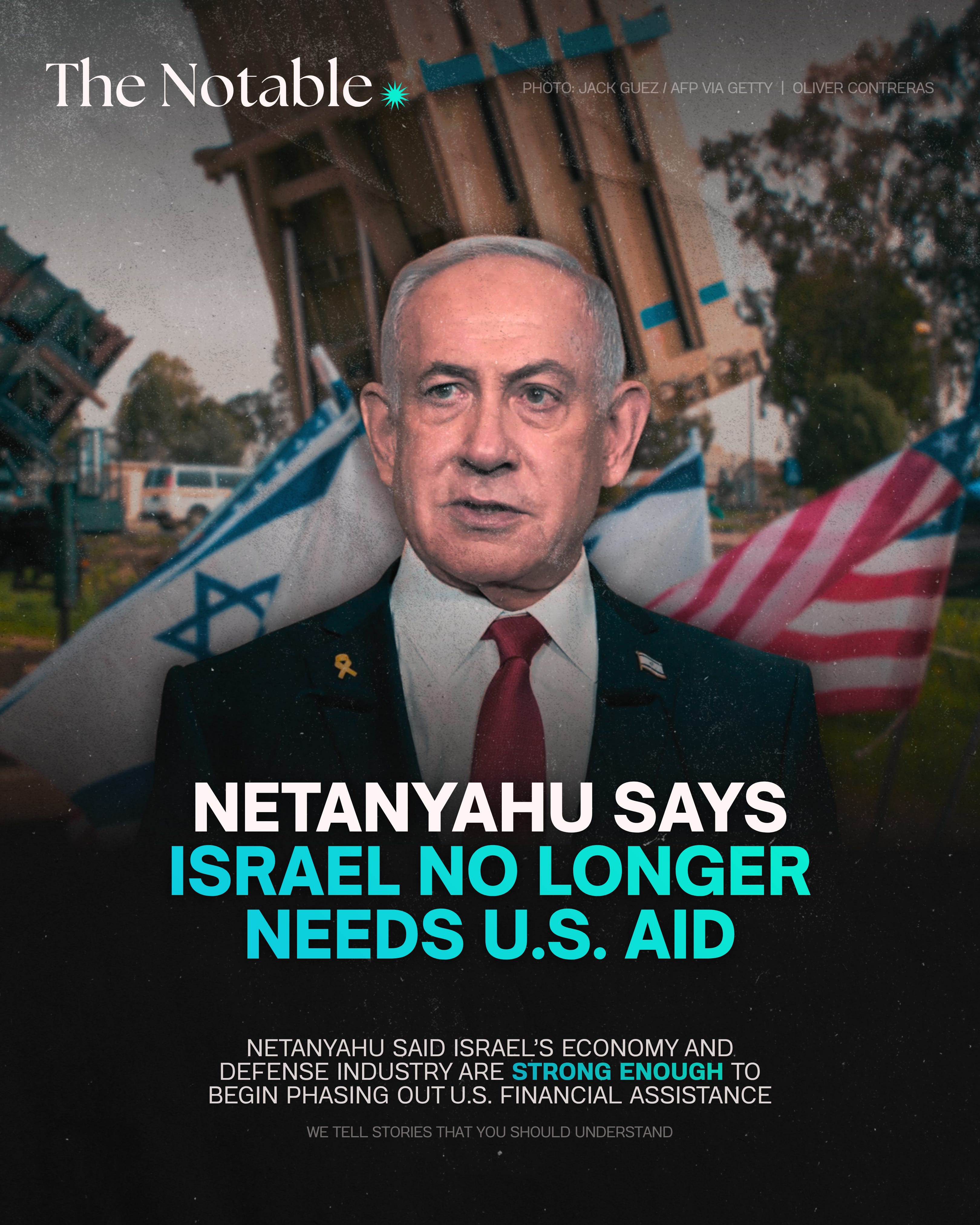
In recent Israeli media appearances, and earlier in a major interview with CBS News, the Israeli prime minister said Israel should begin reducing its dependence on U.S. financial assistance, arguing that the country’s economy and defense industry are now strong enough to increasingly finance their own military needs.
“I want to draw down to zero the American financial support,” Netanyahu told CBS in May, proposing a gradual transition over roughly a decade.
The comments mark one of the clearest public signals yet that parts of the Israeli leadership may be thinking about a long-term restructuring of the U.S.-Israel relationship.
Not an alliance break.
But potentially an evolution.
A Relationship Built on Strategic Support
Israel currently receives approximately $3.8 billion annually under a 10-year military aid agreement signed with Washington during the Obama administration. The deal runs through 2028 and has long served as a symbol of the unusually close strategic relationship between the two countries.
Since the Gaza war began after the October 7 Hamas attacks in 2023, the United States has also approved tens of billions of dollars in additional wartime support for Israel, including weapons transfers, missile defense assistance, and emergency military funding.
Historically, the aid relationship has carried significance far beyond money alone.
For Washington, it represented a strategic investment in a key regional ally. For Israel, it reinforced military superiority, deterrence, and deep institutional integration with the United States.
But the political environment surrounding that support has changed considerably over the past two years.
The Political Context Has Shifted
The Gaza war transformed the domestic political conversation around Israel inside the United States.
Support for Israel remains strong across large parts of American politics, particularly among Republicans and more traditional foreign policy institutions. But the war also accelerated growing divisions within the Democratic Party, especially among younger voters who became increasingly critical of Israeli military operations in Gaza.
What was once treated as a near-untouchable bipartisan consensus has become more politically contested.
That changing environment matters when interpreting Netanyahu’s comments.
By publicly proposing a gradual phaseout himself, Netanyahu may be attempting to strategically reposition Israel before future political pressures in Washington force a more difficult conversation later.
Rather than appearing dependent on American financial assistance at a moment of rising scrutiny, Israel could instead present itself as a technologically advanced military power capable of greater self-reliance.
The message is as much political as it is economic.
This Is Not a Break With Washington
One important distinction has become blurred in some online discussions.
Netanyahu is not proposing that Israel distance itself from the United States strategically.
In fact, he continues to support deep intelligence coordination, missile defense cooperation, weapons collaboration, and broader military integration with Washington. Israel’s security relationship with the United States remains central to its regional posture, especially amid tensions involving Iran and ongoing instability across the Middle East.
The debate is specifically about direct financial aid.
That distinction is critical because it suggests the relationship may not be weakening so much as changing form.
Instead of a traditional donor-recipient structure, the future alliance could evolve toward something more centered on:
joint defense production
technology partnerships
intelligence integration
regional military coordination
and strategic industrial cooperation.
In other words, less financial dependence does not necessarily mean less alignment.
Why Netanyahu Thinks Israel Can Afford It
Netanyahu’s argument rests heavily on Israel’s economic transformation over the past two decades.
Israel has developed one of the world’s most influential technology sectors, becoming a global center for cybersecurity, artificial intelligence, defense technology, semiconductors, and venture-backed innovation. Its defense industry has also expanded significantly, with Israeli weapons systems, drones, missile defense technologies, and cyber capabilities increasingly exported worldwide.
From Netanyahu’s perspective, this economic and technological growth changes the logic of long-term dependency.
If Israel increasingly possesses the industrial and financial capacity to support its own military infrastructure, then gradually reducing reliance on U.S. funding could become both strategically and politically attractive.
Especially in a world where American domestic politics are becoming less predictable.
What Happens Next
In practical terms, nothing changes immediately.
The current U.S.-Israel aid agreement remains locked in through 2028, and any major restructuring would require negotiations between both governments. There is also little indication that Washington is preparing to fundamentally alter military cooperation with Israel in the near term.
But Netanyahu’s comments still matter because they reveal how at least part of the Israeli leadership may now be thinking about the future.
For decades, the U.S.-Israel alliance was built around a relatively stable assumption: overwhelming American backing combined with deep Israeli strategic alignment.
That foundation still exists.
But the political conditions around it are becoming less stable, more polarized, and more contested than at any point in recent memory.
What Netanyahu appears to be signaling is that Israel may be preparing for that future already.