


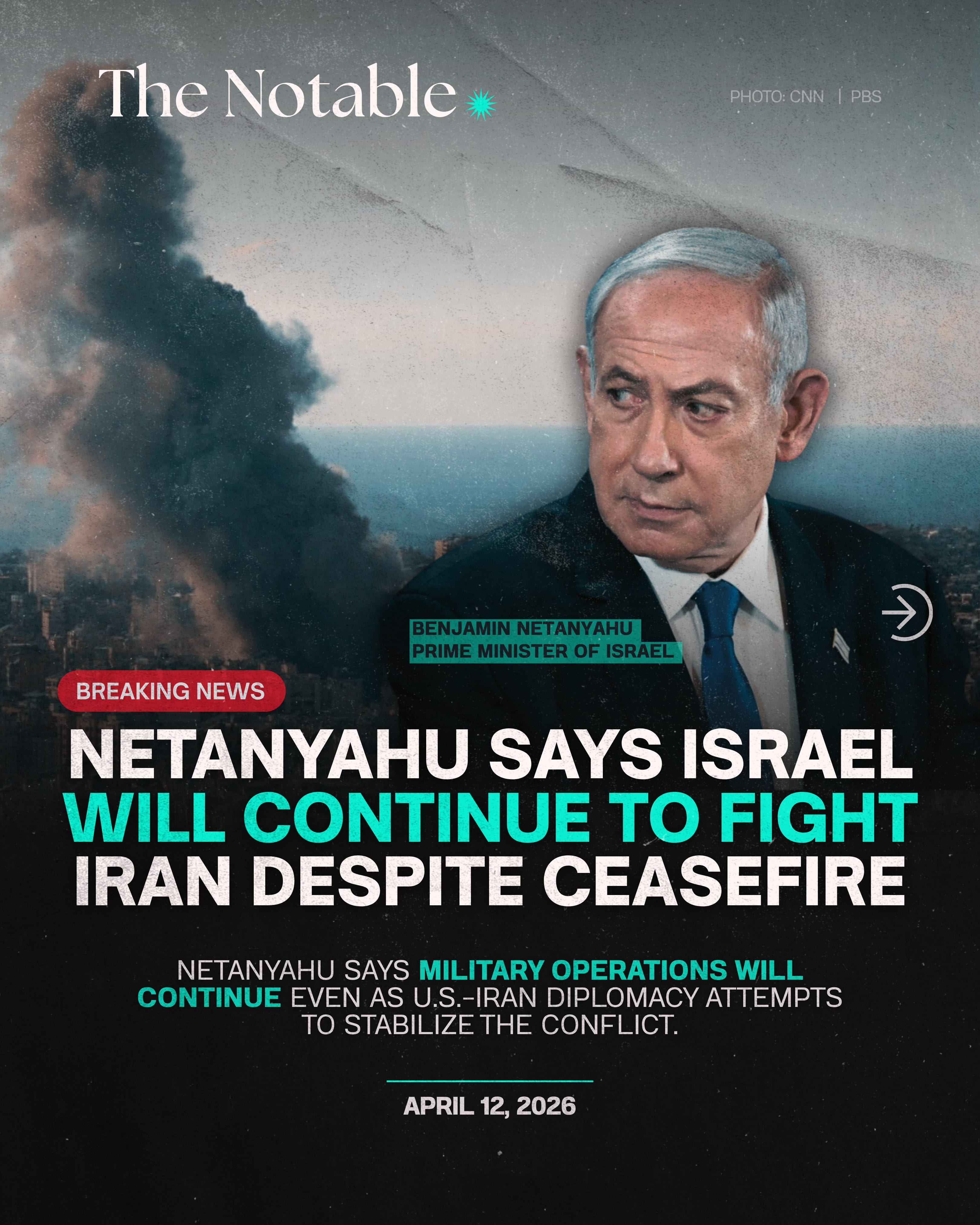
The ceasefire exists on paper.
The war, it appears, does not.
Israeli Prime Minister Benjamin Netanyahu has made that clear. In public remarks, he said Israel will continue fighting Iran and its regional network, declaring that the campaign is “not over” and that further objectives remain.
The timing is critical.
Because this statement comes not in the absence of diplomacy, but in the middle of it.
In recent weeks, a fragile ceasefire has taken shape around the escalating confrontation between Israel and Iran. It is not a comprehensive agreement, but rather a limited pause shaped largely by U.S.–Iran engagement.
That distinction matters.
The ceasefire does not fully bind all actors or all fronts. And Israel has made clear it does not interpret the agreement as requiring a complete halt to its operations.
Instead, Israeli forces have continued targeting elements of Iran’s regional network, particularly Hezbollah in Lebanon.
From Israel’s perspective, the logic is consistent:
If the underlying threat remains, the campaign continues.
At the same time, the United States is engaged in active talks with Iran, seeking to stabilize the situation and prevent a wider regional escalation.
This creates a structural tension.
On one track, diplomacy is attempting to freeze the conflict.
On another, military operations are still actively shaping it.
Netanyahu’s statement signals that Israel may not fully align with the diplomatic timeline or constraints emerging from those talks. It is, in effect, a declaration of strategic independence.
This does not mean a breakdown in alliances.
But it does suggest a divergence in priorities.
What exists now is not a traditional ceasefire.
It is a partial and uneven pause, applied differently across actors and geographies.
Israel has interpreted its scope narrowly, focusing on whether immediate threats tied to Iran’s network persist. Where they do, operations continue.
This reflects a broader pattern in modern conflict:
Formal agreements often coexist with ongoing, lower-intensity military action.
In that sense, the current moment is not a contradiction.
It is a new kind of equilibrium.
The implications are immediate.
If diplomacy between the United States and Iran progresses, pressure may grow on Israel to recalibrate its approach. A more formalized agreement could demand broader compliance.
But if talks stall or fail, the current dynamic may harden into something more dangerous.
Because the infrastructure of escalation is still in place.
Multiple fronts remain active.
And the line between containment and expansion is thin.
This is not just a continuation of a conflict.
It is a test of whether diplomacy can meaningfully constrain it.
Israel is signaling that military objectives cannot be subordinated entirely to negotiation timelines. The United States is testing whether negotiation can prevent those objectives from expanding the war.
Both strategies are operating at the same time.
And for now, neither has fully overridden the other.
That is what makes this moment unstable.
Not the absence of diplomacy.
But its coexistence with ongoing war.