


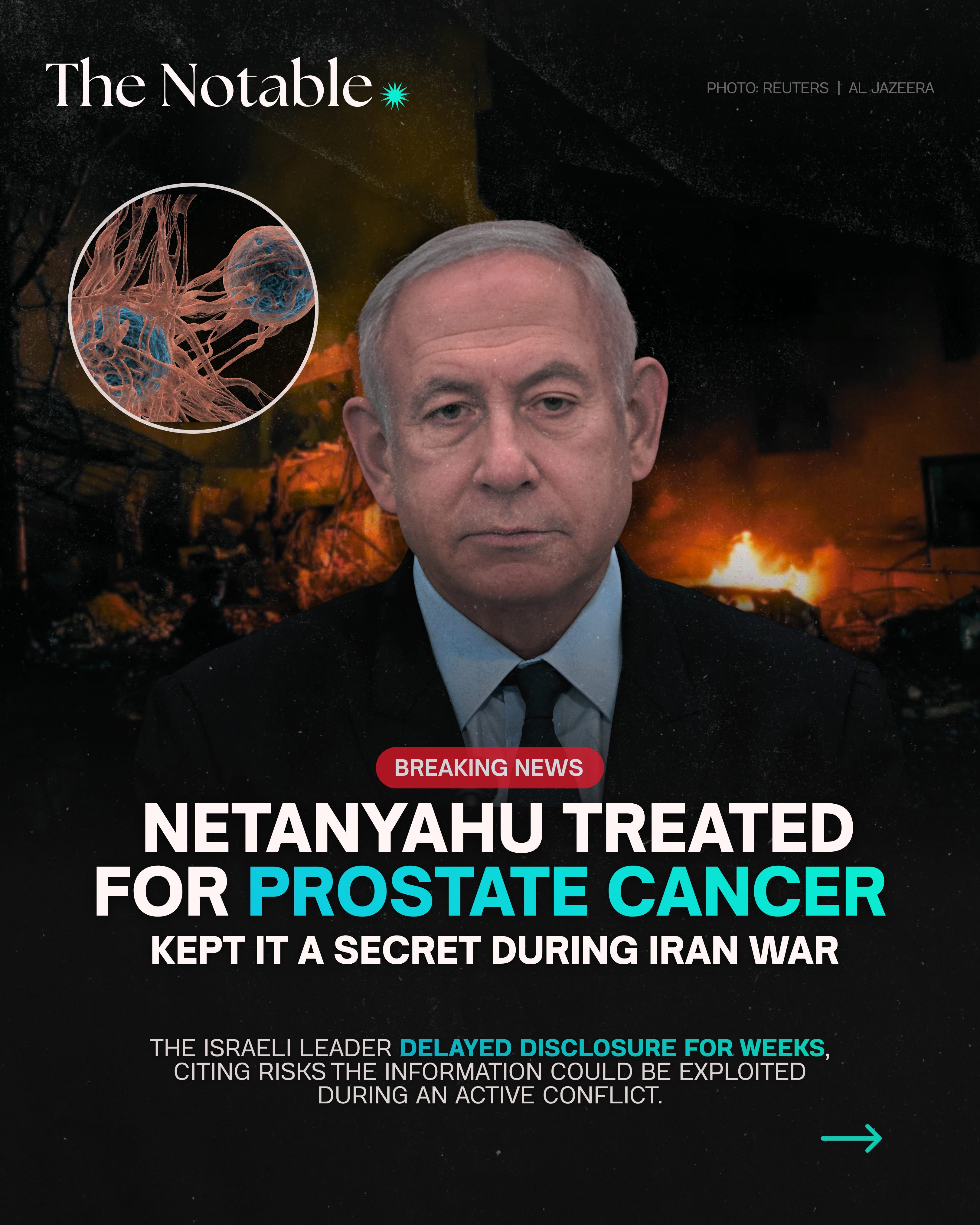
In the middle of an active regional conflict, Israeli Prime Minister Benjamin Netanyahu made a revelation that reframes more than just his health.
He had been diagnosed with early-stage prostate cancer.
He had already undergone treatment.
And he had chosen not to tell the public.
The announcement, released through his official medical report, confirmed that the cancer was detected during a routine check, described as small and localized, and treated with radiation therapy in Jerusalem. Doctors say the treatment was successful and the cancer is no longer present. Netanyahu is now in good health.
On the surface, this is a contained medical episode. Early detection, successful treatment, recovery.
But the timing of disclosure is where the story shifts.
A Decision Made During War
Netanyahu did not reveal the diagnosis immediately. Instead, he delayed disclosure for roughly two months, a period that overlapped with active conflict between Israel and Iran.
According to his office, the decision was intentional. The concern was that news of the prime minister’s illness could be used by Iran for propaganda or psychological leverage.
This was not framed as a privacy decision. It was framed as a strategic one.
In effect, a personal medical condition was treated as sensitive information within a wartime environment.
That distinction matters.
In peacetime, the health of a political leader is a matter of transparency and public trust. In wartime, it can become something else entirely.
A leader’s perceived strength or vulnerability can influence:
Adversary calculations
Domestic morale
Market reactions
Military signaling
Within that context, information about leadership health is no longer neutral. It becomes part of the broader strategic landscape.
Netanyahu’s decision reflects an understanding that modern conflict extends beyond physical confrontation. It includes narrative control, perception management, and the prevention of exploitable signals.
This is not unprecedented. Governments have historically managed or concealed leadership health during periods of instability. What is different is the speed and scale at which information now travels, and the extent to which it can be weaponized in real time.
The Information Layer of Modern Conflict
The explicit concern in this case was propaganda.
Iranian media and affiliated networks have previously circulated misinformation about Israeli leadership, including false claims about Netanyahu’s condition. In that environment, even a confirmed but manageable illness could be amplified, distorted, or used to project weakness.
This is the logic of modern information warfare.
Facts are not only reported. They are interpreted, repackaged, and deployed.
The decision to delay disclosure suggests that governments are increasingly treating information itself as a domain of conflict, alongside land, sea, air, and cyber.
In that domain, timing is as important as truth.
This episode also comes within a broader context of Netanyahu’s recent medical history.
In 2023, he underwent a procedure to implant a pacemaker.
In 2024, he had prostate-related surgery linked to a benign condition.
Each of these events drew attention to the health of a leader who remains central to Israel’s political and military decision-making.
The latest case is different not because of the severity of the illness, but because of its intersection with an ongoing war.
It raises a more structural question:
At what point does personal health become a matter of national security?
The delayed disclosure is likely to prompt debate.
On one side is the argument for transparency. Citizens have a legitimate interest in the health of their leader, especially during periods of crisis.
On the other is the argument for strategic control. If certain information can be exploited by adversaries, withholding it may be seen as a defensive necessity.
There is no clean resolution between these positions.
What this moment reveals is that governments are increasingly navigating that tension in real time, making decisions not just about what is true, but about when truth should be released.
Netanyahu’s cancer diagnosis is no longer a medical story. It is a signal.
It signals that:
Leadership health can be treated as strategic information
Disclosure timing is becoming a tool of statecraft
Modern conflict includes control over narrative, not just territory
The illness was contained. The treatment was successful. The immediate risk has passed.
But the implications extend beyond recovery.
In a world where perception shapes outcomes, even silence can be a form of strategy.