


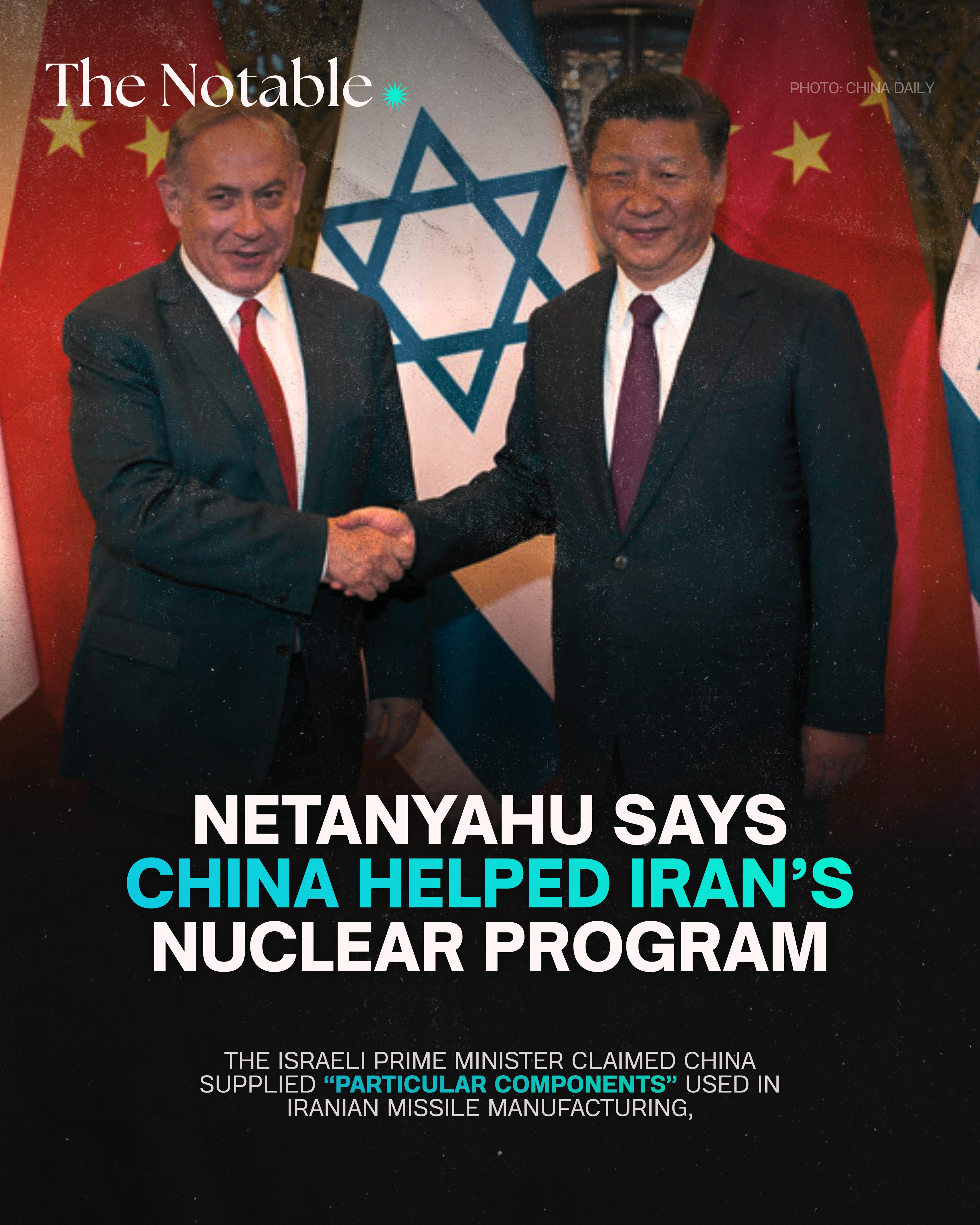
In an interview with CBS News’ 60 Minutes, Netanyahu claimed that China provided “a certain amount of support” and “particular components of missile manufacturing” to Iran. Pressed further on whether that support could still be happening today, he replied simply:
“Could be.”
The statement was brief. But its implications are enormous.
For years, the global conversation around Iran’s missile and drone capabilities has largely focused on Tehran itself: its military strategy, sanctions networks, proxy forces, and domestic weapons production. Netanyahu’s comments shift the conversation outward. Suddenly, the world’s second-largest economy is being pulled more directly into the strategic architecture surrounding Iran’s military capabilities.
That changes the story.
The Israel-Iran conflict is no longer being viewed purely as a Middle Eastern confrontation.
Increasingly, it is becoming entangled with the broader geopolitical struggle between the United States and China.
Netanyahu did not publicly present evidence during the interview. He also did not specify whether the alleged support came directly from the Chinese government, private companies, intermediaries, or dual-use commercial exports. That distinction matters because modern geopolitical competition rarely operates through direct military alliances alone.
Instead, it often moves through:
supply chains,
industrial components,
semiconductor access,
shipping networks,
energy partnerships,
and technologies that can serve both civilian and military purposes.
This is the gray zone of 21st-century power politics.
And it is exactly where concerns about China and Iran have been growing for years.
Why China Keeps Appearing in the Iran Conversation
Beijing, led by Xi Jinping, has repeatedly denied accusations of military assistance to Iran. Chinese officials have consistently framed Beijing as a stabilizing actor that supports diplomacy and regional de-escalation.
But Western intelligence agencies and analysts have long warned that Chinese-linked firms may have supplied dual-use technologies and industrial materials capable of supporting Iran’s missile and drone ecosystem.
This includes allegations involving:
advanced electronics,
manufacturing equipment,
satellite-related support,
industrial chemicals,
and specialized components that can be integrated into missile systems.
Many of these accusations exist in a difficult legal and political space because dual-use technologies are not always straightforward weapons transfers. A machine component exported for industrial manufacturing can potentially support both civilian infrastructure and military production.
That ambiguity is precisely why these networks are so difficult to regulate.
And it is why Netanyahu’s comments matter even without publicly released evidence.
The bigger issue is not simply whether China helped Iran manufacture missile components.
It is what the allegation reveals about how global power is reorganizing.
The post-Cold War world was largely built around globalization and economic integration. Major powers traded heavily with one another even while competing politically. The assumption was that deep economic interdependence would reduce the likelihood of sustained geopolitical confrontation.
That assumption is eroding.
Today, countries increasingly view:
technology,
manufacturing,
rare earths,
energy infrastructure,
shipping routes,
and semiconductor supply chains
as instruments of national power.
The world is reorganizing around strategic dependence.
That is why accusations involving missile components now carry geopolitical weight far beyond the battlefield itself.
Netanyahu’s remarks also land in the middle of a larger American strategic debate.
In Washington, policymakers are increasingly concerned that conflicts involving Iran, Russia, China, and advanced technology supply chains are no longer separate issues. They are becoming interconnected theaters within a broader global competition over power and influence.
Former U.S. President Donald Trump has long framed both China and Iran as central strategic threats to American power. Meanwhile, bipartisan concern in Washington over Chinese technological influence has intensified dramatically over the past several years.
If Israeli officials continue publicly linking China to Iran’s missile capabilities, pressure could grow for:
tighter export controls,
expanded sanctions,
broader scrutiny of Chinese industrial firms,
and deeper technology restrictions between China and Western allies.
That would push the Middle East conflict even further into the center of global great-power rivalry.
Modern Wars Are No Longer Just Regional
Perhaps the most important lesson from Netanyahu’s remarks is this:
Modern conflicts are increasingly fought through invisible systems long before missiles are launched.
The defining geopolitical struggles of this decade are not only about territory or military power. They are also about:
who controls supply chains,
who manufactures critical technologies,
who dominates industrial infrastructure,
and who can influence the networks connecting the global economy.
This is why seemingly technical questions about manufacturing components now sit at the center of international politics.
A missile may launch from the Middle East.
But the supply chain behind it can stretch across continents.