


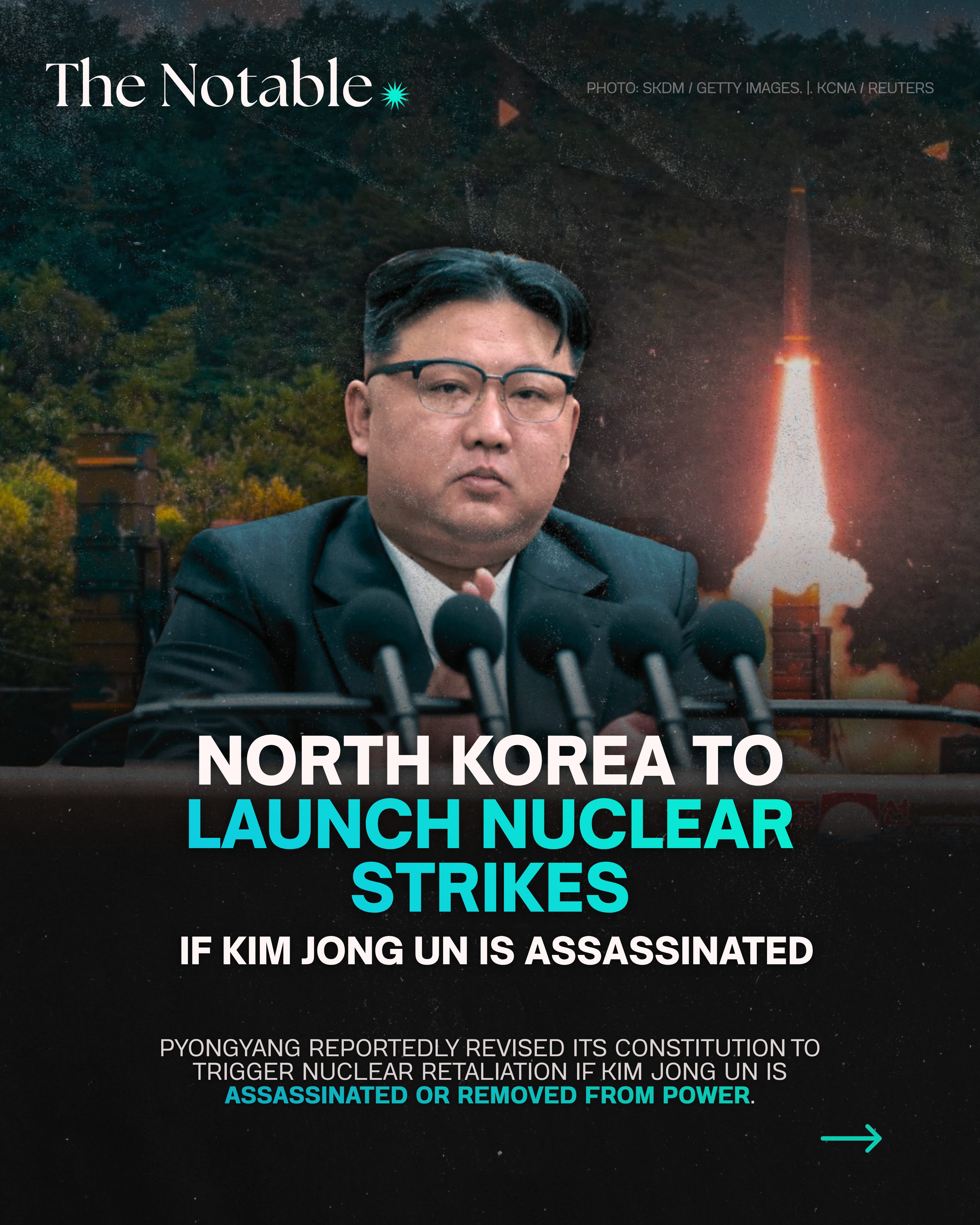
North Korea has reportedly updated its constitution to authorize an automatic nuclear strike if Kim Jong Un is assassinated or loses control of the state.
At first glance, the move sounds extreme even by Pyongyang’s standards. But strategically, it reveals something deeper and increasingly important about the modern world:
Authoritarian regimes are learning that survival may depend not just on having nuclear weapons, but on guaranteeing retaliation even after leadership collapse.
That distinction matters.
Because it signals a shift from nuclear deterrence as a military tool to nuclear deterrence as a regime survival system.
And it may tell us where global geopolitics is heading next.
The Constitutional Change
According to South Korean intelligence assessments and multiple international reports, North Korea quietly revised its constitution during a Supreme People’s Assembly session in March 2026.
The reported amendment creates what analysts are describing as a “dead man’s switch” style mechanism: if Kim Jong Un is assassinated or removed from power, a nuclear response could automatically be triggered.
The full constitutional text has not been publicly released, and many operational details remain unclear. But politically, the message appears intentional.
Pyongyang wants adversaries to believe that killing Kim Jong Un would not stop nuclear retaliation.
In other words:
decapitation does not equal victory.
That dramatically changes the logic of military confrontation.
The Iran Lesson
The timing is not accidental.
The reported constitutional change comes only months after the Iran-Israel-US conflict that culminated in the assassination of Iran’s Supreme Leader Ali Khamenei earlier this year.
For North Korea, that event likely reinforced one of its oldest strategic fears:
regime decapitation.
Pyongyang has long believed that the United States ultimately seeks regime change whenever hostile governments lose their deterrent credibility. Iraq, Libya, and now Iran have become central reference points in how North Korea views global security.
The lesson North Korea appears to be drawing is simple:
A state without survivable retaliation capabilities becomes vulnerable.
That may explain why Pyongyang is now moving beyond traditional nuclear deterrence toward something more rigid, automated, and existential.
Nuclear Weapons Are Becoming Personal
During the Cold War, nuclear doctrine was largely state-centered. Deterrence existed between superpowers, institutions, and military systems.
North Korea’s evolving doctrine looks different.
Its nuclear posture is becoming deeply personalized around Kim Jong Un himself.
The state is effectively merging:
leadership survival
regime survival
nuclear retaliation
into a single structure.
That creates a far more dangerous dynamic because it compresses political and military calculations into one question:
Is the regime itself under threat?
If the answer becomes yes during a crisis, escalation could happen much faster.
North Korea’s reported constitutional change is part of a broader trend reshaping global security.
Across multiple regions, nuclear powers are increasingly:
lowering escalation thresholds
emphasizing tactical nuclear systems
hardening command structures
preparing for leadership-targeted warfare
building survivable retaliation systems
At the same time, geopolitical tensions are rising simultaneously across Europe, the Middle East, and Asia.
The post-Cold War assumption that globalization and economic interdependence would gradually reduce major-power confrontation is weakening.
Instead, the world is reorganizing around power, deterrence, and strategic survival.
North Korea may simply be expressing that reality more openly than others.
Why This Matters Beyond North Korea
The deeper significance of this story is not just about Kim Jong Un.
It is about what happens when states begin believing that survival depends on making retaliation unavoidable.
That logic reduces flexibility.
It increases uncertainty.
And it makes crises harder to contain.
Even if North Korea’s system is not fully automated in practice, the perception alone matters. Nuclear deterrence works psychologically as much as militarily.
Pyongyang wants rivals like the United States, South Korea, and Japan to hesitate before considering any operation aimed at regime removal.
The strategy is built on one central idea:
fear must survive even if leadership does not.
And that may become one of the defining realities of the next geopolitical era.