


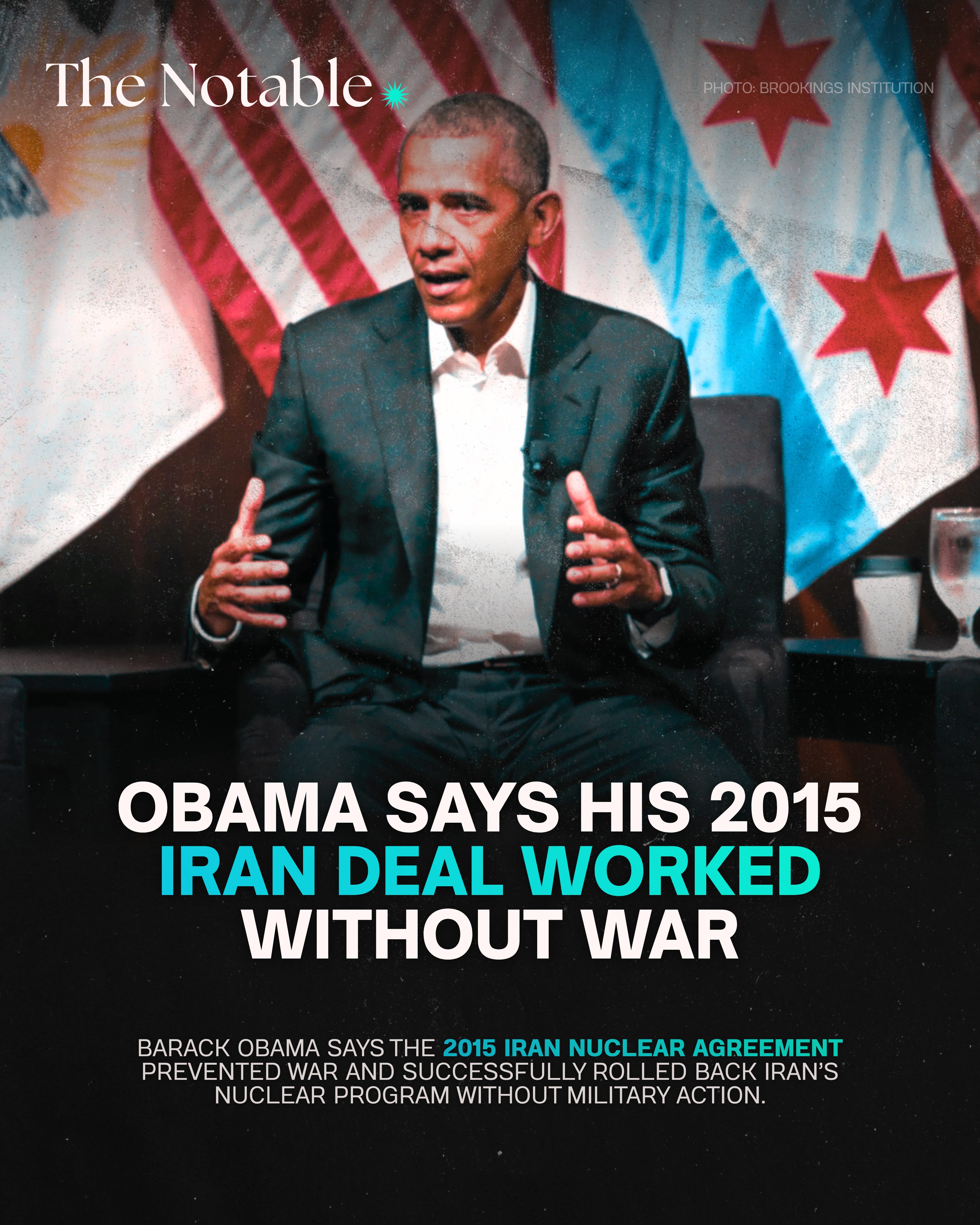
In a recent CBS interview, former U.S. President Barack Obama defended his 2015 nuclear agreement with Iran with unusual bluntness.
“We pulled it off without firing a missile,” Obama said. “We got 97% of their enriched uranium out. There’s no dispute that it worked and we didn’t have to kill a whole bunch of people or shut down the Strait of Hormuz.”
The remarks have quickly resurfaced across political and geopolitical discussions online because they touch a question that remains unresolved nearly a decade later:
Did diplomacy successfully contain Iran’s nuclear ambitions, or did the collapse of the agreement simply delay a larger confrontation?
That debate is no longer just historical. It has returned at a moment when tensions involving Iran, regional instability, energy security, and U.S. strategy in the Middle East are once again moving back to the center of global politics.
The Deal Obama Still Defends
The agreement Obama referenced was the 2015 Joint Comprehensive Plan of Action, commonly known as the Iran nuclear deal.
Negotiated between Iran, the United States, the United Kingdom, France, Germany, Russia, China, and the European Union, the deal was designed to place strict limits on Iran’s nuclear activities in exchange for sanctions relief.
At the core of the agreement was a simple strategic objective: lengthen the amount of time Iran would need to produce enough material for a nuclear weapon.
Under the deal:
Iran dramatically reduced its stockpile of enriched uranium
Thousands of centrifuges were removed or disabled
International inspectors gained expanded access to nuclear facilities
Uranium enrichment levels were heavily restricted
International monitoring bodies later confirmed that Iran had significantly reduced its enriched uranium stockpile under the agreement, aligning with Obama’s claim that roughly 97% had been removed.
For the Obama administration, the agreement represented something larger than a technical nuclear framework. It was a test of whether diplomacy could prevent another catastrophic Middle East war after decades of conflict in Iraq and Afghanistan.
That is why Obama’s recent comments focused less on technical compliance and more on the alternative scenario he believes was avoided.
Not just a nuclear crisis, but a regional military conflict.
One of the most important parts of Obama’s remarks was his reference to the Strait of Hormuz.
The narrow waterway sits between Iran and the Gulf states and remains one of the world’s most strategically important shipping routes. Roughly one-fifth of global oil trade passes through it.
For decades, military planners and energy analysts have feared that a direct conflict involving Iran could threaten shipping through the strait, potentially triggering global energy shocks and wider regional escalation.
Obama’s argument was therefore not only about uranium stockpiles or inspections.
It was about cost.
His position is that the 2015 agreement reduced nuclear risk without triggering:
war,
mass casualties,
or major disruption to global energy markets.
That framing remains central to how supporters of the deal defend it today.
The Critics Never Believed It Was Enough
But the Iran deal was controversial from the beginning.
Critics argued the agreement did not permanently dismantle Iran’s nuclear capabilities. Instead, they believed it temporarily slowed the program while leaving Tehran with the infrastructure, knowledge, and long-term ability to restart enrichment later.
Among the deal’s most prominent critics was Donald Trump.
Trump repeatedly argued the agreement was weak, temporary, and strategically dangerous. In 2018, his administration formally withdrew the United States from the deal and restored sanctions under a “maximum pressure” campaign designed to economically isolate Iran.
The decision became one of the defining foreign policy reversals between the Obama and Trump eras.
Supporters of Trump’s approach believed economic pressure would force Iran into accepting a stricter agreement.
Instead, the years that followed produced a different outcome.
Iran’s Nuclear Program Expanded Again
After the U.S. withdrawal, Iran gradually stopped complying with major restrictions under the original agreement.
Enrichment levels increased. Advanced centrifuge operations resumed. Stockpiles grew larger.
Western officials and nuclear analysts later warned that Iran’s breakout timeline, the estimated time needed to produce enough fissile material for a nuclear weapon, had significantly shortened compared to the years immediately after the deal took effect.
This is the central argument Obama and many supporters of the agreement continue to make today:
The deal was containing the program until the framework collapsed.
Critics, however, counter that the agreement only postponed the problem and failed to permanently resolve the underlying strategic threat.
That disagreement still divides American foreign policy thinking nearly ten years later.
A Debate That Has Returned
What makes Obama’s comments particularly relevant now is the broader geopolitical environment surrounding them.
The Middle East is once again facing heightened instability. Concerns about regional escalation involving Iran have returned to international headlines. Energy security remains fragile. And global powers are increasingly operating in a far more fragmented and confrontational geopolitical landscape than they were in 2015.
In that environment, Obama’s remarks are being interpreted as more than a defense of his legacy.
They are part of a larger argument about whether diplomacy between rivals still works in a world increasingly shaped by coercion, sanctions, military pressure, and collapsing international trust.
The debate over the 2015 Iran nuclear deal was never only about centrifuges or uranium.
It was about how great powers manage threats before they become wars.
And nearly a decade later, that question remains unresolved.