


As the war in Gaza continues to reshape international politics, governments are no longer limiting themselves to statements of concern or calls for restraint. Increasingly, they are taking positions that would have been politically unthinkable only a few years ago.
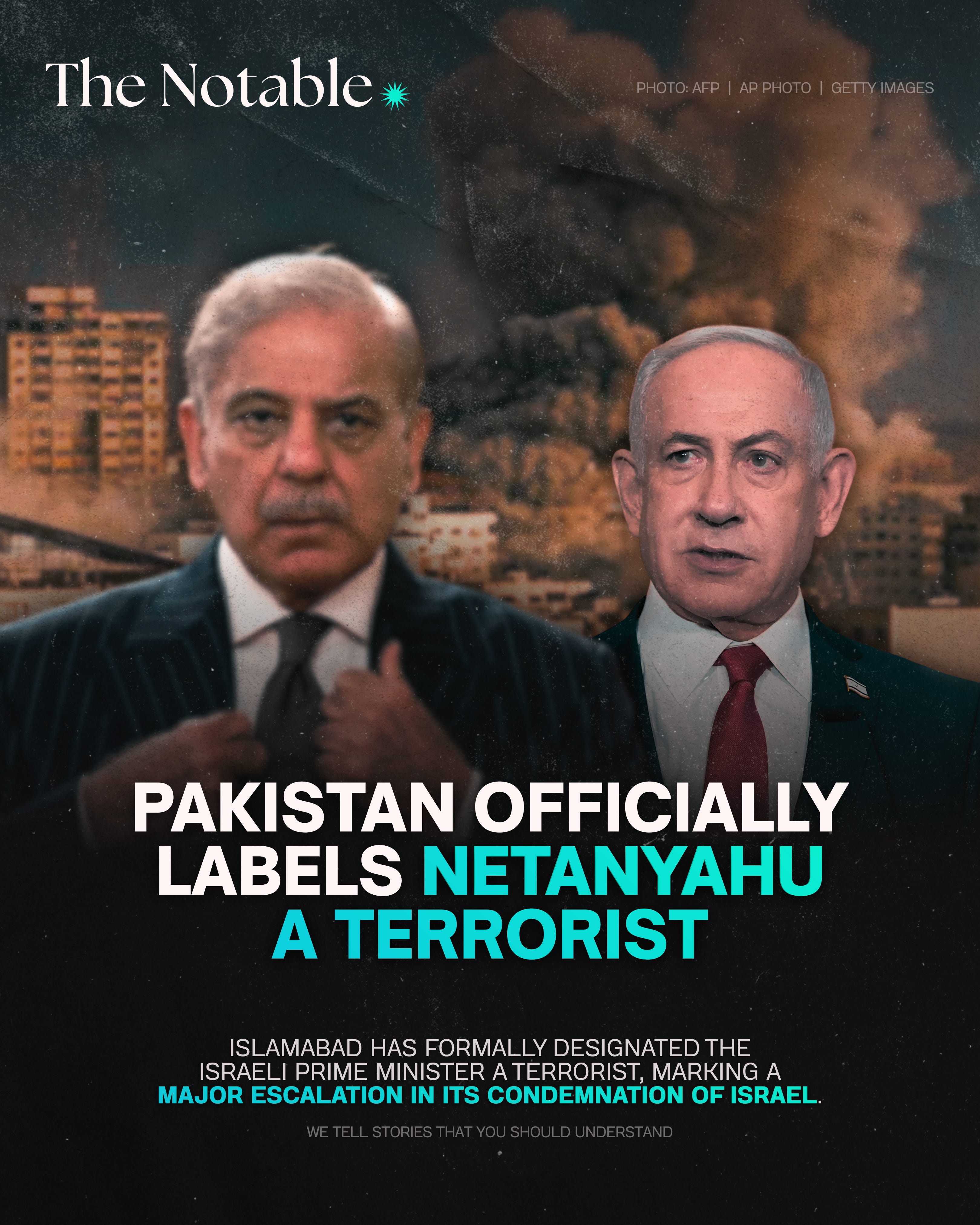
Pakistan’s decision to officially designate Israeli Prime Minister Benjamin Netanyahu a terrorist is one of the clearest examples of that shift.
Adopted through a federal cabinet resolution, the designation represents one of the strongest formal condemnations of Israel’s political leadership by a sovereign government. While it does not carry the legal force of an international court ruling or create obligations for other countries, it establishes Pakistan’s official state position and signals how sharply the global debate over the Gaza war has evolved.
What Pakistan Did
The Pakistani government formally designated Benjamin Netanyahu a terrorist as part of its broader response to Israel’s military campaign in Gaza.
The decision is political rather than judicial. It does not constitute an international arrest warrant, nor does it automatically trigger sanctions or legal proceedings outside Pakistan. Instead, it is an official expression of Islamabad’s foreign policy, carrying diplomatic and symbolic significance rather than direct legal effect.
Even so, the move places Pakistan among the governments taking an increasingly uncompromising stance toward Israel’s leadership as the conflict enters another year.
Why This Is Not a Sudden Policy Change
Although the designation has attracted renewed international attention, it is not a dramatic departure from Pakistan’s longstanding position.
Pakistan has never recognized the State of Israel and has consistently supported Palestinian statehood since its independence. Successive Pakistani governments have maintained that recognition of Israel is contingent upon a negotiated settlement establishing an independent Palestinian state.
Since the start of the Gaza war, Islamabad has repeatedly accused Israel of violating international law, called for an immediate ceasefire, and supported international efforts to investigate alleged war crimes. The designation of Netanyahu fits squarely within that broader diplomatic framework.
Separate From International Courts
One distinction is particularly important.
Pakistan’s designation should not be confused with international legal proceedings.
It is not a decision by the International Criminal Court or the International Court of Justice, nor does it carry the legal consequences associated with either institution. Those bodies operate independently under international law, while Pakistan’s action is a sovereign political decision reflecting its own assessment of the conflict and its foreign policy priorities.
Understanding that distinction is essential. The designation is politically significant, but its legal reach remains limited to Pakistan’s own official position.
A Sign of a More Fragmented World
The importance of Pakistan’s decision lies less in its legal consequences than in what it reveals about the changing international landscape.
The Gaza war has become more than a regional conflict. It has exposed profound disagreements over international law, humanitarian responsibility, and the legitimacy of military force. Governments are increasingly dividing into competing diplomatic camps, with some continuing to support Israel’s security objectives while others adopt progressively stronger measures against its leadership.
Pakistan’s decision reflects this broader realignment. Rather than treating the conflict as a distant regional crisis, countries are incorporating it into their own foreign policy identities and strategic positioning.
As the war continues, diplomatic language itself is becoming more consequential. Labels once considered extraordinary are now entering official government policy, illustrating how the conflict is reshaping not only the Middle East but also the norms and alliances that underpin global politics.