


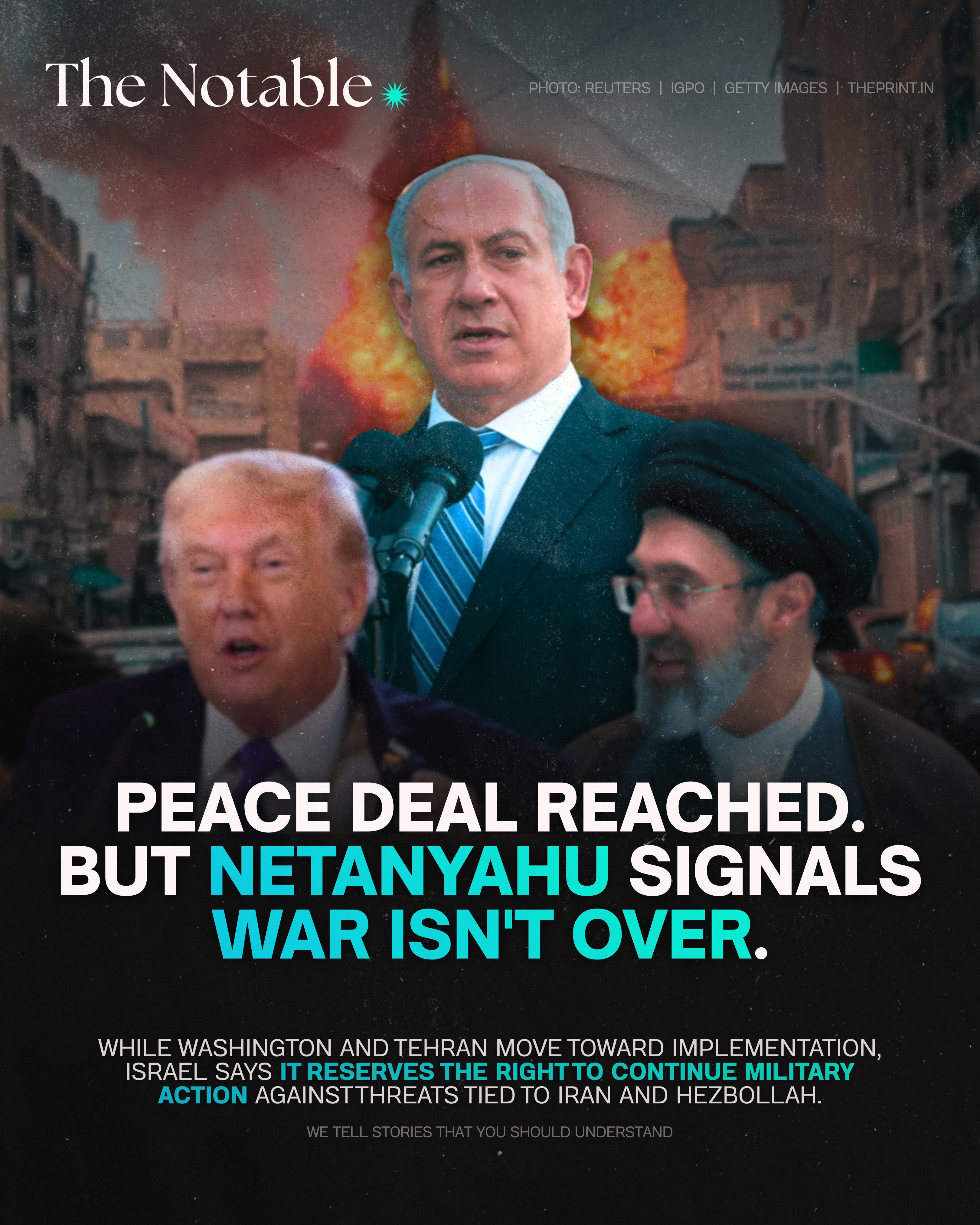
Just hours after the United States and Iran announced a landmark agreement to end their recent conflict, a new fault line has emerged, not between Washington and Tehran, but between Washington and one of its closest allies.
Israeli Prime Minister Benjamin Netanyahu is signaling that Israel does not consider itself bound by key provisions of the agreement and intends to preserve its freedom to conduct military operations against threats it perceives from Iran and Hezbollah.
The result is a remarkable geopolitical moment: a peace deal has been reached, but one of the region’s most powerful military actors is already questioning parts of it.
The Deal
President Donald Trump announced that the United States and Iran had reached an agreement to halt hostilities, bringing an end to the most serious direct confrontation between the two countries in decades.
The agreement is intended to stop the cycle of escalation that threatened to pull the Middle East into a wider regional war. It also aims to restore stability to critical energy routes and create a foundation for broader diplomatic engagement between Washington and Tehran.
For Trump, the deal represents a major foreign policy achievement. After months of rising tensions, missile exchanges, and fears of a larger conflict, the administration is presenting the agreement as a pathway toward de-escalation.
But almost immediately after the announcement, signs emerged that the diplomatic breakthrough might not be as straightforward as it appeared.
Israel Pushes Back
According to multiple reports, Netanyahu informed Trump that Israel does not consider itself bound by provisions related to Lebanon and will continue acting against threats as it sees necessary.
The message was clear: while Washington may have reached an understanding with Tehran, Israel retains the right to make its own security decisions.
Israeli National Security Minister Itamar Ben-Gvir reinforced that position publicly, declaring that Israel is a sovereign country and is not subordinate to the United States.
Taken together, the statements suggest that Israeli leaders are unwilling to accept any arrangement that could limit their ability to strike Hezbollah, Iranian assets, or other groups they view as security threats.
In other words, while the United States is attempting to close a chapter, Israel is signaling that it may not consider the story finished.
Why This Matters
The immediate issue is not simply Lebanon.
The deeper issue is who gets to define security in the Middle East after the war.
The Trump administration appears to be pursuing a traditional diplomatic objective: reducing tensions, preventing further escalation, and transforming a military confrontation into a political process.
Israel’s leadership, however, operates from a different set of calculations.
For Netanyahu, the central concern is not the existence of an agreement. It is whether Iran and its network of regional allies remain capable of threatening Israel in the future.
If Israeli leaders believe those threats persist, they are signaling that they reserve the right to act regardless of diplomatic understandings reached elsewhere.
This is where the interests of Washington and Jerusalem begin to diverge.
One side is trying to stabilize the region through diplomacy.
The other is determined to maintain military freedom of action.
A Rare Public Rift
Disagreements between American and Israeli leaders are not new.
They have occurred under Democratic and Republican administrations alike.
What makes this moment notable is how quickly the disagreement surfaced after the agreement was announced.
Normally, differences between allies are managed behind closed doors. This time, however, competing visions for the post-war order became visible almost immediately.
That public nature matters.
Diplomatic agreements depend not only on signatures and commitments but also on the willingness of key actors to support them.
If one of the region’s most influential powers signals that it does not consider itself constrained by important elements of the arrangement, questions inevitably arise about the agreement’s durability.
The Bigger Story
The most important development may not be the peace deal itself.
Nor may it be Israel’s response.
The bigger story is what the episode reveals about the changing dynamics of American influence in the Middle East.
For decades, Washington has been the central architect of regional security arrangements.
Yet Israel’s response highlights an increasingly important reality: even close allies may choose to pursue their own strategic objectives when they believe their security interests require it.
That does not mean the U.S.-Israel relationship is collapsing.
Far from it.
But it does mean that alignment cannot be assumed, even during moments of major diplomatic breakthrough.
What Happens Next
The coming days will determine whether the agreement evolves into a durable settlement or merely a temporary pause.
If Israel continues military operations against targets linked to Iran or Hezbollah, pressure will immediately fall on the new arrangement.
Washington will seek to preserve the diplomatic gains it has secured.
Israel will seek to preserve its strategic freedom.
Iran will be watching to see whether the agreement can actually restrain its adversaries.
For now, one thing is clear.
A peace deal has been reached.
But the struggle over what that peace actually means is only beginning.