


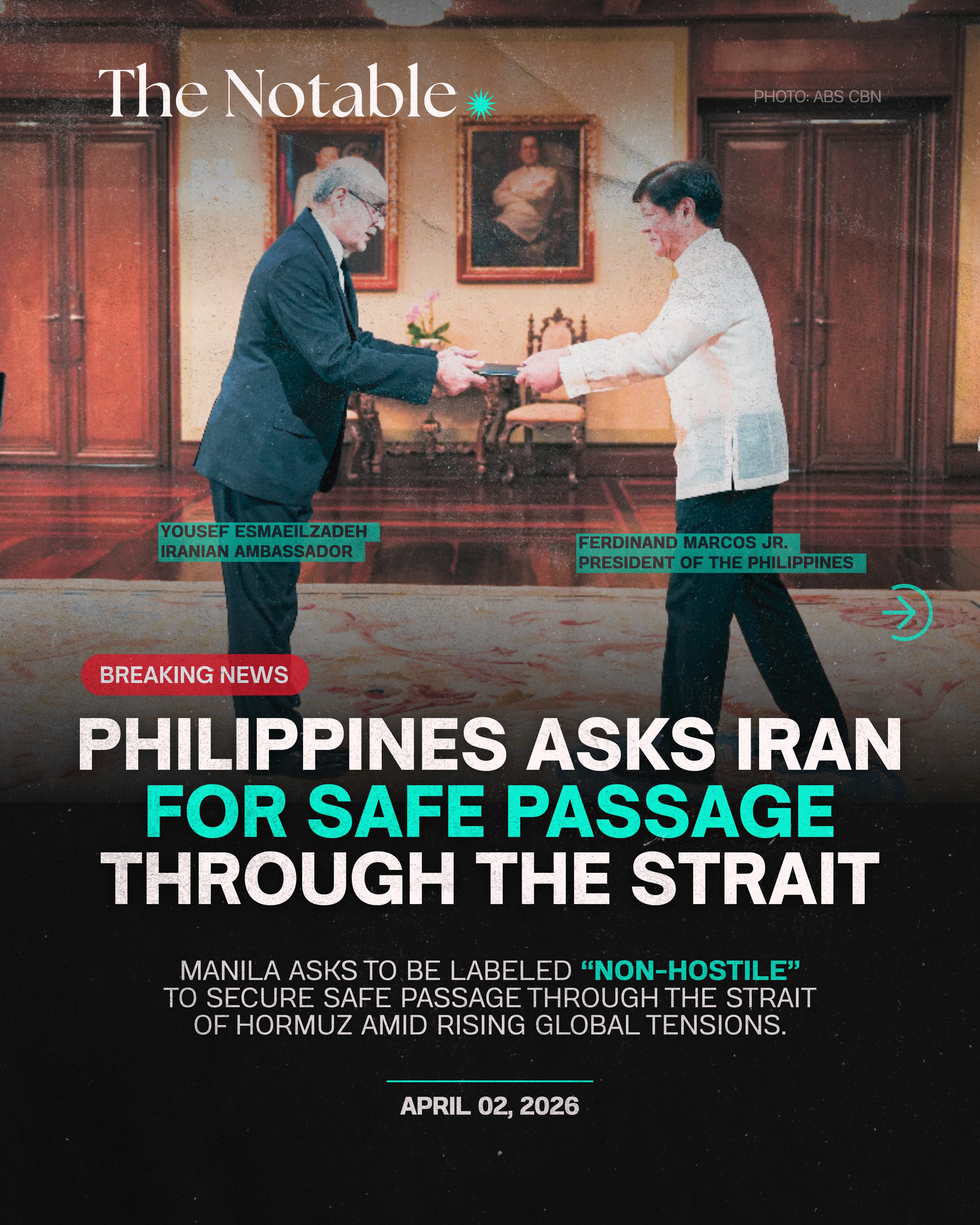
Philippines Seeks Iran Assurances as Oil Route Becomes Conditional
The Philippines has taken an unusual but increasingly necessary diplomatic step. As tensions reshape global energy flows, Manila is now directly engaging Tehran to secure access to one of the world’s most critical oil routes.
The government under Ferdinand Marcos Jr. has formally asked Iran to designate the Philippines as a “non-hostile” country. The request is aimed at ensuring safe passage for Philippine-flagged vessels and oil shipments through the Strait of Hormuz, a narrow waterway that carries a significant share of the world’s oil supply.
The move reflects a deeper reality: access to energy is no longer just a matter of markets. It is becoming a matter of diplomacy.
A Direct Appeal to Tehran
The request was raised during a meeting between Foreign Affairs Secretary Maria Theresa Lazaro, Energy Secretary Sharon Garin, and Iranian Ambassador Yousef Esmaeilzadeh in Manila.
At its core, the message was straightforward. The Philippines is seeking assurance that its ships will not be targeted, delayed, or denied passage as Iran tightens control over traffic through the Strait of Hormuz.
In recent weeks, Iran has signaled that access to the strait is no longer automatic. Instead, passage is increasingly tied to political positioning, with preference given to countries it does not consider hostile.
For Manila, this creates an immediate challenge.
A Vulnerable Energy Position
The Philippines imports nearly all of its oil, much of it sourced from or passing through the Middle East. This makes the country highly exposed to disruptions in the Strait of Hormuz.
Even short-term instability can ripple quickly through the economy. Fuel prices rise. Power generation becomes more expensive. Transportation costs increase. Inflationary pressure follows.
These risks are not theoretical. The Philippines has already been grappling with energy strain in recent weeks, underscoring how fragile its supply lines can be under geopolitical stress.
Securing safe passage is therefore not simply precautionary. It is essential.
A Shifting Global Pattern
The Philippines is not alone in recalibrating its approach.
As tensions in the Middle East escalate, several countries have begun pursuing direct arrangements with Iran to ensure their vessels can continue to pass through the strait. What was once a guaranteed international route is now becoming a negotiated corridor.
This marks a subtle but important shift in how global energy flows are managed.
Traditionally, chokepoints like the Strait of Hormuz operated under broad assumptions of open access, even during periods of tension. Now, access is becoming conditional, shaped by political alignment and bilateral engagement.
The implications extend far beyond any single country.
Between Alliances and Necessity
For the Philippines, the situation carries an added layer of complexity.
Manila is a long-standing defense ally of the United States, a country deeply entangled in tensions with Iran. At the same time, its economic stability depends on uninterrupted energy imports that pass through waters now influenced by Tehran.
This creates a delicate balancing act.
On one side is strategic alignment. On the other is economic survival.
The Philippines’ outreach to Iran does not signal a shift in alliances. Instead, it reflects a growing reality for many countries: in moments of systemic disruption, pragmatism can take precedence over positioning.
What This Signals
This development is not just about one country seeking safe passage.
It points to a broader transformation in the global system, where energy security is increasingly negotiated, not assumed.
When critical infrastructure becomes exposed to conflict, the rules change. Access becomes selective. Stability becomes fragile. And countries, regardless of their alliances, are forced to adapt.
The Philippines’ request to Iran captures that shift in real time.
It is a reminder that in today’s geopolitical landscape, even long-standing partnerships may not be enough to guarantee something as fundamental as the flow of oil.
What Comes Next
Iran has signaled openness to such requests, but no formal designation has been publicly confirmed.
If granted, the Philippines could secure short-term stability in its oil supply chain. If not, the risks to its energy system could escalate quickly.
More broadly, the outcome will be closely watched.
Because what is being tested here is not just a bilateral relationship, but a larger question:
Who controls access to the world’s most critical resources when the system is under strain?
And increasingly, the answer is no longer straightforward.