


Read full story here. (March 25, 2026)
This is no longer just about rising fuel prices.
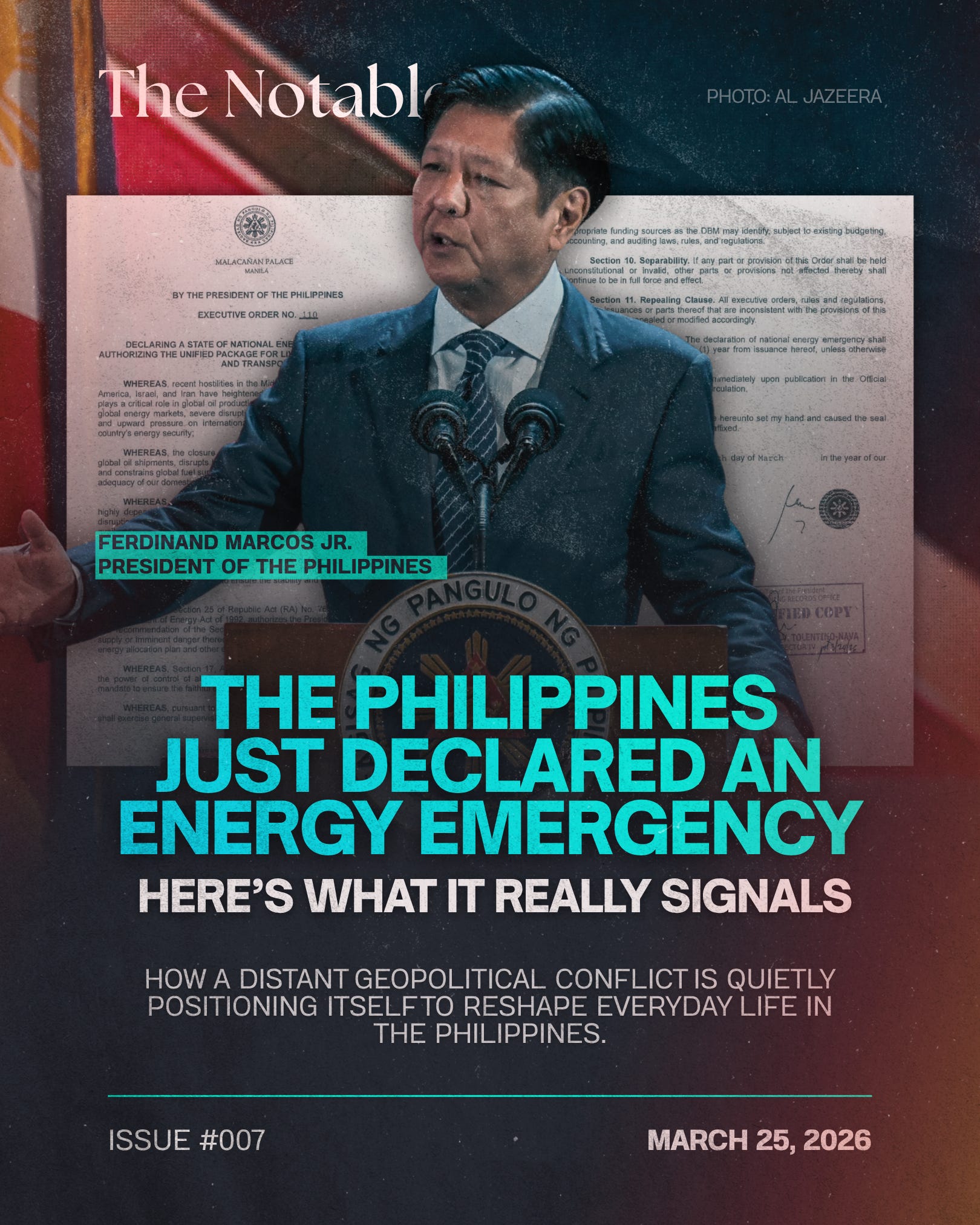
President Ferdinand Marcos Jr has signed Executive Order No. 110, formally declaring a state of national energy emergency in the Philippines.
The order cites escalating hostilities in the Middle East involving the United States, Israel, and Iran, which have disrupted global oil production and transport. It specifically points to constraints in the Strait of Hormuz, a critical global oil corridor, as a key factor driving supply uncertainty and price volatility. As a country heavily dependent on imported fuel, the Philippines is now facing what officials describe as an imminent risk of critically low energy supply.
The declaration authorizes the government to implement a unified package of interventions across livelihoods, industry, food, and transport. It also activates legal mechanisms to enforce fuel allocation, conservation measures, and emergency responses to stabilize supply. The order will remain in effect for one year unless lifted or extended.
For Filipinos, this signals a shift from abstract global risk to direct domestic impact. Higher fuel costs are expected to continue feeding into transportation fares, food prices, and overall inflation. Public transport operators and logistics networks face increasing pressure, while businesses may adjust operations to manage rising energy costs. In more severe scenarios, disruptions to transport and mobility cannot be ruled out if supply tightens further.
Beyond the Philippines, this move sends a broader signal. It shows how quickly global energy disruptions can cascade into national emergencies, especially in economies that rely heavily on imported oil. The Philippines is effectively moving early, not because it is uniquely vulnerable, but because it is structurally exposed.
For neighboring countries in Southeast Asia, the implications are clear. Many share similar dependencies on global fuel supply chains. If disruptions persist, similar measures may follow across the region.
What happens next depends on the trajectory of the global oil supply. If constraints in key shipping routes continue, governments may be forced to escalate from conservation and subsidies to stricter controls.
The declaration is not just a response. It is a signal that the global energy system is under stress, and its effects are now being felt at the national level.