


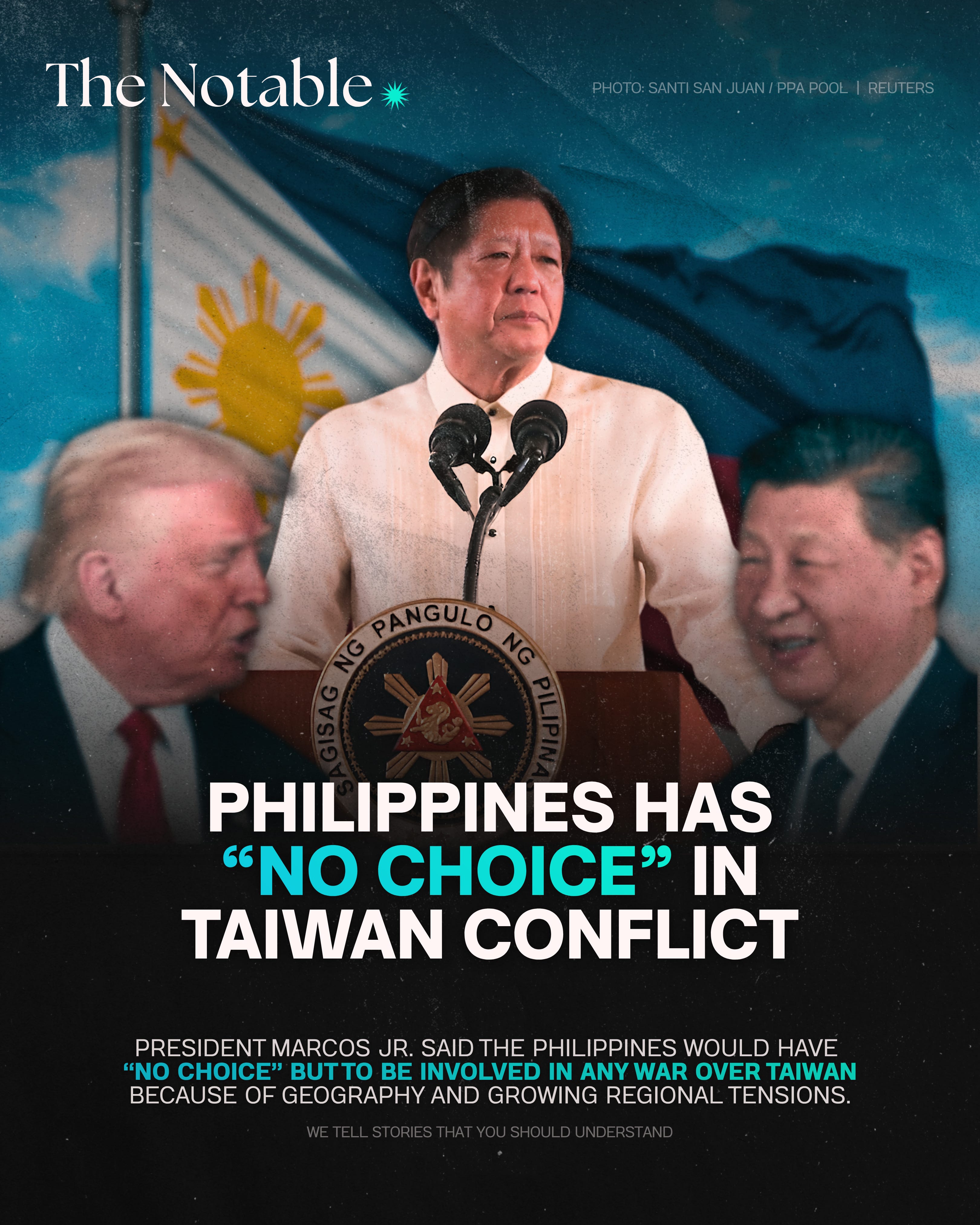
President Ferdinand Marcos Jr. has issued one of the clearest warnings yet from a Southeast Asian leader about the growing risk of war over Taiwan.
Speaking ahead of an official visit to Japan, Marcos said the Philippines would inevitably be involved in any conflict over Taiwan because of geography, regional security realities, and the country’s strategic position in the Indo-Pacific.
“We do not have a choice,” Marcos said, referring to the Philippines’ proximity to Taiwan.
The statement marks another major shift in the region’s geopolitical atmosphere. What was once treated as a hypothetical U.S.-China flashpoint is increasingly being discussed by Asian governments as a realistic strategic contingency.
And for the Philippines, the issue is becoming impossible to separate from its own national security.
Geography Is Changing the Equation
Taiwan sits just north of the Philippines.
The Luzon Strait, which separates Taiwan from the Philippines’ northern islands, is one of the most strategically important waterways in Asia. Any military conflict in the Taiwan Strait would likely spill into surrounding airspace and maritime routes that directly affect the Philippines.
That reality is shaping how Manila now talks about Taiwan.
Marcos emphasized that the Philippines does not want war and continues to uphold the “One China” policy, which formally recognizes Beijing over Taipei diplomatically.
But he also acknowledged what many regional defense planners increasingly believe privately: if a Taiwan conflict erupts, nearby countries may not be able to remain neutral even if they want to.
The Philippines would likely face:
refugee and evacuation pressures
disruptions to shipping and trade
military spillover near northern territory
pressure tied to U.S. military access agreements
potential risks to overseas Filipino workers in Taiwan
In other words, geography alone may make isolation impossible.
The Philippines Is Moving Closer to the U.S.
Marcos’ comments come amid deepening military cooperation between Manila and Washington.
Since taking office, Marcos has significantly expanded defense coordination with the United States after years of more China-friendly positioning under former President Rodrigo Duterte.
Under the Enhanced Defense Cooperation Agreement (EDCA), the Philippines granted the U.S. expanded access to military facilities, including sites located closer to Taiwan.
Joint military exercises between the two countries have also grown larger and more strategically focused.
Earlier this month, U.S. and Philippine forces conducted major drills near Taiwan, including deployments of advanced anti-ship missile systems in northern Philippine territory.
For Washington, the Philippines is becoming increasingly important in any potential Taiwan contingency because of its geographic position along the so-called “First Island Chain,” a key strategic line stretching from Japan to Southeast Asia.
For Beijing, however, these developments look increasingly like containment.
China has repeatedly accused the Philippines of escalating regional tensions and aligning too closely with U.S. military strategy in the Indo-Pacific.
Southeast Asia Is Being Pulled Into the Rivalry
Marcos’ remarks reflect a larger regional transformation.
For years, many Southeast Asian countries attempted to balance relations between China and the United States while avoiding direct alignment in great-power competition.
That balancing space is now narrowing.
The South China Sea disputes, expanding military activity around Taiwan, and growing U.S.-China rivalry are forcing governments across the region to prepare for scenarios that once seemed distant.
The Philippines may now be one of the clearest examples of that shift.
Its geography places it directly between America’s regional military strategy and China’s expanding sphere of influence.
That creates a difficult strategic reality for Manila:
maintaining economic ties with China while increasingly depending on U.S. security guarantees.
Marcos’ statement suggests Philippine leaders now see Taiwan instability not as a foreign issue, but as a direct national security concern.
A Regional Flashpoint Is Becoming More Dangerous
Taiwan remains one of the most dangerous geopolitical flashpoints in the world.
China considers Taiwan part of its territory and has repeatedly refused to rule out the use of force to achieve unification. The United States, meanwhile, continues supporting Taiwan militarily while strengthening alliances across the Indo-Pacific.
As military exercises, naval patrols, and strategic signaling intensify, governments throughout Asia are beginning to speak more openly about the possibility of conflict.
The significance of Marcos’ remarks is not simply that the Philippines may become involved in a Taiwan crisis.
It is that leaders in the region increasingly believe such a scenario is plausible enough to publicly prepare their populations for it.
That alone shows how much the geopolitical environment in Asia has changed.