


Russia’s war in Ukraine has entered another uncertain phase, with diplomatic channels still open but the fundamental dispute over territory unresolved.
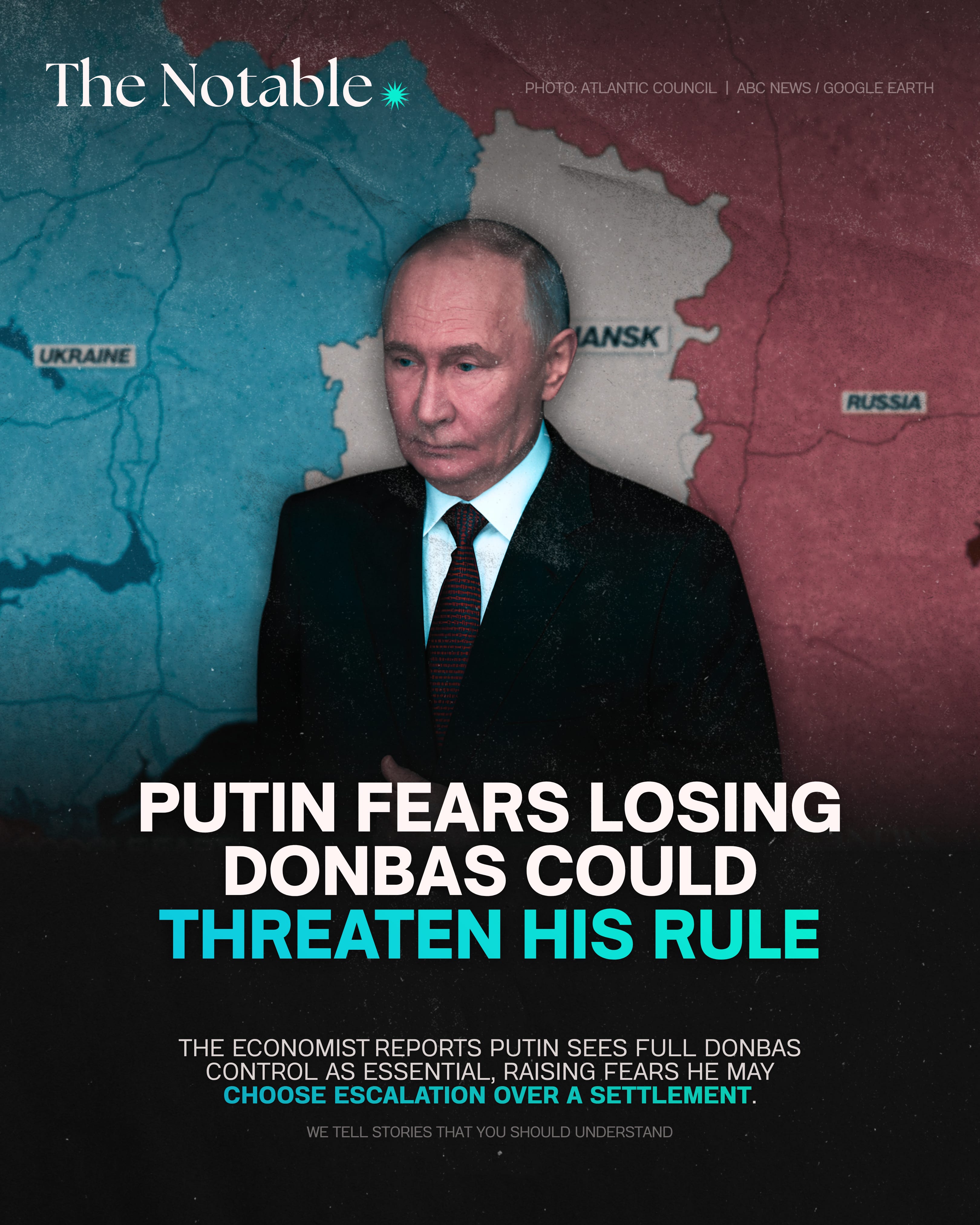
Against that backdrop, The Economist reported in late August that people close to the Kremlin believe Russian President Vladimir Putin considers the complete capture of Donbas a minimum acceptable outcome.
The report presents the issue as more than a military objective. It argues that Putin may see an inconclusive end to the war as a threat to his political survival.
One source cited by The Economist reportedly described Putin as fearing that, without victory, “they will hang me.” The report does not establish who Putin allegedly meant, when the remark was made, or whether there is an organized faction within the Russian leadership seeking to remove him.
That distinction matters. The claim is an account from anonymous sources close to the Kremlin, not evidence of an imminent coup or assassination plot.
Why Donbas Matters
Donbas, comprising Ukraine’s Donetsk and Luhansk regions, has been at the center of Russia’s war since the conflict began.
Russia formally claimed to annex both regions in 2022, despite not controlling all of their territory. Luhansk is almost entirely under Russian control, while significant portions of Donetsk remain under Ukrainian control.
The remaining territory has become particularly important because Russia’s stated war aims and negotiating demands continue to include control over the region.
The Institute for the Study of War has assessed that Russian forces control most, but not all, of Donetsk Oblast. It has also reported that Moscow has repeatedly set deadlines for capturing the remainder of the region without achieving them.
This makes Donbas both a military objective and a political problem for the Kremlin.
The War Has Not Produced the Decisive Victory Moscow Sought
Nearly five years into the full-scale invasion, Russia has captured substantial Ukrainian territory but has not achieved its broader strategic objectives.
The Russian military failed to seize Kyiv in the opening phase of the 2022 invasion. Ukraine subsequently retook large areas in the north, northeast and south.
Russia has since concentrated much of its military effort on eastern and southern Ukraine. Its advances have generally become slower and more costly.
Recent battlefield assessments indicate that Russian forces continue to make progress in parts of Donetsk, but at a pace that makes a rapid conquest of the remaining Ukrainian-held territory difficult.
That creates a strategic dilemma for Putin.
A settlement that leaves Russia without all of Donbas could be presented domestically as an incomplete victory. But continuing the war requires additional troops, money and military resources while exposing Russia to continued casualties and economic pressure.
The Prospect of Another Large Recruitment Drive
The Economist’s report also points toward a potentially significant expansion of Russia’s manpower pool.
Sources cited in reporting on the article put the possible additional recruitment requirement at approximately 300,000 to 400,000 personnel.
That figure should be treated cautiously. It is not evidence that Putin has ordered a new mobilization of 400,000 troops.
There is, however, separate reporting that makes the possibility worth watching.
Ukrainian President Volodymyr Zelenskyy said in August that Kyiv believed Russia could seek to recruit approximately 300,000 additional troops following Russia’s September parliamentary elections.
Reuters reported the claim while noting that it was a Ukrainian assessment rather than an independently confirmed Russian mobilization order.
The distinction is important: there are signs that Moscow is preparing for a prolonged war, but there is not yet sufficient evidence to treat a new mass mobilization as a confirmed event.
Why Escalation Could Become Politically Attractive
Putin’s dilemma is not simply whether Russia can continue fighting.
It is whether continuing the war could be politically safer than ending it without achieving the Kremlin’s objectives.
The Economist’s reporting suggests that Putin may believe a compromise that leaves Donbas partially under Ukrainian control could expose him to criticism from Russian elites, nationalist constituencies and elements of the security establishment.
In this interpretation, the war creates its own political logic.
The longer Russia fights, the greater the cost of accepting a settlement that appears to concede that those sacrifices failed to achieve the stated objectives.
That can create a dangerous incentive: military escalation becomes easier to justify than political retreat.
This is an interpretation of the Kremlin’s incentives, not proof that Putin has made a final decision to escalate.
Peace Talks Remain Possible, But the Core Dispute Has Not Changed
Diplomatic activity has continued despite the deadlock.
Ukraine and the United States have continued discussing possible frameworks for ending the war, while communication with Russia has not completely disappeared.
But territory remains the central obstacle.
Moscow has continued to demand territorial concessions from Ukraine, while Kyiv has resisted formally surrendering territory it considers Ukrainian sovereign land.
The Kremlin has also described the negotiations as being in a deep pause.
This leaves the two sides in a familiar position: diplomatic channels exist, but the fundamental conditions for a settlement remain far apart.
The Kremlin’s Problem Is Bigger Than One Battlefield
The significance of the Economist report lies less in the dramatic claim about Putin personally and more in what it suggests about the Kremlin’s strategic incentives.
Russia has spent enormous resources pursuing control over Ukrainian territory. The Kremlin has repeatedly framed the war as a struggle over Russia’s security, status and historical place.
A settlement that fails to deliver the territorial outcome Moscow has demanded could therefore create a difficult political narrative inside Russia.
Putin would have to explain why the country endured years of war without achieving one of its central objectives.
That does not mean defeat would automatically threaten his rule. Putin has maintained a highly centralized political system, extensive control over state institutions and significant repression of dissent.
But it does mean that the political consequences of an inconclusive war could be greater than the battlefield outcome alone suggests.
What Is Known and What Remains Uncertain
The most important claims should be separated from the speculation surrounding them.
What is well established: Russia continues to seek territorial gains in Donbas. Russian forces still do not control all of the region. Territory remains a major obstacle to peace negotiations. Russia continues to devote substantial military resources to the war.
What is reported but not independently established: The Economist’s sources say Putin views full control of Donbas as a minimum objective and fears the consequences of ending the war without victory. The report also points to the possibility of recruiting hundreds of thousands of additional personnel.
What remains unproven: There is no confirmed evidence that an organized group inside the Kremlin is preparing to remove Putin, that his life is under imminent threat, or that a 300,000–400,000-person mobilization has been ordered.
Those distinctions are essential when evaluating the story.
What Comes Next
The most important developments to watch are straightforward.
First, whether Russia announces or begins a major new recruitment campaign following its September elections.
Second, whether Russian forces can significantly accelerate their advance toward the remaining Ukrainian-held areas of Donetsk.
Third, whether Moscow changes its territorial demands in negotiations.
And finally, whether Putin chooses to increase the military pressure rather than accept a settlement that leaves Russia without full control of Donbas.
The central question is no longer simply whether Russia can capture more Ukrainian territory.
It is whether the Kremlin believes ending the war without achieving full control of Donbas would be more dangerous than continuing it.
If The Economist’s reporting is accurate, that calculation could become one of the most consequential factors shaping the next phase of the war.