


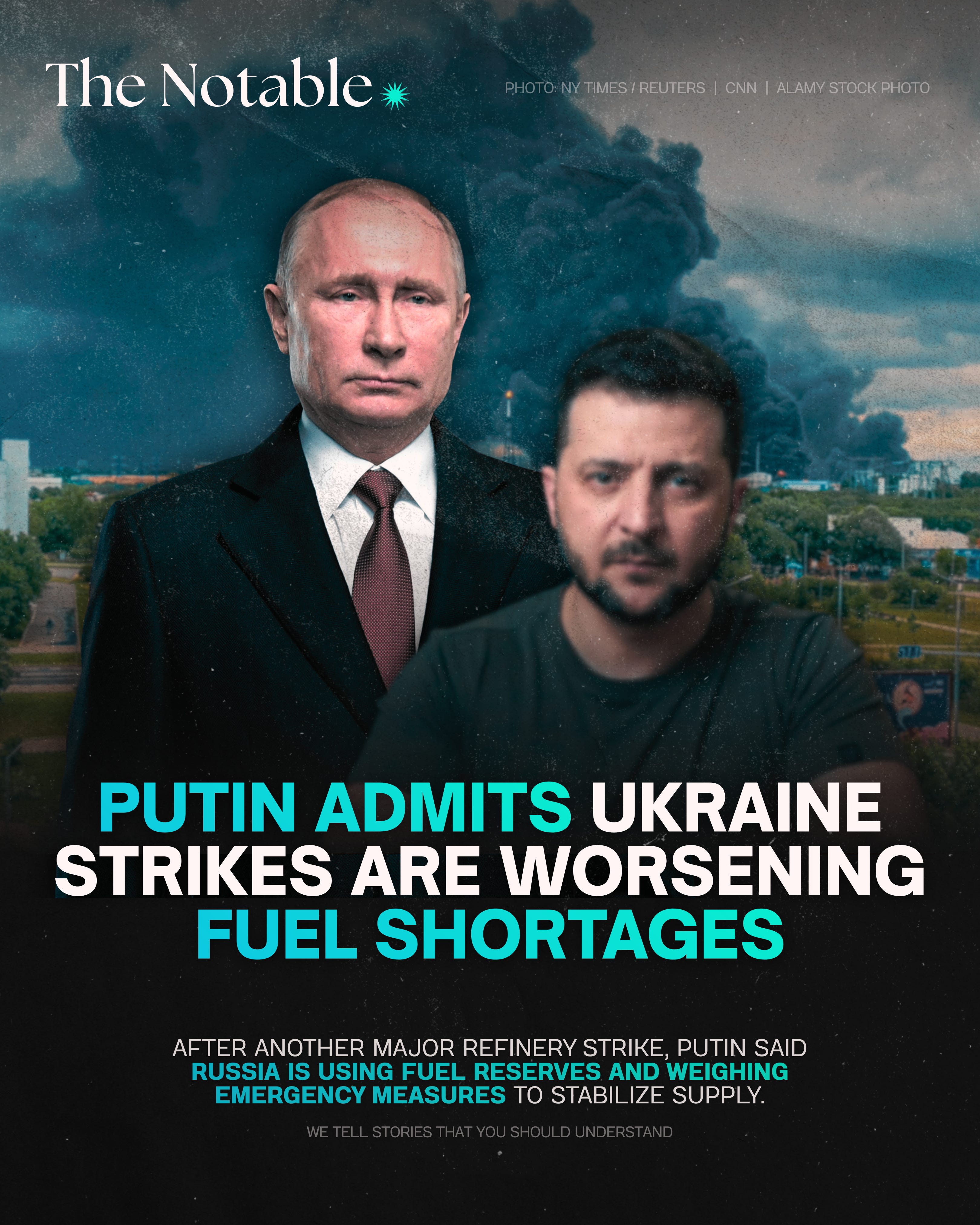
Russia is facing growing fuel supply strain after Ukrainian drones struck another major oil refinery deep inside Russian territory, prompting President Vladimir Putin to publicly acknowledge worsening shortages and announce emergency stabilization measures.
The development marks one of the clearest signs yet that Ukraine’s long-range drone campaign is beginning to create visible economic pressure inside Russia itself.
Ukrainian Drones Hit Key Southern Refinery
Ukrainian drones struck the Slavyansk-on-Kuban oil refinery in Russia’s Krasnodar Krai, triggering a massive fire at a strategically important facility tied to southern Russia’s fuel network and Black Sea logistics routes.
Russian authorities said the blaze spread across tens of thousands of square meters before emergency crews moved to contain it. The refinery is located near infrastructure linked to Crimea and southern military supply corridors, making it a significant target in Ukraine’s expanding campaign against Russian energy infrastructure.
The strike is part of a broader Ukrainian strategy focused on degrading the systems that sustain Russia’s war effort far from the front lines.
Over the past year, Ukraine has increasingly targeted:
oil refineries
fuel depots
storage facilities
logistics hubs
energy infrastructure connected to military supply chains
The goal appears increasingly clear: raise the economic and logistical cost of the war inside Russia itself.
Fuel Shortages Spread Across Russia
Following repeated refinery disruptions, reports of fuel shortages and long gas station lines have emerged across multiple Russian regions.
Areas near the Black Sea, parts of Siberia, and regions in central Russia have reportedly experienced supply disruptions and temporary purchase limits at some fuel stations.
While some viral social media claims surrounding nationwide rationing remain difficult to independently verify, the broader shortages themselves are no longer in serious dispute.
The most important shift came when Putin publicly acknowledged the problem.
Speaking on the issue, the Russian president said the country is now drawing from strategic fuel reserves while domestic refineries operate at full capacity. Russian officials are also considering a complete diesel export ban in an effort to stabilize internal supply.
The Kremlin additionally warned that prolonged shortages could disrupt agriculture, transportation, and regional logistics networks.
Why Putin’s Acknowledgment Matters
The significance of the moment goes beyond fuel prices or refinery damage.
Throughout much of the war, the Kremlin managed to shield most Russians from direct visible disruption despite sanctions, battlefield losses, and international isolation. Moscow consistently projected an image of economic resilience and internal stability.
That is why Putin’s public acknowledgment is notable.
It suggests the pressure generated by Ukraine’s expanding drone campaign is becoming difficult to dismiss internally, particularly as attacks increasingly target infrastructure critical to daily economic activity.
The Kremlin rarely publicly highlights vulnerabilities linked directly to Ukrainian strikes unless the effects become difficult to contain.
Ukraine’s Strategy Is Expanding Beyond the Battlefield
Ukraine’s long-range drone operations have evolved into one of the most important asymmetric elements of the war.
Rather than focusing exclusively on front-line combat, Kyiv is increasingly attempting to weaken the infrastructure supporting Russia’s military and wartime economy. Oil infrastructure has become a particularly attractive target because relatively inexpensive drones can create disproportionately costly disruptions.
Each refinery strike forces Russia to:
repair damaged infrastructure
divert air defenses deeper into the country
stabilize fuel markets
protect logistics routes
manage domestic economic pressure
The cumulative effect matters more than any single attack.
Even when facilities resume operations, repeated disruptions can create bottlenecks across refining, storage, and distribution systems over time.
A New Phase Of Economic Pressure
The broader significance is that the war is increasingly moving beyond the battlefield and into Russia’s domestic infrastructure and economy.
For years, the Kremlin maintained relative internal stability despite sanctions and military escalation. But fuel shortages are far more visible to ordinary citizens than abstract financial restrictions or geopolitical isolation.
Long gas station lines, supply concerns, and emergency reserve measures represent a different category of wartime pressure: one that directly affects daily life.
That does not mean Russia is “running out of fuel,” as some exaggerated online narratives have claimed. Russia still retains substantial refining capacity and significant strategic reserves.
But the latest developments suggest Ukraine’s drone campaign is beginning to impose more meaningful internal costs on the Russian system than before.
And increasingly, even the Kremlin is acknowledging it publicly.