


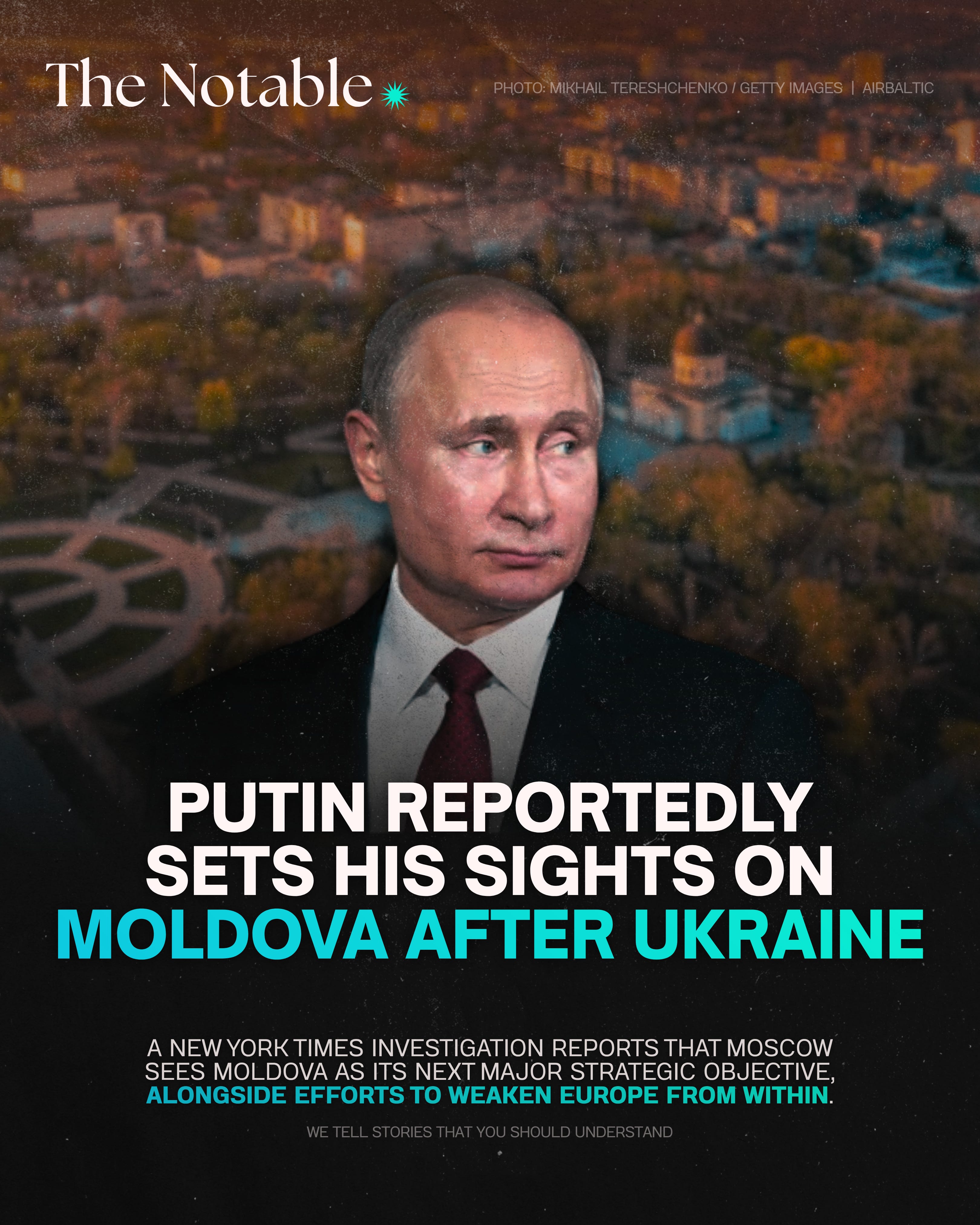
A New York Times investigation has raised a potentially consequential new dimension in Russia’s confrontation with Europe: Western intelligence officials reportedly believe Vladimir Putin’s government views Moldova as Russia’s next major strategic objective after Ukraine, while seeking to weaken the European Union and NATO from within.
The reporting does not establish that Russia has decided to invade Moldova, nor does it mean an attack is imminent. Instead, it describes a broader strategy combining military pressure, political interference, disinformation, cyber operations and efforts to exploit divisions inside Europe.
For Moldova, a small country between Ukraine and Romania, the stakes are unusually high.
The reported Kremlin strategy
According to The New York Times, Putin told senior Russian military officials during a secret briefing in late 2025 that one of Russia’s objectives for 2026 was the collapse or internal weakening of NATO and the European Union.
Western officials familiar with the intelligence reportedly identified Moldova as Russia’s second major objective after Ukraine.
The distinction matters. The reporting is based on intelligence from officials familiar with a classified meeting, rather than a publicly released Kremlin document. The alleged strategy should therefore be understood as an intelligence assessment, not as proof of a predetermined invasion plan.
But the broader pattern of Russian pressure against Moldova is already well documented.
Why Moldova matters to Moscow
Moldova occupies a strategically sensitive position between Ukraine and Romania.
Romania is a member of both NATO and the European Union. Moldova is not a NATO member, but it has increasingly aligned itself with the EU and has moved toward deeper political, economic and security cooperation with the bloc.
The country also contains one of Europe’s most persistent unresolved conflicts: Transnistria, a separatist territory where Russian troops have been stationed for decades.
That combination makes Moldova strategically important beyond its size.
A Russia-friendly government in Chisinau could complicate Ukraine’s western flank, create another security problem for neighboring Romania and challenge the EU’s ability to expand its influence eastward.
Russia’s campaign has already been underway
The significance of the NYT investigation is partly that it places years of Russian activity inside a broader strategic framework.
Moldovan authorities and Western governments have repeatedly accused Russia and Russian-linked networks of attempting to influence the country’s political process.
Those efforts have included allegations of illicit political financing, vote-buying, disinformation campaigns, cyberattacks and attempts to mobilize political groups against Moldova’s pro-European government.
International election-monitoring and democracy organizations have also documented the increasingly sophisticated nature of foreign interference surrounding Moldova’s elections.
The objective is not necessarily to seize territory.
Political destabilization can be considerably cheaper than military intervention.
If a foreign power can influence elections, undermine public confidence, finance political movements or deepen social divisions, it can potentially change a country’s strategic direction without firing a shot.
Moldova has resisted the pressure
Despite the pressure, Moldova has continued moving toward Europe.
The country’s pro-European political forces survived a critical parliamentary election in 2025, despite extensive allegations of Russian interference.
The result represented an important setback for Moscow because Moldova’s government retained its European orientation.
The EU has subsequently continued advancing Moldova’s accession process.
That trajectory directly conflicts with Moscow’s preferred sphere of influence.
For Russia, Moldova is therefore not simply a neighboring country. It represents a larger geopolitical contest over whether states in Russia’s former sphere of influence can freely integrate with European institutions.
The Transnistria factor
The separatist region of Transnistria adds another layer of risk.
Transnistria broke away from Moldova following the collapse of the Soviet Union and has operated outside the control of the Moldovan government for decades.
Russia maintains military personnel there and has historically presented itself as a security guarantor for the separatist territory.
Any major deterioration in Moldova’s political or security situation could therefore interact with an existing Russian military presence.
That does not automatically mean Transnistria would become a battlefield. But it gives Moscow an existing foothold inside Moldova that few other European countries possess.
Why Ukraine remains central
Moldova cannot be separated from the war in Ukraine.
Russia’s ability to exert military pressure on Moldova is heavily influenced by the outcome and geography of the Ukraine war.
The NYT reporting suggests that Moscow’s territorial ambitions in southern Ukraine could have implications for Moldova because control of additional Ukrainian territory could potentially improve Russia’s strategic position toward the Moldovan border.
This is one reason the future of Ukraine matters to countries far beyond Kyiv.
The war is not only about territory inside Ukraine. It is also reshaping the security architecture of Eastern Europe.
The larger target: European cohesion
The most consequential part of the reporting may not be Moldova itself.
It is the allegation that Russia’s broader objective is to weaken the institutions that hold much of Europe together.
NATO’s strength depends not only on military capabilities but on political cohesion. The same is true of the European Union.
A divided NATO is less capable of deterring Russia.
A divided EU is less capable of imposing coordinated sanctions, supporting Ukraine or integrating countries such as Moldova.
This makes political interference potentially strategic rather than merely disruptive.
The goal would not necessarily be to defeat Europe militarily. It could be to make European governments increasingly unwilling or unable to act collectively.
Moldova as a test case
Moldova offers Moscow an unusually favorable environment for this kind of pressure.
It is geographically close to Russia’s war in Ukraine, has an unresolved separatist conflict involving Russian forces, and contains significant political divisions over the country’s relationship with Moscow and Europe.
At the same time, its population and economy are much smaller than those of EU or NATO members.
That makes Moldova vulnerable to pressure while making it symbolically important.
If Russia could pull Moldova away from the EU, Moscow could demonstrate that European integration is reversible and that Russian influence remains decisive in the region.
If Moldova instead continues toward EU membership, it would represent another strategic loss for the Kremlin.
What the NYT report does and does not establish
The reporting should be interpreted carefully.
It does establish, according to The New York Times’ sources, that Western intelligence believes Russia has identified Moldova as a major strategic objective and that Putin reportedly discussed a broader campaign against European institutions.
It does not establish that Russia has ordered an invasion of Moldova.
Nor does it prove that Moscow will achieve its reported objectives.
That distinction is important because Russia’s capacity to execute a strategy is not the same as its desire to pursue one.
The Kremlin faces significant military, economic and political constraints, particularly while its war in Ukraine continues.
What happens next
The most important indicators to watch are political rather than purely military.
Further Russian cyberattacks or disinformation campaigns targeting Moldova would be significant. So would efforts to finance pro-Russian political movements, destabilize the government or exploit the Transnistria issue.
Moldova’s continued EU accession process will also matter.
The closer Chisinau moves toward European institutions, the more strategically consequential the country’s political direction becomes for Moscow.
And the outcome of the war in Ukraine remains fundamental.
If Russia expands its territorial control in southern Ukraine, the strategic environment around Moldova could become more dangerous. If Russia fails to achieve its broader objectives, Moscow’s ability to translate pressure into territorial or political gains may remain limited.
The bigger picture
The Moldova story is ultimately part of a larger struggle over Europe’s post-Cold War security order.
Russia is attempting to preserve or rebuild influence over countries that Moscow considers strategically important. Moldova, Ukraine and other states between Russia and the EU sit at the center of that contest.
Europe, meanwhile, is trying to expand its political and economic institutions eastward while maintaining support for Ukraine and deterring further Russian aggression.
That is why Moldova matters far beyond its borders.
The immediate question is not simply whether Russia will invade Moldova.
It is whether Moscow can use political interference, economic pressure, information warfare and its existing military presence to pull Moldova away from Europe, while exploiting divisions inside the EU and NATO.
If the NYT reporting is accurate, Moldova is not an isolated target.
It is part of a much larger contest over whether Europe can remain politically united in the face of Russian pressure.