


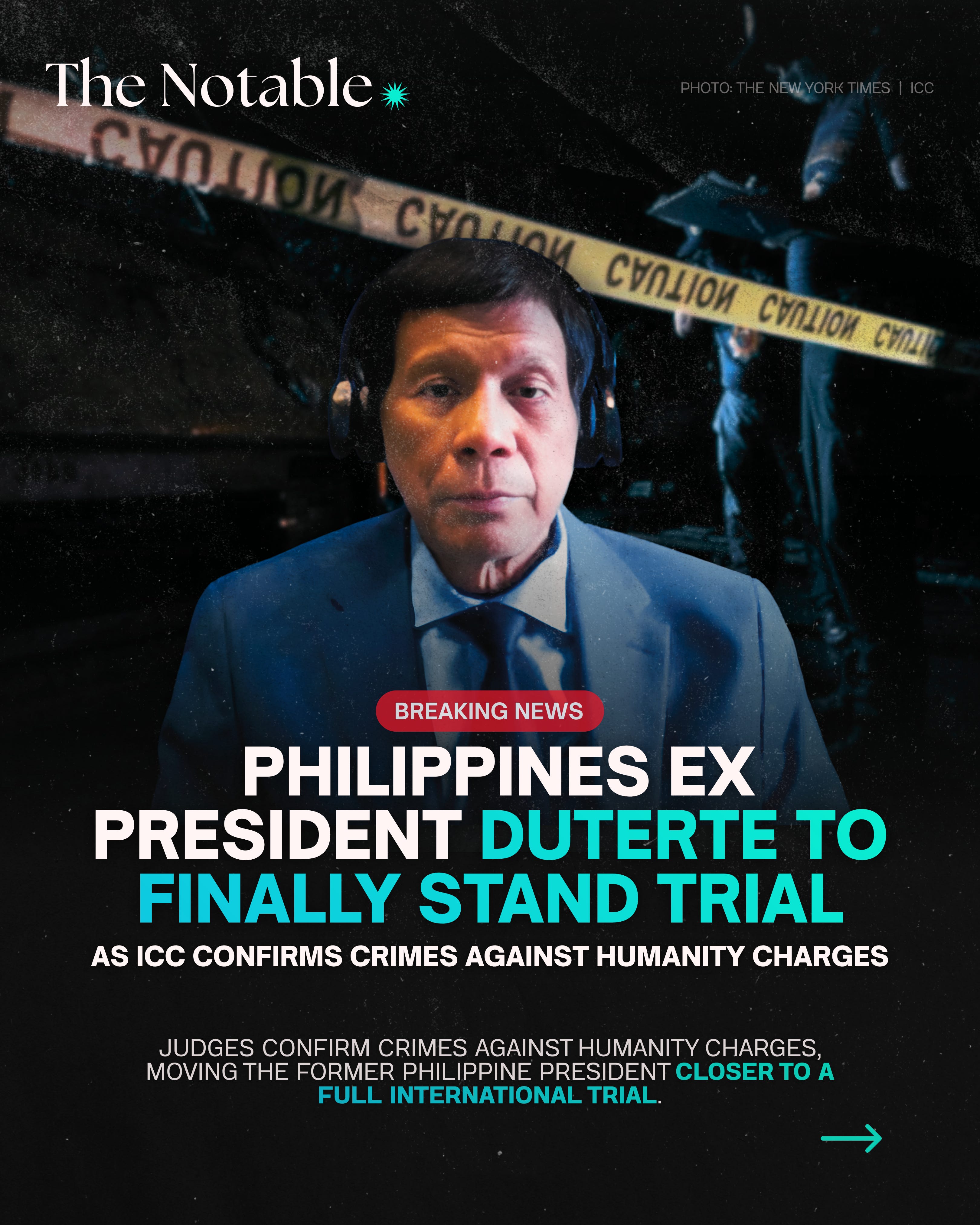
The decision now sits with the court.
The International Criminal Court has formally confirmed crimes against humanity charges against former Philippine president Rodrigo Duterte, clearing the way for a full trial over one of the most controversial anti-drug campaigns in modern political history.
It is a legal turning point. But more than that, it is a test of whether power exercised within borders can still be judged beyond them.
The case moves forward
In confirming the charges, ICC judges concluded there are substantial grounds to believe Duterte is criminally responsible for murder linked to his “war on drugs,” which defined his presidency from 2016 to 2022.
The case now enters the trial phase, where prosecutors will attempt to prove that the killings were not isolated acts, but part of a coordinated and systematic campaign. The legal threshold has shifted. The question is no longer whether there is enough evidence to proceed, but whether that evidence can establish guilt beyond reasonable doubt.
Duterte has denied wrongdoing. His defense argues that his rhetoric was political, not operational, and that the case itself is shaped by international pressure rather than legal merit.
For now, he remains in custody in The Hague, awaiting the next stage of proceedings.
From domestic policy to international prosecution
At the center of the case is a policy that reshaped the Philippines.
Duterte’s anti-drug campaign was built on a promise: restore order quickly and decisively. In practice, it resulted in thousands of deaths. Official figures place the toll at around 6,000. Human rights groups argue the number could be several times higher.
What distinguishes this case is not only the scale, but the structure.
Prosecutors are not attempting to litigate every killing. Instead, they are focusing on a smaller set of incidents to establish a pattern. The legal strategy is clear: demonstrate that violence was not incidental, but embedded in the system itself.
This is where the concept of command responsibility becomes central. The trial will hinge on whether Duterte can be linked directly to the design, encouragement, or tolerance of these actions.
The case also revives a deeper legal tension.
The Philippines formally withdrew from the ICC in 2019, during Duterte’s presidency. Yet the court maintains jurisdiction over alleged crimes committed while the country was still a member.
This is not a procedural detail. It is the foundation of the case.
If upheld through trial, it reinforces a critical principle: states cannot fully shield themselves from international accountability by exiting institutions after the fact. If challenged successfully, it could weaken the ICC’s reach in future cases.
Either outcome will shape how international law interacts with national sovereignty in the years ahead.
A political shift at home
The trial unfolds against a different political backdrop in Manila.
Under President Ferdinand Marcos Jr., the Philippine government has taken a more measured stance toward the ICC. While not fully re-engaging with the court, the administration has signaled a willingness to cooperate with legal processes.
This marks a clear departure from Duterte’s approach, which was openly confrontational.
But the shift is not absolute. Duterte remains a powerful political figure domestically, with enduring public support and a political network that continues to shape Philippine politics.
The case, therefore, is not only legal. It is also political, unfolding across institutions, public opinion, and competing narratives of justice and sovereignty.
What this trial is really about
At one level, this is a case about killings, accountability, and the rule of law.
At another, it is about something more structural.
The ICC is attempting to answer a difficult question: can a leader be held personally responsible for violence carried out in the name of state policy?
The answer will depend on whether prosecutors can bridge the gap between rhetoric and action, between political messaging and operational reality.
That gap is where many such cases fail.
A trial is expected, but not immediate. Pre-trial procedures, evidentiary challenges, and jurisdictional arguments could delay proceedings for months.
When it begins, the burden will shift heavily onto prosecutors to establish a clear chain of responsibility.
For Duterte, the stakes are personal and historic.
For the ICC, they are institutional.
And for the broader international system, the implications are harder to ignore.
Because this case is not only about what happened in the Philippines.
It is about whether the exercise of power, even at its most domestic, can still be constrained by rules that exist beyond it.