


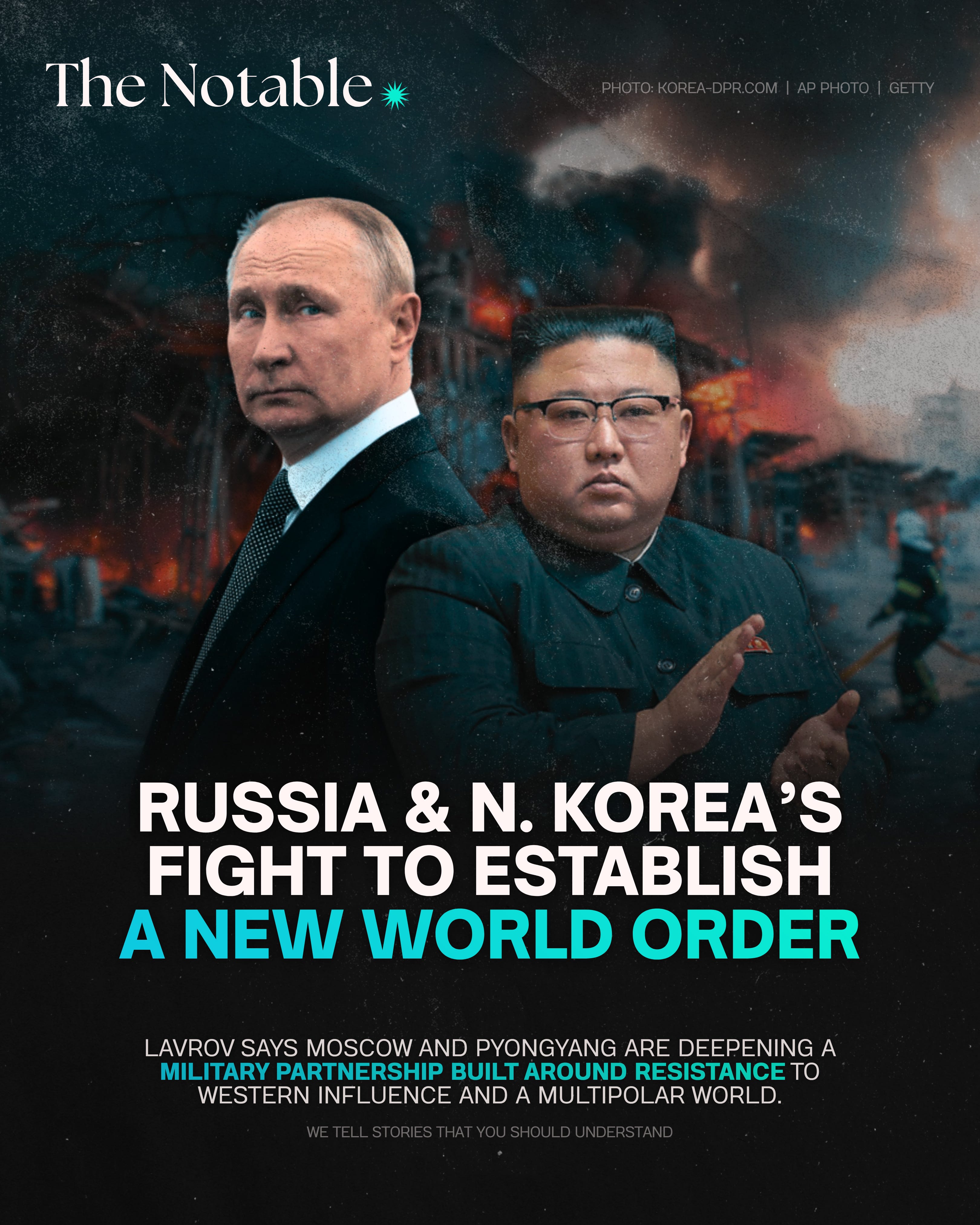
Russia and North Korea are no longer simply cooperating as diplomatic partners. Their relationship has evolved into a military and strategic partnership that increasingly reflects a shared opposition to the U.S.-led international order.
Russian Foreign Minister Sergey Lavrov has repeatedly praised North Korea’s military support for Russia, including the deployment of North Korean personnel to fight alongside Russian forces in Kursk Oblast. Moscow and Pyongyang now increasingly describe their cooperation in the language of sovereignty, multipolarity and resistance to Western influence.
That evolution matters because the relationship is beginning to extend beyond the immediate needs of the Ukraine war.
The central question is no longer simply why North Korea is helping Russia. It is what both governments hope to build from the partnership.
From diplomatic ties to a military alliance
The relationship entered a new phase in June 2024, when Russian President Vladimir Putin and North Korean leader Kim Jong Un signed a Comprehensive Strategic Partnership Treaty during Putin’s visit to Pyongyang.
The agreement included a mutual-assistance provision requiring the two countries to provide immediate military and other assistance if either side faces armed aggression.
It was a significant shift.
For decades, Russia and North Korea maintained relations rooted in Cold War history, but their strategic importance to one another had declined after the Soviet Union collapsed. The war in Ukraine changed that calculation.
Russia needed ammunition, artillery and other military supplies. North Korea possessed large stocks compatible with Soviet- and Russian-designed systems. Pyongyang, meanwhile, had strong incentives to deepen ties with Moscow, particularly as its relations with the United States and South Korea remained hostile.
The result was a relationship that became increasingly practical, military and transactional.
North Korean forces enter the Ukraine war
The most consequential development was North Korea’s decision to send military personnel to Russia.
North Korean troops were deployed to support Russian operations against Ukraine’s incursion into Kursk Oblast. Their involvement was initially reported by Ukrainian and Western intelligence agencies before Pyongyang and Moscow eventually acknowledged the deployment.
Lavrov has since publicly praised the North Korean contribution.
During meetings with North Korean officials, he described North Korean soldiers as having helped Russian forces in the liberation of Kursk and praised their role in fighting Ukrainian forces and foreign mercenaries.
The language is revealing.
Moscow is not portraying North Korea’s involvement as an isolated transaction involving weapons or manpower. It is presenting the two countries as partners fighting a common enemy.
That is a significant political evolution.
The language of a “new world order”
The strategic partnership is also being framed in ideological terms.
Russia and North Korea increasingly use the concept of a multipolar world to describe the international system they want to see emerge.
In this vision, the United States should no longer occupy a dominant position in global affairs. Major powers and states with their own strategic interests should instead have greater freedom to determine their foreign and security policies without pressure from Washington or its allies.
Russian officials have repeatedly described the current international transition as a movement away from what Moscow calls a unipolar system.
North Korea’s government uses similar language, particularly when criticizing U.S. alliances in Asia.
Their July 2026 discussions explicitly connected bilateral cooperation to the construction of what Russian officials described as a “new just multipolar world order.”
This does not mean Russia and North Korea have suddenly created an alternative international system.
It means the two governments are increasingly presenting their bilateral relationship as part of a much larger geopolitical transformation.
Why Russia needs North Korea
For Moscow, the value of North Korea is immediate.
The war in Ukraine has placed enormous demands on Russia’s military-industrial system. North Korea has provided Russia with substantial quantities of artillery ammunition and missiles, while its personnel have added manpower to Russian operations.
North Korean military support can therefore help Russia sustain a prolonged conflict while reducing some pressure on its own forces and defense industry.
But there is also a broader strategic benefit.
North Korea gives Russia a stronger position in Northeast Asia at a time when Moscow’s relations with the United States, NATO, Japan and South Korea remain deeply antagonistic.
Closer relations with Pyongyang also create additional complications for Washington and its allies.
Russia does not need North Korea to become a global superpower. It needs North Korea to become a more capable strategic partner.
That is already happening.
What North Korea gains
The relationship is equally important for Pyongyang.
North Korea has lived under extensive international sanctions for decades and has faced severe restrictions on its access to international markets, technology and financial systems.
Russia provides an alternative source of economic and diplomatic support.
More importantly, military cooperation can provide North Korea with something difficult to obtain elsewhere: access to battlefield experience and potentially advanced military knowledge.
North Korean personnel participating in the Ukraine war are gaining direct experience with modern warfare, including drones, artillery, electronic warfare and battlefield surveillance.
The extent of technology transfers between Moscow and Pyongyang remains difficult to establish publicly. But the possibility is strategically important to South Korea, Japan and the United States.
A stronger North Korean military would change the security environment across Northeast Asia.
The military relationship is still evolving
Recent reporting suggests the partnership may be expanding beyond the original deployment of North Korean troops to Kursk.
Ukrainian officials have reported the deployment of a North Korean missile unit to Russia and have raised concerns about additional North Korean personnel being sent to support Russian operations.
Those claims require caution.
Some of the larger figures circulating publicly, including Ukrainian estimates of tens of thousands of additional North Korean troops, have not been independently verified. The exact scale of North Korea’s military involvement therefore remains uncertain.
But uncertainty over numbers should not obscure the broader trend.
North Korea has already crossed a major threshold by sending military personnel to participate directly in Russia’s war.
That precedent matters.
A partnership built on shared opposition
Russia and North Korea do not have identical interests.
Moscow’s priorities include Ukraine, its confrontation with NATO and its attempt to reshape the European security architecture.
Pyongyang’s primary concerns are the survival of its regime, its confrontation with South Korea and the United States, and the development of its nuclear and conventional military capabilities.
Their partnership works because those interests increasingly overlap.
Both governments oppose the expansion of U.S.-led alliances. Both reject Western pressure over their domestic and foreign policies. Both argue that sovereignty should take precedence over what they regard as Western-defined international norms.
The Ukraine war has therefore created an unusually strong strategic convergence.
The China factor
China remains an essential part of this equation.
Beijing is North Korea’s most important economic partner and has historically been Pyongyang’s primary external backer. At the same time, China maintains a complicated relationship with Russia and has sought to preserve its own strategic flexibility over the Ukraine war.
This means the Russia-North Korea relationship should not automatically be interpreted as the creation of a unified Russia-China-North Korea bloc.
The three countries have overlapping interests, but they do not share identical objectives.
Still, deeper Russia-North Korea cooperation creates another layer in the strategic competition between the United States and its allies and the increasingly diverse group of states seeking greater autonomy from the Western-led system.
Washington faces a complicated choice
The timing is particularly important for the United States.
Washington continues to confront Russia over Ukraine while maintaining its military alliances with South Korea and Japan.
At the same time, the Trump administration has shown interest in reopening dialogue with Kim Jong Un.
That creates a difficult strategic balance.
The United States wants to reduce the risk posed by North Korea’s nuclear and missile programs. But Russia’s deepening relationship with Pyongyang gives North Korea another major power willing to cooperate with it.
The more valuable Russia becomes to North Korea, the more difficult it may become for Washington to isolate Pyongyang through pressure alone.
The bigger shift
The most important development is not a single statement from Lavrov or a single deployment of North Korean soldiers.
It is the transformation of the relationship itself.
Russia and North Korea have moved from historical partners to increasingly active military collaborators. Their cooperation now includes weapons, personnel, political coordination and a shared narrative about the future of the international system.
The war in Ukraine accelerated that transformation.
Russia needed military support. North Korea needed a powerful partner. The result was a relationship that neither side had the same incentive to build before the war.
Now both governments are presenting that relationship as part of something larger.
What to watch next
The key indicators will be practical rather than rhetorical.
First, watch whether North Korea sends additional military personnel to Russia and whether its role expands beyond Kursk.
Second, watch for evidence of deeper Russian military or technological assistance to North Korea, particularly in areas affecting its missile, satellite and conventional military capabilities.
Third, watch how China responds. Beijing’s position will matter because Russia and North Korea’s growing alignment could reshape the strategic environment surrounding China itself.
Finally, watch Washington’s engagement with Pyongyang.
If Russia and North Korea continue deepening their partnership while the United States attempts to reopen dialogue with Kim Jong Un, the Korean Peninsula could become an increasingly important arena in the wider contest over the international order.
The emerging picture
Russia and North Korea are not establishing a new world order by themselves.
But they are building a partnership that reflects the world they believe is emerging: less dominated by a single superpower, more divided among competing centers of power, and increasingly willing to challenge Western influence.
For Russia, North Korea provides military capacity and strategic depth.
For North Korea, Russia provides a powerful partner, diplomatic protection and potential access to military expertise.
And for the broader international system, their relationship is another sign that the post-Cold War balance of power is becoming harder to describe in terms of a single dominant center.
The significance lies not only in what Moscow and Pyongyang are doing together now.
It lies in what their cooperation could make possible next.