


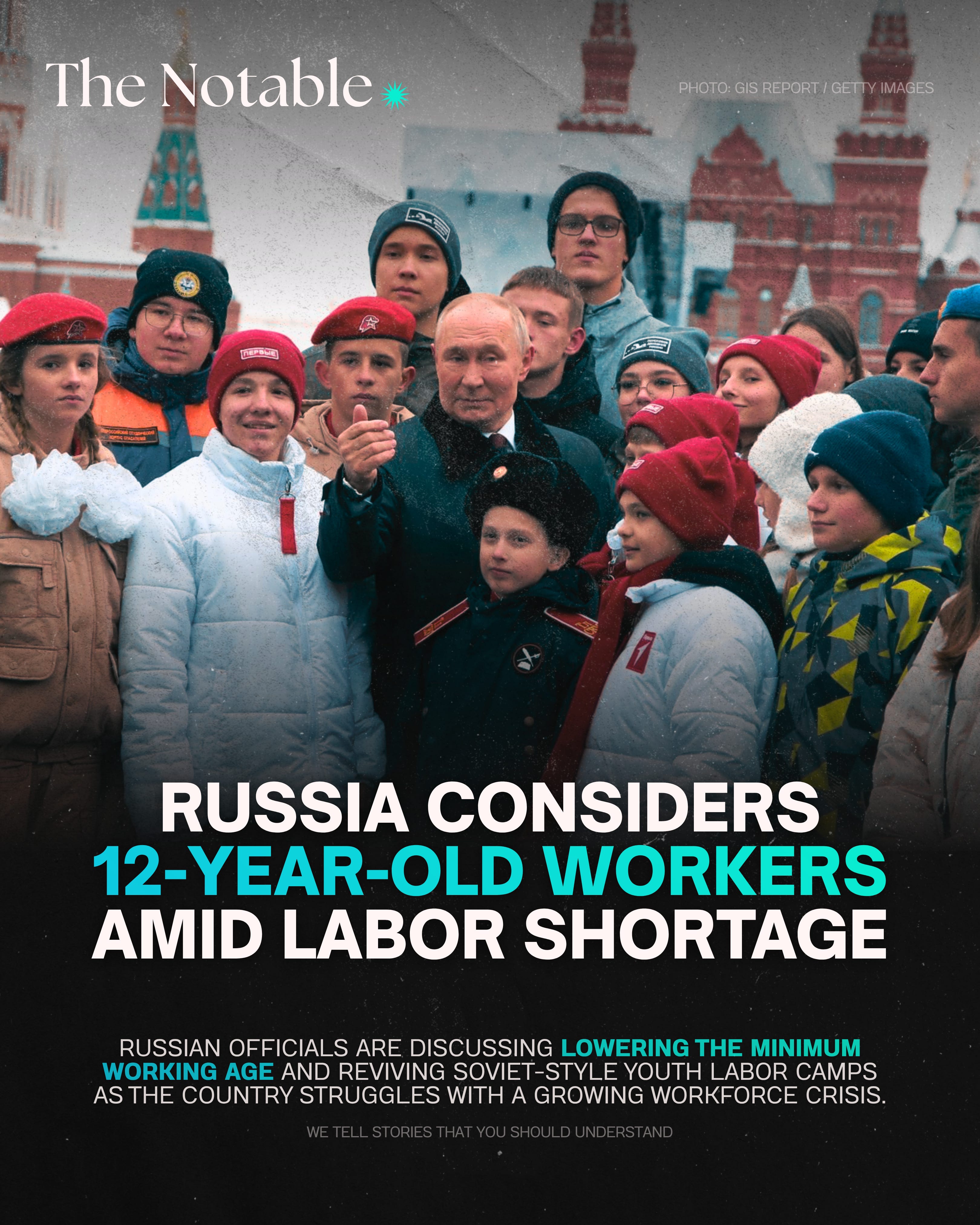
Russia’s labor shortage has become so severe that officials are now discussing something that would have seemed politically unthinkable just a few years ago: allowing children as young as 12 to enter the workforce.
The proposal has triggered controversy inside Russia and drawn attention abroad, not because it is government policy, but because it offers a revealing glimpse into the growing economic pressures facing the country.
The debate began in late May when Moscow Children’s Rights Commissioner Olga Yaroslavskaya suggested lowering the minimum working age for summer employment from 14 to 12 years old. According to her argument, many young people already want to work during school holidays and should be given more opportunities to do so.
Days later, she expanded the proposal further by suggesting the revival of Soviet-era labor and recreation camps, where children would spend part of their summer participating in organized work activities alongside traditional camps and educational programs.
The ideas remain proposals. They have not been adopted by the Russian government and would require legal changes before they could take effect. Nevertheless, the discussion itself is significant because it highlights a much larger problem confronting Russia.
A Workforce Crisis Years In The Making
Russia is facing one of the most serious labor shortages in its post-Soviet history.
For years, the country has struggled with demographic decline. Birth rates have remained low, the population is aging, and the pool of working-age citizens has gradually shrunk. These challenges existed long before the war in Ukraine, but recent events have accelerated the pressure.
Military mobilization has removed hundreds of thousands of men from the civilian workforce. At the same time, many working-age Russians left the country after the invasion of Ukraine and subsequent mobilization campaigns. Businesses across multiple industries have reported difficulties finding workers, from manufacturing and construction to transportation and services.
Russia’s unemployment rate has fallen to historically low levels, creating a situation where employers are competing for a shrinking number of available workers.
The result is a labor market under increasing strain.
Why The Child Labor Debate Matters
On the surface, the proposal concerns summer jobs for teenagers. But the broader significance lies elsewhere.
Governments typically respond to labor shortages by increasing immigration, encouraging workforce participation among older citizens, investing in automation, or introducing policies aimed at boosting birth rates over the long term.
The fact that some officials are discussing younger workers suggests concern about the depth of the labor shortage.
Supporters argue that allowing younger teenagers to work during school holidays could provide useful skills, offer income opportunities, and help address labor gaps in certain sectors. Similar youth employment programs exist in various countries, though usually under strict regulations.
Critics counter that lowering the working age risks weakening protections designed to safeguard children’s education, welfare, and development. They also argue that labor shortages should be solved through broader economic reforms rather than by expanding the labor pool downward.
The debate therefore extends beyond employment policy. It raises questions about how societies respond when demographic and economic pressures begin colliding.
The Shadow Of The Soviet Past
The proposal to revive labor and recreation camps has attracted particular attention because of its Soviet associations.
It is important to distinguish these camps from the Soviet Union’s infamous Gulag system.
The camps being discussed are modeled on Soviet-era youth programs where schoolchildren participated in agricultural work, community projects, or seasonal labor while also taking part in recreational and educational activities.
For supporters, such programs are remembered as a way to teach responsibility and practical skills.
For critics, they symbolize state-directed labor and reflect an outdated approach to youth development.
Either way, the proposal taps into a broader trend visible in contemporary Russia: the selective revival of Soviet-era institutions, narratives, and practices as the country searches for solutions to modern challenges.
A Sign Of Deeper Structural Pressures
Whether these proposals ever become law may ultimately matter less than what they reveal.
Russia’s labor shortage is not a temporary problem. It is the product of long-term demographic trends that have been compounded by geopolitical events and economic disruptions.
The country’s leadership has repeatedly identified demographics as one of Russia’s most important strategic challenges. Population decline affects everything from economic growth and military recruitment to tax revenues and long-term national power.
As a result, policymakers are increasingly being forced to confront difficult trade-offs.
The debate over 12-year-old workers and Soviet-style labor camps should therefore not be viewed simply as a story about child labor. It is a story about demographics, economic resilience, and the growing pressure facing a country whose workforce is shrinking while its strategic ambitions remain unchanged.
For now, the proposals remain under discussion.
But the fact that they are being discussed at all may be the most important part of the story.