


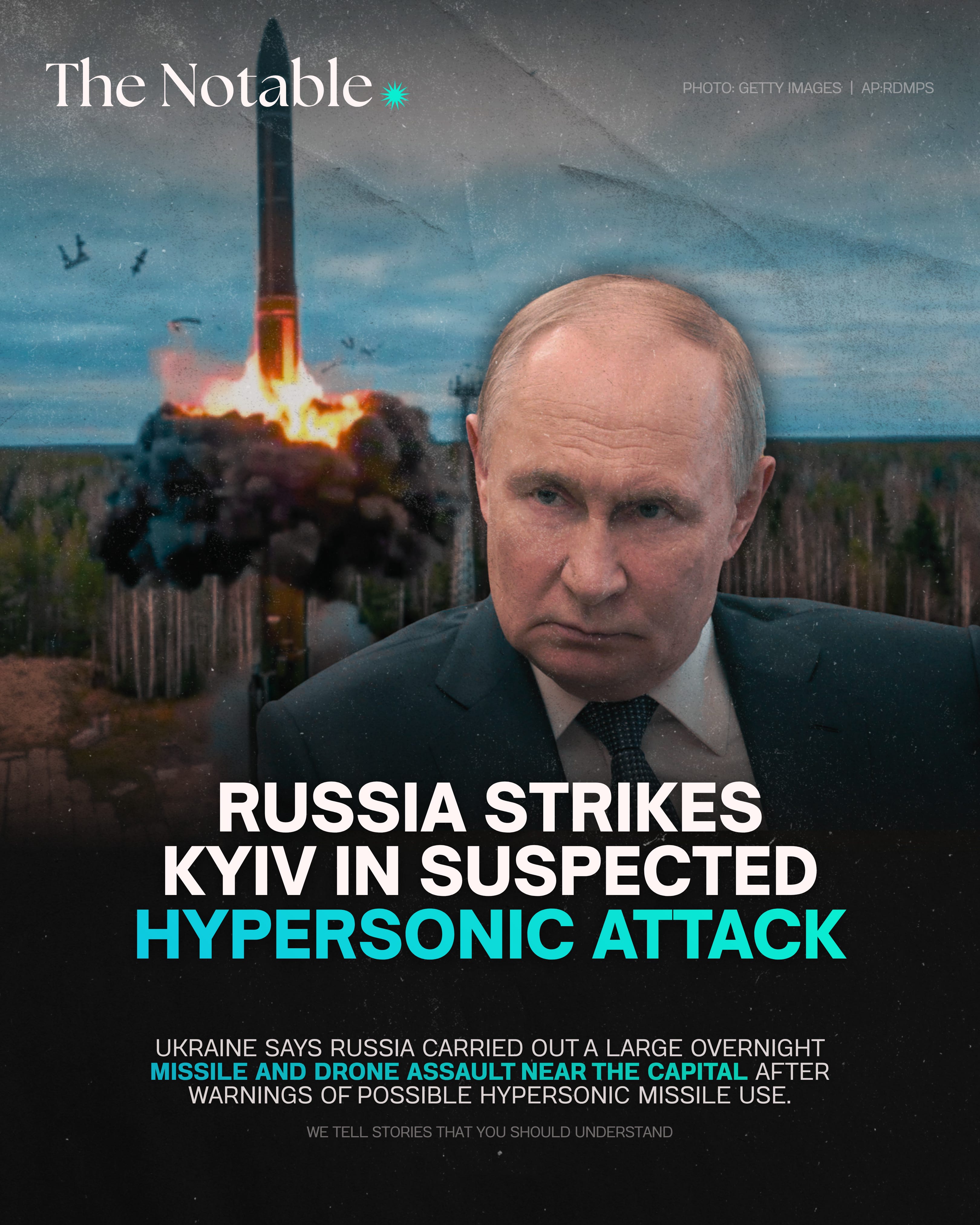
Russia launched a major overnight missile and drone assault targeting Kyiv and surrounding regions, marking one of the most significant escalations in recent weeks as concerns grow over Moscow’s expanding use of advanced long-range weapons.
Explosions were reported across the Ukrainian capital late into the night as air defense systems attempted to intercept incoming missiles and drones. Ukrainian officials said residential areas were damaged in several districts, triggering fires and emergency rescue operations across the city.
The attack came only hours after Ukrainian President Volodymyr Zelensky publicly warned that Russia could deploy its newer Oreshnik hypersonic missile system in a retaliatory strike.
The timing immediately raised international attention.
While Ukrainian authorities were still working to confirm the exact missile systems used during the assault, the possibility of hypersonic-capable weapons being involved added a new layer of strategic significance to the attack.
A Rapid Escalation
The strike did not happen in isolation.
Over recent weeks, both Russia and Ukraine have intensified long-range attacks far beyond frontline battle zones. Ukraine has expanded drone operations targeting military and industrial infrastructure inside Russia, including areas near Moscow. Russia, meanwhile, has continued large-scale missile campaigns against Ukrainian cities and energy infrastructure.
Tensions escalated further after Moscow accused Ukraine of carrying out a deadly strike in Russian-controlled Luhansk. Russian officials claimed civilians were killed after a dormitory building was hit, while Ukraine said the strike targeted a military drone command facility being used by Russian forces.
Following the incident, reports emerged that Russian President Vladimir Putin had instructed military officials to prepare stronger retaliatory measures.
Then came Zelensky’s warning.
Speaking publicly before the overnight assault, the Ukrainian president said intelligence shared by Ukraine and its Western partners suggested Russia was preparing a major strike potentially involving the Oreshnik missile system.
Hours later, Kyiv came under attack.
Why the Oreshnik Missile Matters
The Oreshnik missile has become one of Russia’s most closely watched strategic weapons.
Moscow describes the system as a hypersonic-capable intermediate-range ballistic missile able to travel at more than ten times the speed of sound. Its speed and maneuverability are designed to make interception significantly more difficult than conventional missile systems.
Russia first introduced the Oreshnik into the war during a strike in late 2024. Additional launches near western Ukraine earlier this year drew particular concern from NATO governments because of their proximity to alliance territory.
Unlike conventional missile strikes, the use of hypersonic systems carries both military and psychological implications.
The weapons are designed not only to penetrate air defenses, but also to demonstrate technological superiority and strategic reach. For Moscow, deploying these systems sends a broader message to Ukraine and the West that Russia retains escalation options beyond conventional battlefield warfare.
Even when their direct military impact is debated, their signaling effect is substantial.
Growing Pressure on Air Defenses
The latest assault also highlights the growing pressure on Ukraine’s air defense network.
Since the start of the war, Western-supplied systems including Patriot batteries and other advanced interceptors have played a central role in protecting major Ukrainian cities from missile attacks. But Russia’s increasing use of mixed drone-and-missile saturation strikes is designed partly to overwhelm interception capacity.
Hypersonic systems create an even more difficult challenge.
Although some Russian hypersonic missiles have reportedly been intercepted in previous attacks, military analysts note that repeated large-scale launches can strain even advanced defense systems, particularly when combined with waves of drones and ballistic missiles.
The continued escalation is also raising concern across Europe.
Poland reportedly activated military aviation during the attack as a precaution due to the scale of Russian missile activity near NATO territory.
A War Moving Into Another Phase
More than four years after Russia’s full-scale invasion began, the war is increasingly defined by long-range strikes, strategic signaling, and technological escalation rather than rapid territorial breakthroughs.
Both sides are now attempting to impose pressure deep behind enemy lines.
Ukraine is expanding drone warfare into Russian territory. Russia is escalating aerial bombardment campaigns while signaling its willingness to deploy more advanced missile systems.
At the same time, diplomatic efforts remain largely frozen.
Ceasefire discussions have stalled, battlefield attrition continues, and neither side currently appears willing to make major concessions. Instead, the conflict is evolving into a broader contest of endurance, industrial capacity, and strategic escalation management.
The latest strike on Kyiv reflects that shift clearly.
This is no longer only a war over territory.
It is increasingly a war over pressure, deterrence, resilience, and the ability to sustain escalation without triggering a wider regional confrontation.