


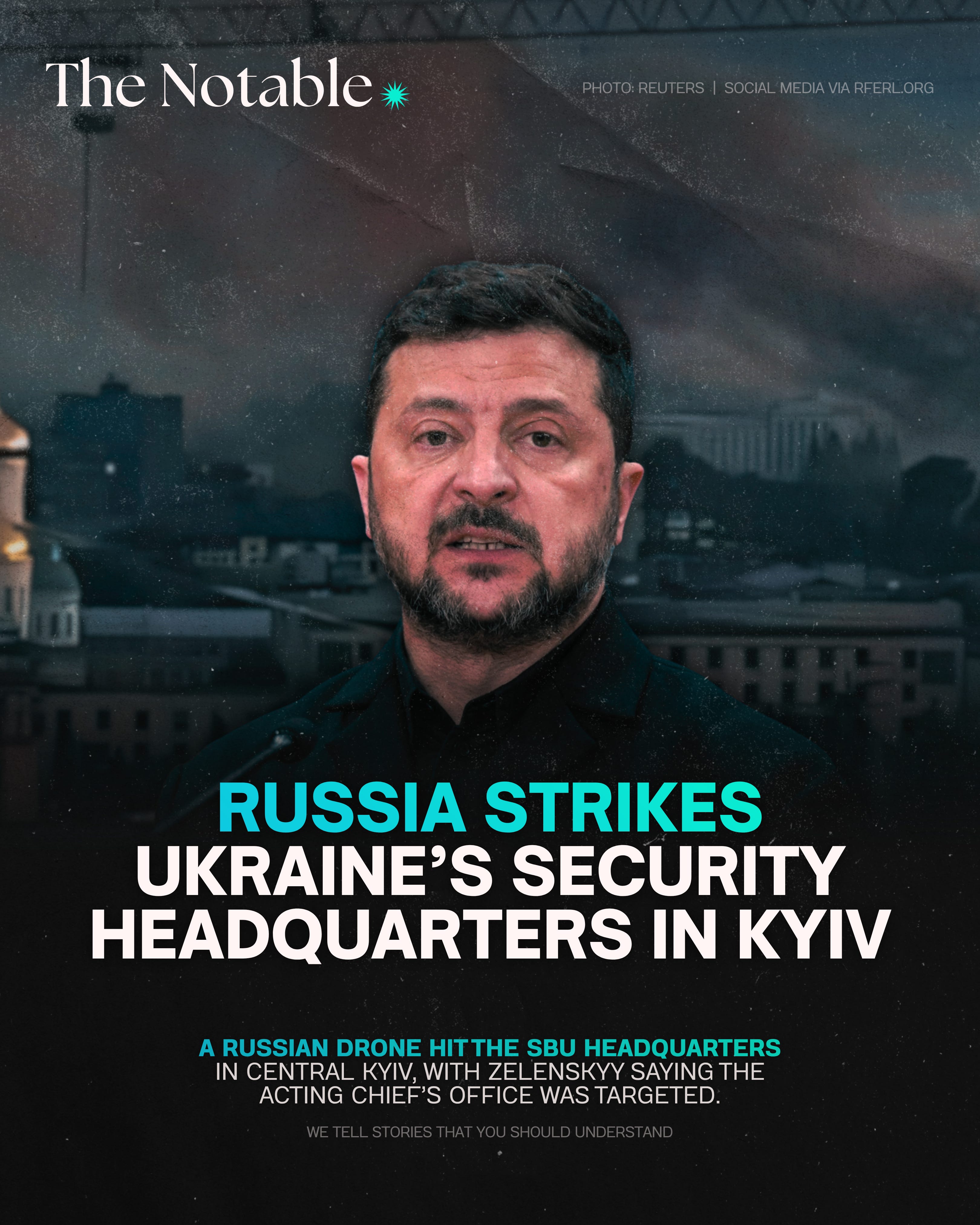
On September 4, a Russian drone struck the central headquarters of Ukraine’s Security Service, or SBU, on Volodymyrska Street in Kyiv.
The building sits in the historic center of the Ukrainian capital, directly across from St. Sophia Cathedral. Ukrainian President Volodymyr Zelenskyy said the drone was aimed specifically at the office of acting SBU chief Oleksandr Poklad. Ukrainian reporting said Poklad was not in the office when the strike occurred.
The attack caused a fire and sent heavy smoke over central Kyiv. Kyiv authorities initially reported five people injured, but the casualty figure was subsequently updated to at least 12 wounded.
Russia had not publicly commented on the strike in the immediate reporting.
Why the Target Matters
The SBU is one of Ukraine’s most important wartime security institutions. Its responsibilities include domestic security and counterintelligence, while its special operations have increasingly extended deep into Russian territory.
The agency has been associated with some of Ukraine’s most significant covert operations against Russia, including attacks targeting military infrastructure. That makes its headquarters a particularly consequential target in the wider conflict.
The significance of Friday’s strike therefore goes beyond physical damage to a government building. It demonstrates that Russia was able to reach the headquarters of an agency deeply involved in Ukraine’s wartime intelligence and security operations. Reuters described the site as one of the war’s most high-profile targets.
Part of a Broader Escalation in Kyiv
The strike did not occur in isolation.
Russian forces had been attacking Kyiv on consecutive days. On September 3, Russian drones struck a Coca-Cola production facility outside the capital, according to Zelenskyy, while other attacks caused casualties and damage in the Kyiv region.
The pattern has also increasingly extended beyond nighttime attacks. Associated Press reported that Russian drone and missile strikes are now occurring during both daytime and nighttime hours, disrupting transportation, businesses, schools and ordinary life across the capital.
Friday’s strike consequently fits into a broader intensification of Russia’s aerial campaign rather than representing an isolated incident.
The Timing Is Politically Significant
The attack also came at a sensitive diplomatic moment.
The United States was preparing to send envoys Steve Witkoff and Jared Kushner to Moscow and Kyiv as Washington attempted to revive negotiations aimed at ending the war. Reuters reported on September 4 that the planned visits were still subject to security concerns, while Russian and U.S. reports indicated the envoys were expected to travel between the two capitals.
The proximity between the strike and the planned diplomatic mission is notable. But there is an important distinction: there is currently no confirmed evidence establishing that Russia timed the attack specifically to undermine the U.S. diplomatic effort.
Ukraine has presented the strike as evidence of continued Russian escalation. That is Kyiv’s assessment, rather than an independently established explanation for Moscow’s intentions.
Zelenskyy Signals Retaliation
Zelenskyy responded by ordering the SBU leadership to prepare what he described as an “appropriate” and “tangible” response.
He indicated that Ukraine could seek to mirror the Russian attack, with Ukrainian forces supporting the response.
That creates another potential escalation point.
A strike against a major Ukrainian security institution could prompt retaliation against Russian security, military or government targets. If that happens, the exchange could become part of a broader cycle in which both sides increasingly target sensitive institutions far from the immediate front lines.
The Larger Strategic Picture
The most important element of the attack is not simply that a Russian drone reached central Kyiv.
It is what Russia chose to target.
The SBU has become an important instrument of Ukraine’s ability to fight beyond the conventional battlefield. Striking its headquarters sends a powerful message about the vulnerability of even highly protected state institutions in the capital.
At the same time, Ukraine has demonstrated an expanding ability to conduct long-range operations against targets inside Russia. The conflict is therefore increasingly characterized by attacks that reach deep behind traditional front lines.
The result is a battlefield that is becoming less geographically contained.
What Comes Next
Three developments now matter most.
First, whether Ukraine carries out the retaliation promised by Zelenskyy. Second, whether Russia responds with another escalation against Kyiv or other Ukrainian state institutions. And third, whether the attack affects the planned U.S. diplomatic engagement with Moscow and Kyiv.
For now, the strike has produced a striking contradiction: as Washington prepares another attempt to move the war toward negotiations, Russia and Ukraine continue to demonstrate their ability and willingness to raise the military stakes.
The SBU headquarters strike does not by itself determine the future of diplomacy. But it is another indication of how difficult any path toward de-escalation has become.