


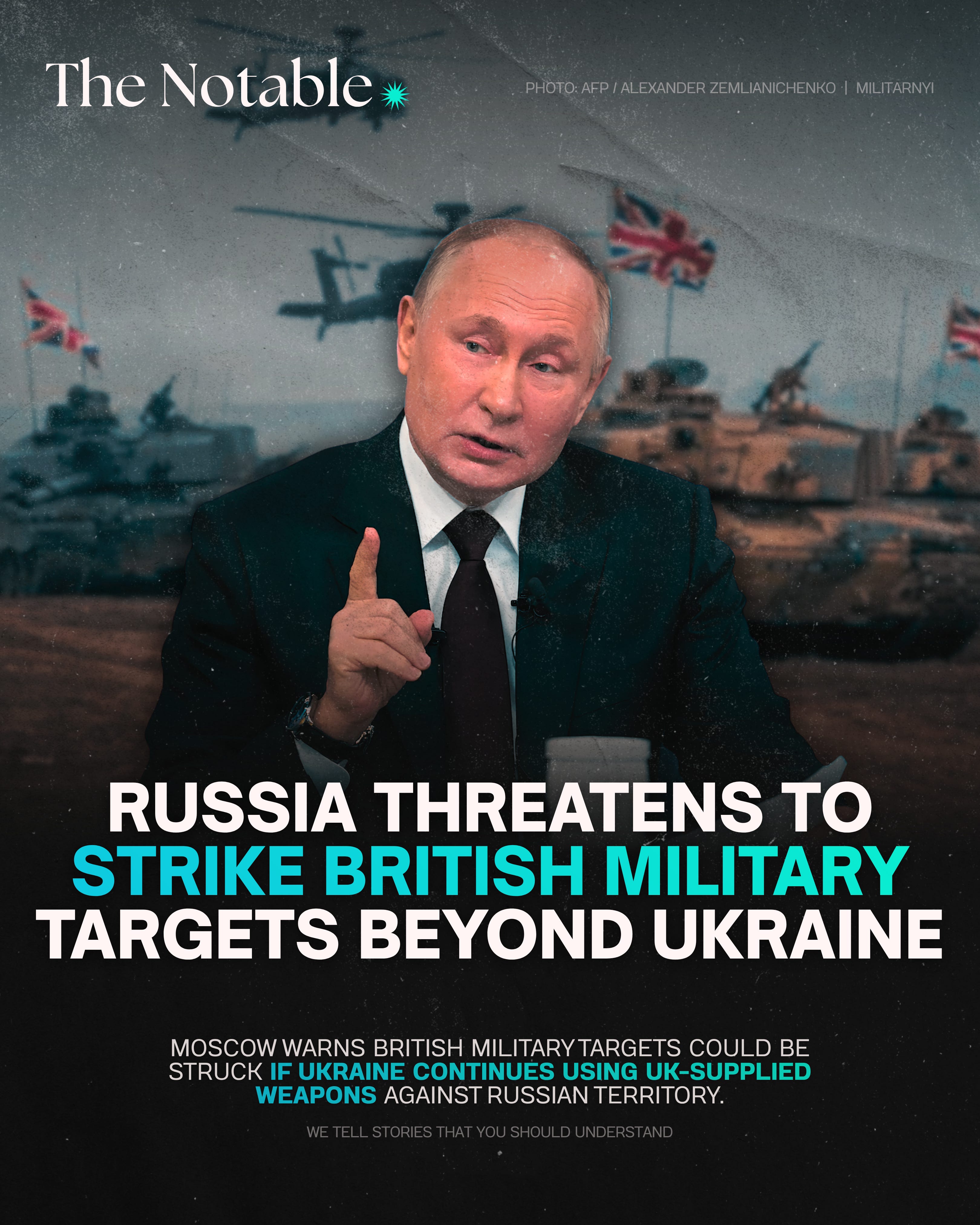
Russia has issued one of its strongest direct warnings against the United Kingdom since the start of the war in Ukraine, saying British military facilities and equipment could become targets if Ukraine continues using British-supplied weapons against Russian territory.
On August 27, Russian Foreign Ministry spokeswoman Maria Zakharova said British military facilities and equipment in Ukraine and beyond its borders could be targeted. Moscow linked the warning to Ukraine’s continued use of British-supplied weapons, including Storm Shadow cruise missiles, against Russian territory.
The statement does not amount to an announcement of an imminent Russian attack on Britain. Moscow did not identify a specific British target, provide a timetable, or say that an attack had been ordered.
But the wording represents a significant escalation in Russia’s rhetoric toward Britain.
Why Britain is being singled out
Britain has become one of Ukraine’s most important military supporters since Russia’s full-scale invasion in 2022.
Among the weapons supplied by the UK are Storm Shadow cruise missiles, a long-range system developed by MBDA and jointly produced by Britain and France. Ukraine has used the missiles to strike targets deep inside Russian territory.
London has also moved beyond simply transferring weapons.
In late August, Britain announced plans that would allow classified information concerning British components of the missile system to be shared with Ukraine. The goal is to support Ukraine’s development of its own long-range missile-production capability.
For Moscow, that represents a potentially important shift.
Instead of relying exclusively on weapons manufactured abroad and transferred to Ukrainian forces, Kyiv could eventually develop a larger domestic capacity to produce long-range strike weapons.
Russia has argued that this makes Britain increasingly involved in the conflict.
The threat developed over several days
The August 27 warning did not emerge in isolation.
The escalation began with Britain’s announcement of deeper cooperation on Ukrainian long-range missile production.
Russian officials responded by warning that Russia would seek to destroy missile-production facilities in Ukraine.
The rhetoric then expanded.
Russian officials and advisers raised the possibility that British facilities involved in producing weapons for Ukraine could themselves become targets.
On August 27, Zakharova went further, warning that British military facilities and equipment beyond Ukraine’s borders could potentially be targeted.
That progression matters.
The threat moved from Ukrainian infrastructure supported by Britain, to British defense-industrial facilities, and ultimately to British military assets outside Ukraine.
What Russia is threatening
The distinction between a threat and an announced attack is important.
Russia has not said that it has decided to attack Britain.
Instead, Moscow has warned that British military targets could become legitimate targets under circumstances it associates with Britain’s military assistance to Ukraine.
The phrase “beyond its borders” is particularly significant because it broadens the geographic scope of the warning.
However, it remains deliberately ambiguous. Russia did not specify whether it meant British military assets located elsewhere outside Ukraine, facilities in the United Kingdom itself, or both.
There is also no public evidence from the latest statements that Russia has begun preparations for a direct strike on British territory.
Britain is a NATO member
The most consequential aspect of the warning is Britain’s membership in NATO.
The United Kingdom is not simply another country providing weapons to Ukraine. It is one of NATO’s principal military powers and a nuclear-armed state.
A Russian attack on British territory would therefore be fundamentally different from Russia striking Ukrainian forces or infrastructure.
NATO’s central principle is collective defense under Article 5, which states that an armed attack against one member is considered an attack against all members.
That does not mean every conceivable incident would automatically result in a full-scale NATO-Russia war. The circumstances of an attack, its location, scale and attribution would matter enormously.
But a deliberate Russian strike on British territory would carry the potential to create a direct confrontation between Russia and the NATO alliance.
That is why Moscow’s latest warning is being watched closely.
Why Storm Shadow matters
Storm Shadow has become particularly important because of its range and ability to strike targets well behind the front lines.
The weapon allows Ukraine to target military infrastructure, command facilities and other high-value sites at considerable distances from the battlefield.
Russia has repeatedly objected to Western-supplied long-range weapons being used against targets inside Russia.
The Kremlin’s argument is that Western countries are becoming increasingly involved in determining how and where these weapons are used.
Western governments, meanwhile, have supported Ukraine’s right to defend itself against Russia’s invasion.
That creates a dangerous strategic cycle.
The more capable Ukraine becomes of striking Russian territory, the more pressure Moscow faces to deter Western countries from supplying those capabilities.
The more Russia threatens the countries supplying Ukraine, the greater the risk that the war’s confrontation extends beyond Ukraine itself.
Britain’s deeper role in Ukraine
Britain has consistently taken a relatively forward position in supporting Ukraine.
Its assistance has included military equipment, training and diplomatic support. The country has also been involved in efforts to strengthen Ukraine’s ability to sustain its own defense industry.
The latest missile-production cooperation could therefore be more consequential than another weapons transfer.
If Ukraine can eventually produce more long-range weapons domestically, Russian attempts to disrupt individual foreign shipments would become less effective.
From Moscow’s perspective, attacking the underlying supply chain or production infrastructure could therefore become increasingly attractive as a deterrence strategy.
But extending attacks to British facilities would carry a much greater escalation risk.
The larger danger
The most important issue is not whether Russia will immediately attack Britain.
There is currently no evidence that Moscow has announced an imminent attack.
The more important question is how far the boundaries of the Russia-Ukraine war can expand before direct confrontation between Russia and NATO becomes unavoidable.
For more than four years, Western governments have attempted to provide Ukraine with increasingly sophisticated weapons while avoiding direct war with Russia.
Moscow has repeatedly responded with warnings that Western military support is making those countries participants in the conflict.
The latest British warning shows how that boundary is becoming increasingly contested.
Russia is effectively saying that there may be consequences not only for Ukrainian forces using Western weapons, but also for the Western military infrastructure supporting them.
What happens next
The immediate focus will be on whether Russia’s warning remains rhetorical or is followed by concrete action.
Three developments will be particularly important.
First, whether Russia identifies specific British military or defense-industrial facilities as potential targets.
Second, whether Britain expands its support for Ukrainian long-range missile production despite Moscow’s warning.
Third, whether other NATO governments respond by increasing military protection around facilities that could potentially be viewed by Moscow as part of the Ukrainian weapons supply chain.
For now, the latest Russian statement is a warning, not an announced attack.
But its significance lies in the direction of travel.
The conflict is increasingly testing the boundary between indirect Western support for Ukraine and direct confrontation with Russia. Britain’s expanding role in Ukraine’s long-range strike capabilities has now made London the subject of an explicit Russian military warning.
That does not mean war between Russia and Britain is imminent.
It does mean that the space for escalation is becoming narrower.