


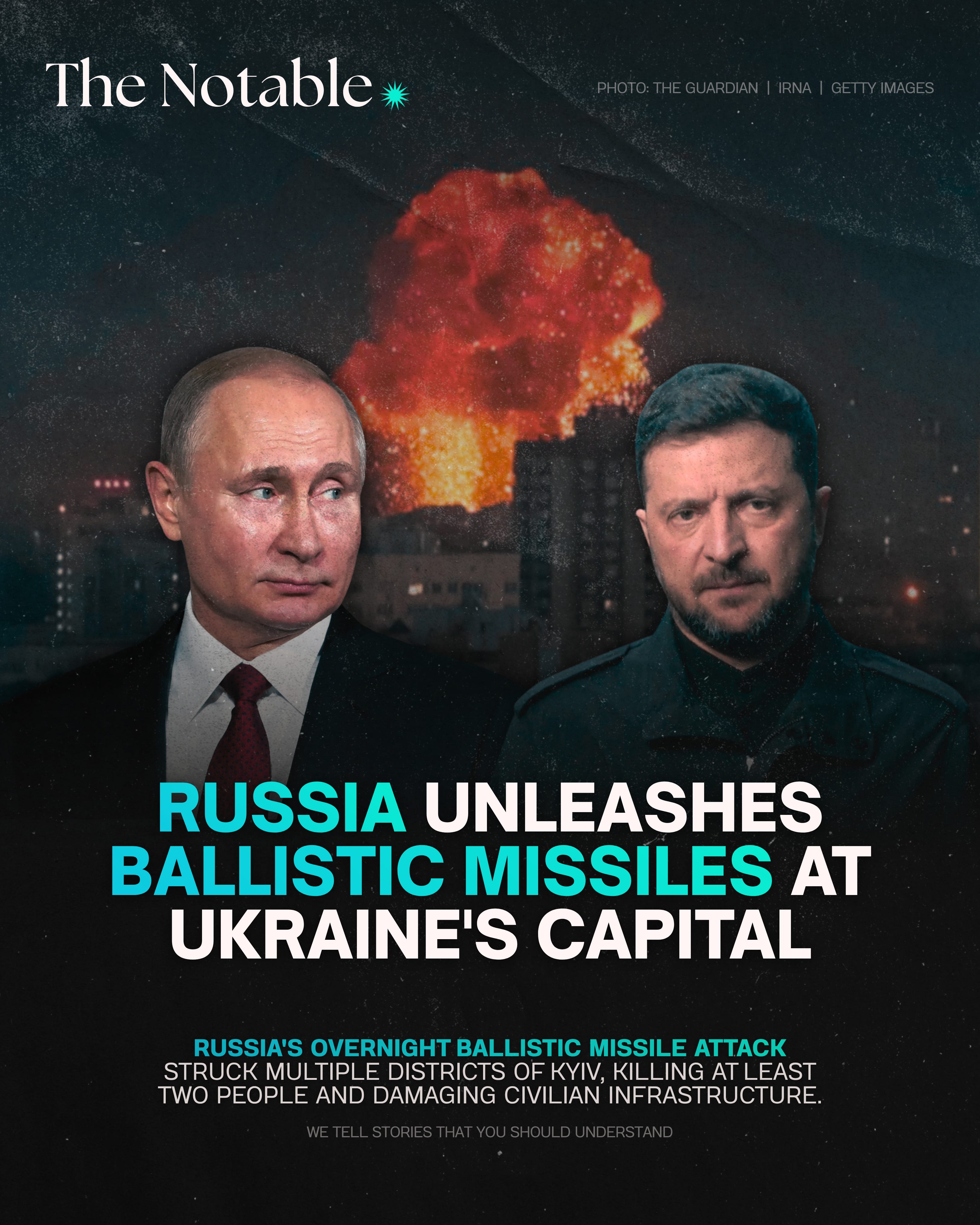
Overnight strikes killed at least two people and injured several others as Russia intensified its missile campaign against Kyiv, highlighting a war that continues to escalate through long-range attacks on both sides.
Russia launched an overnight ballistic missile attack on Kyiv on Thursday, striking multiple districts of Ukraine’s capital and leaving at least two people dead, according to Ukrainian authorities. The attack triggered explosions across the city, damaged civilian infrastructure, and renewed concerns over the intensifying exchange of long-range strikes between Russia and Ukraine.
The strikes began in the early hours of the morning, when air raid sirens sounded across Kyiv as Russian ballistic missiles approached the city. Ukrainian officials said the missiles struck at least two districts, causing fires in warehouses and industrial buildings while damaging vehicles and surrounding infrastructure. Emergency responders were deployed immediately to extinguish fires, search damaged buildings, and assist residents caught in the attack.
Authorities reported that at least two people were killed and six others were injured, including a 16-year-old. Rescue operations continued throughout the day, and officials cautioned that casualty figures could change as assessments were completed.
Russia says military facilities were the target
Russia’s Defense Ministry said the operation targeted Ukraine’s military-industrial complex, including facilities involved in drone production and storage. It also claimed to have struck military cargo and fuel infrastructure at the ports of Odesa and Pivdennyi.
As throughout much of the war, Moscow described the strikes as attacks on military objectives. Ukrainian authorities, however, said the missiles caused civilian casualties and damage inside the capital. Reuters could not independently verify Russia’s claims regarding the intended targets.
The differing accounts reflect a familiar pattern in the conflict, where military operations often have consequences that extend beyond their stated objectives, particularly in densely populated urban areas.
Kyiv remains under sustained pressure
The latest strike is not an isolated incident. Ukrainian officials say Kyiv has endured multiple Russian missile and drone attacks this month alone, underscoring the capital’s continued strategic importance more than four years into the full-scale invasion.
Russia has increasingly combined ballistic missiles, cruise missiles, and large waves of drones in coordinated attacks designed to challenge Ukraine’s layered air defense network. Ballistic missiles pose a particular challenge because they travel at extremely high speeds and give defenders only a short window to detect and intercept them.
Although Ukraine has significantly strengthened its air defenses with support from Western allies, repeated attacks continue to test the country’s ability to protect major cities and critical infrastructure.
A broader escalation across the battlefield
The attack also comes amid a broader intensification of long-range warfare.
In recent weeks, Ukraine has expanded its own campaign against targets inside Russia, striking military facilities, logistics hubs, fuel depots, and defense-related infrastructure using drones and other long-range capabilities. These operations aim to disrupt Russia’s ability to sustain its military campaign and increase the cost of continuing the war.
Russia has responded with renewed missile and drone attacks against Ukrainian cities, energy facilities, industrial sites, and transportation infrastructure. Rather than signaling a move toward de-escalation, both sides appear increasingly willing to extend the conflict deeper into each other’s territory.
The result is a war that is becoming less defined by shifting front lines alone and more by a sustained contest over logistics, industrial capacity, and strategic infrastructure.
Why this attack matters
The latest ballistic missile strike illustrates how the conflict continues to evolve despite periodic diplomatic efforts and international calls for restraint. While ground fighting remains concentrated in eastern and southern Ukraine, long-range strikes have become an increasingly important tool for both militaries.
For Ukraine, defending major population centers such as Kyiv remains essential to maintaining public confidence and protecting critical government and economic functions. For Russia, repeated missile attacks serve both military and strategic purposes by placing constant pressure on Ukraine’s defense systems and industrial base.
As both countries expand their long-range capabilities, the war is entering a phase where critical infrastructure, logistics networks, and urban resilience are becoming just as important as territorial gains on the battlefield.
The overnight attack on Kyiv is another reminder that the conflict remains highly dynamic, with little indication that either side is prepared to reduce the intensity of military operations in the near future.